
Introduction
This article describes Authlete’s Service Access Tokens (SATs). A SAT is a bearer credential issued for a single Authlete service. It is the credential your Authorization Server, Resource Server, CLI scripts, or CI/CD pipelines present when calling Authlete’s runtime and service-administration APIs. Permission customization, either via a preset or by selecting individual permissions, lets you scope a token to exactly what its caller needs, so a Resource Server only gets introspection rights, an administrative tool only gets the client-management rights it requires, and so on.SATs are the right credential for service-level runtime workloads. For
management-plane operations that span every service in an organization such
as creating services, reading the organization audit log, or driving Terraform
/ CI-CD provisioning, use an Organization Access Token instead.
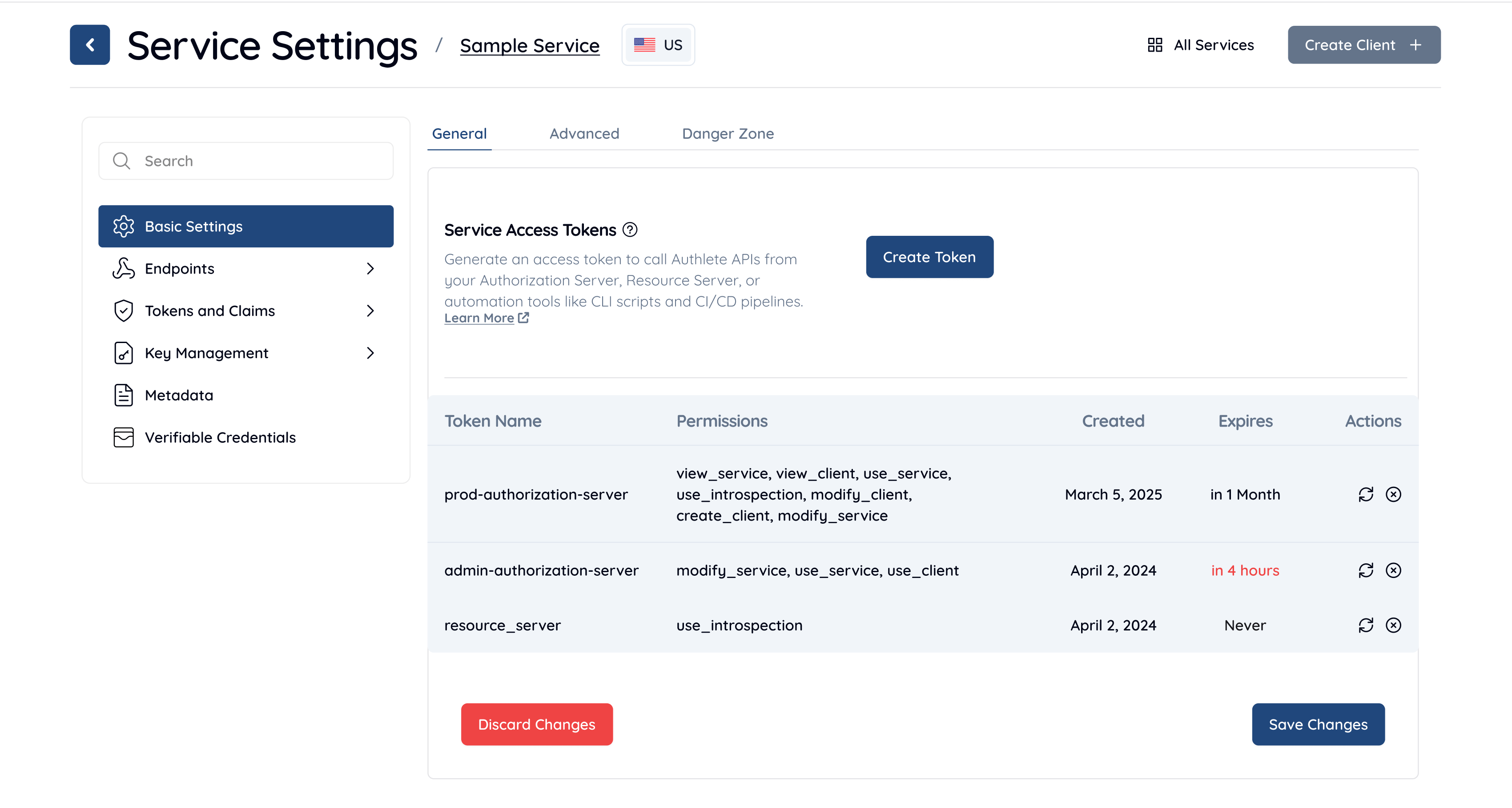
Token Properties
Token Name
A human-readable identifier used to distinguish tokens in the Service Access Tokens list. The name has no effect on token behavior or permissions.Expiration Date
Specifies when the token will expire and become invalid.- If set, the token cannot be used after the specified date.
- If not set, the token does not expire.
Token Value
The token value is displayed only once, when the token is created or rotated.- It must be copied and stored securely at creation time.
- The plain token value cannot be retrieved again after this step.
Rotation
Tokens can be rotated to generate a new value.- Rotation invalidates the previous token value immediately.
- The new token value is displayed once and must be copied and saved.
- Permissions and metadata (name, expiration) are preserved across rotation unless explicitly updated.
Token List
All Service Access Tokens are listed in a table with the following columns:- Token Name: User-defined identifier.
- Permissions: Assigned permissions for the token.
- Created: Date the token was created.
- Expires: Expiration date, or no expiry if not set.
- Actions: Available operations such as rotation or deletion.
Permission Presets
Pre-configured permission sets aligned to standard OAuth 2.0 roles. Selecting a preset applies a fixed combination of permissions; if you then add or remove permissions manually, the preset is cleared.Custom Permissions
Permissions can be selected individually when a preset does not match your use case. Permissions follow the inheritance rules described in Permission Inheritance and selecting a higher-level permission implicitly grants the lower-level ones. If bothpreset and permissions are omitted, the Create button is
disabled. You must select a preset or at least one permission before the
token can be issued. If a preset is selected and the caller then adds or
removes individual permissions, the preset is cleared.
use_service
Runtime OAuth/OIDC operations. The standard permission for an Authorization
Server deployment. Allows calling:
/auth/authorization/auth/token/auth/userinfo/auth/introspection/auth/revocation/pushed_auth_req/service/configuration/service/jwks/get/backchannel/authentication/device/authorization/device/verification/device/complete/federation/*/vci/*(Verifiable Credentials)/jose/verify/idtoken/reissue/token/create/token/update/token/delete/token/revoke/token/get/list/rs/sign/hsk/get/client/authorization/get/list/client/registration(Dynamic Client Registration)
use_introspection,
view_service, and view_client.
use_introspection
Token introspection only. The minimum permission a Resource Server needs to
validate access tokens. Allows calling:
/auth/introspection/auth/introspection/standard
view_service
Read service configuration. Allows calling:
/service/get/service/get/list
view_client. Use this for monitoring
dashboards or read-only integrations.
view_client
Read client details. Allows calling:
/client/get/client/get/list/client/granted_scopes/get/client/extension/requestable_scopes/get
modify_client
Update and delete clients, including the endpoints required to perform user
logout via authorization deletion. Allows calling:
/client/update/client/delete/client/secret/update/client/secret/refresh/client/lock_flag/update/client/extension/requestable_scopes/update/client/granted_scopes/delete/client/authorization/delete(user session revocation / logout)/client/authorization/update
view_client.
create_client
Register new OAuth clients programmatically. Allows calling:
/client/create/client/get/default
use_service,
modify_client, view_service, and
view_client. Use this for platforms that dynamically
provision OAuth clients.
modify_service
Full service administration. Allows calling:
/service/update/hsk/create/hsk/delete/client/extension/requestable_scopes/delete
Known issue:
modify_service
does not currently grant use_introspection implicitly.
See Troubleshooting 403 Errors for the
workaround.Permission Inheritance
Higher-level permissions implicitly grant the lower-level permissions they depend on. The inheritance chain is:modify_service→ all permissionscreate_client→use_service,modify_client,view_service,view_clientuse_service→use_introspection,view_service,view_clientmodify_client→view_clientview_service→view_client
When building a custom permission set, select only the highest-level
permission your caller requires; lower-level permissions in its inheritance
chain are granted implicitly.
Using a Service Access Token
Send the token as a bearer credential on theAuthorization header of any
Authlete service-level API call. Pair it with your Service ID and the
appropriate API server URL.
The following is an example token-endpoint call from an Authorization Server
using a SAT that holds the use_service permission.
use_introspection.
403 Forbidden. For example, a token holding only
use_introspection cannot call /auth/token.
How the Console Issues a Token
Service Access Tokens are issued by the Authlete IdP’s/api/servicetoken/create endpoint. The Management
Console calls this endpoint on your behalf when an administrator clicks
Create Token; the endpoint authenticates the caller as an IdP user
(via session or user access token) and requires the
MODIFY_SERVICE privilege on the target service. Service
Access Tokens and Organization Access Tokens are not accepted as the bearer
credential for this endpoint.
The request body the console submits has the following shape.
The response body shape is as follows.
The
accessToken field is returned only once. It cannot be
retrieved again afterwards; copy it to a secrets manager immediately. The
same single-display rule applies to the value returned by token rotation.Troubleshooting 403 Errors
If an Authlete API call fails with HTTP403 Forbidden, the response body
includes a resultMessage that names the exact permission the endpoint
requires.
[CREATE_CLIENT],
[MODIFY_CLIENT]) to a permission in Custom Permissions
and reissue the token with that permission. Two options:
- Recreate the token with a preset that covers the operation. For
client-management calls, the Admin Authorization Server preset
(
modify_service) covers every client-management and service-management endpoint. - Recreate the token with custom permissions. Select only the access
right the error message named (or its lowest-level ancestor in
Permission Inheritance). For example, a workload
that only needs to provision and update clients should hold
create_client; that single permission implicitly grantsuse_service,modify_client,view_service, andview_client.
The
use_service permission (applied by the
Authorization Server preset) grants the runtime OAuth/OIDC
endpoints required by a standard Authorization Server, but it does
not grant /client/create or
/client/delete. Workloads that need to register or remove
clients (for example a CI pipeline that provisions test clients, or a
self-service developer portal) must be issued a token with
create_client or modify_client, or use
the Admin Authorization Server preset
(modify_service, which is the default selection).Known issue: The introspection endpoints
(
/auth/introspection and
/auth/introspection/standard) currently require an
explicit use_introspection permission on the token. The
modify_service and create_client
permissions do not implicitly grant
use_introspection (inheritance in the underlying
AccessRight enum is direct, not transitive), so a token
issued with the Admin Authorization Server preset, or a
custom token holding only modify_service or
create_client, will fail
/auth/introspection with HTTP 403 /
A457101.Workaround: Issue introspection-calling tokens with the
Custom preset and include
use_introspection explicitly alongside the higher-level
permission — for example
["modify_service", "use_introspection"] or
["create_client", "use_introspection"]. Tokens
issued with this combination will continue to function unchanged once the
underlying bug is fixed, so the workaround is forward-compatible. The
Authorization Server preset (use_service)
and Resource Server preset
(use_introspection) are not affected.Common 403s and what to switch to
Common Use Cases
Security Best Practices
- Use least privilege. A Resource Server should hold only
use_introspection; a read-only dashboard should hold onlyview_service. Reservemodify_servicefor trusted admin tooling. - Use a separate token per workload. Do not share a single SAT across the Authorization Server, the Resource Server, and your CI pipeline; each should have its own token with its own permission set and its own rotation cadence.
- Set an expiration date on every SAT used by automation, and rotate them as part of your secret-rotation policy.
- Never commit SATs to source control. Store them in a secrets manager (AWS Secrets Manager, GCP Secret Manager, HashiCorp Vault, 1Password, etc.) and inject them at runtime.
- Rotate immediately on suspected compromise, on personnel change, or on any change to the workload that consumes the token.