Documentation Index
Fetch the complete documentation index at: https://developers.authlete.com/llms.txt
Use this file to discover all available pages before exploring further.
Preface
Request Object
is a JWT that contains a set of request parameters as its Claims.
The request object is capable to be signed as well as encrypted to protect against tampering and/or unintended data exposure. It can be passed by reference instead of value, to make a size of an authorization request (via browser redirect) smaller.
This article describes instructions for Authlete to support authorization requests with request objects.
Configuration
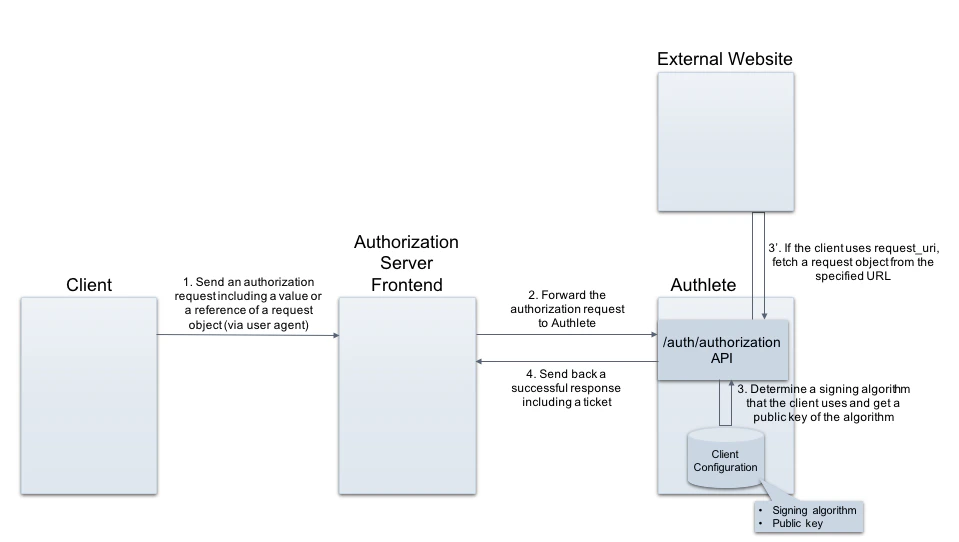
In order for an Authlete service to process authorization requests that employ a request object, you have to configure these two properties so that the service can verify a signature of the object.
- A signing algorithm used for request objects
- A public key that corresponds to the specified signing algorithm
Optionally, you can configure Authlete to allow clients to:
- Encrypt requests objects, and/or
- Use “request_uri.”
These settings are specified for each client through Authlete’s Developer Console
.
 Processing request objects
1. Specifying a signing algorithm
Enter a value representing a signing algorithm, for Request Object Signature Algorithm section in Authorization tab. The following example shows a result when “ES256” has been registered. Request Object Signature Algorithm
2. Registering a public key
Register a JWK formatted public key for “JWK Set Content” section, or specify a URL for “JWK Set URL” in JWK Set tab. The following example shows a result when an ES256 public key has been registered. JWK Set Content
With the settings above, when the configured client makes a authorization request that contains a request object, the Authlete service verifies a signature of the object using the public key determined by the signing algorithm, and proceeds further.
JWK Set Content
With the settings above, when the configured client makes a authorization request that contains a request object, the Authlete service verifies a signature of the object using the public key determined by the signing algorithm, and proceeds further.
Option: Specifying an encryption algorithm
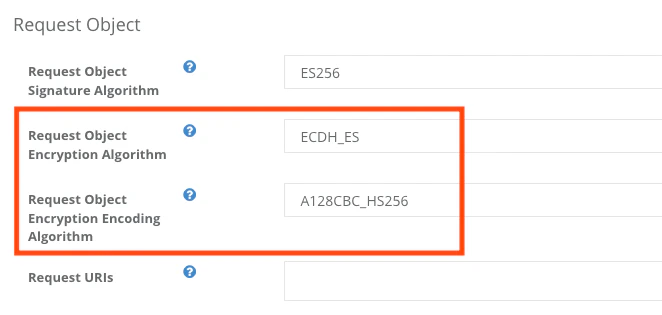
Specify appropriate values for “Encryption Algorithm” and “Encryption Encoding Algorithm” in Authorization tab, if you want to use encrypted request objects.\
Option: Registering values for request_uri
Enter appropriate values for “Request URIs” in Authorization tab so that the client make an authorization request with request_uri (pass-by-reference) instead of request (pass-by-value).
Examples
API request / response examples are as follows. (folded for readability)
Request
Client: Creating a request object
Assume a client creates a signed JWT (a request object) that contains the following payload:
{
   "exp": 1597130002,
   "iss": "17201083166161",
   "aud": "https://as.example.com",
   "scope": "openid profile",
   "response_type": "code",
   "client_id": "17201083166161",
   "redirect_uri": "https://client.example.org/cb/example.com",
   "nonce": "lvzxcjkb78643ki5kigsysigyb",
   "foo": "bar"
}
eyJhbGciOiJFUzI1NiJ9.
ewogICJleHAiOiAxNTk3MTMwMDAyLAogICJpc3MiOiAiMTcyMDE
wODMxNjYxNjEiLAogICJhdWQiOiAiaHR0cHM6Ly9hcy5leGFtcG
xlLmNvbSIsCiAgInNjb3BlIjogIm9wZW5pZCBwcm9maWxlIiwKI
CAicmVzcG9uc2VfdHlwZSI6ICJjb2RlIiwKICAiY2xpZW50X2lk
IjogIjE3MjAxMDgzMTY2MTYxIiwKICAicmVkaXJlY3RfdXJpIjo
gImh0dHBzOi8vY2xpZW50LmV4YW1wbGUub3JnL2NiL2V4YW1wbG
UuY29tIiwKICAibm9uY2UiOiAibHZ6eGNqa2I3ODY0M2tpNWtpZ
3N5c2lneWIiLAogICJmb28iOiAiYmFyIgp9.
JnuCpEL1mRKPBUfXIO5mPtusY2lnz1w6oS6QQdYai7VUXUxfPA7
elMIWdsExc7tsSovTTAMK8mSxz9COAciY-Q
Client: Making an authorization request
Then the client crafts an authorization request with the request object above. The request will include it either as a value (request) or a reference (request_uri).
- Passing the object by value
GET /cb/example.com
 &client_id=...
 &scope=openid
 &response_type=code
 &**request=eyJhbGciOiJFUzI1NiJ9.
   ewogICJleHAiOiAxNTk3MTMwMDAyLAogICJpc3MiOiAiMTcyMDE
   wODMxNjYxNjEiLAogICJhdWQiOiAiaHR0cHM6Ly9hcy5leGFtcG
   xlLmNvbSIsCiAgInNjb3BlIjogIm9wZW5pZCBwcm9maWxlIiwKI
   CAicmVzcG9uc2VfdHlwZSI6ICJjb2RlIiwKICAiY2xpZW50X2lk
   IjogIjE3MjAxMDgzMTY2MTYxIiwKICAicmVkaXJlY3RfdXJpIjo
   gImh0dHBzOi8vY2xpZW50LmV4YW1wbGUub3JnL2NiL2V4YW1wbG
   UuY29tIiwKICAibm9uY2UiOiAibHZ6eGNqa2I3ODY0M2tpNWtpZ
   3N5c2lneWIiLAogICJmb28iOiAiYmFyIgp9.
   JnuCpEL1mRKPBUfXIO5mPtusY2lnz1w6oS6QQdYai7VUXUxfPA7
   elMIWdsExc7tsSovTTAMK8mSxz9COAciY-Q HTTP/1.1**Host: as.example.com
...
- Passing the object by reference
The client have to put the request object to the request_uri location e.g. https://client.example.org/request.jwt and make it accessible to Authlete.
GET /cb/example.com
&client_id=...
&scope=openid
&response_type=code
&**request\_uri=https://client.example.org/request.jwt**
HTTP/1.1
Host: as.example.com
...
Authorization Server: Making a request to Authlete API
On receiving the authorization request, the authorization server makes a request to Authlete’s /auth/authorization API
. The request contains the authorization request from the client as a value of “parameters”.
curl -s -X POST https://api.authlete.com/api/auth/authorization
 -u $apiKey:$apiSecret
 -H 'Content-type: application/json'
 -d '{"parameters":
       "redirect_uri=https://client.example.org/cb/example.com
        &client_id=...
        &scope=openid
        &response_type=code
        &**request=eyJhbGciOiJFUzI1NiJ9.
          ewogICJleHAiOiAxNTk3MTMwMDAyLAogICJpc3MiOiAiMTcyMDE
          wODMxNjYxNjEiLAogICJhdWQiOiAiaHR0cHM6Ly9hcy5leGFtcG
          xlLmNvbSIsCiAgInNjb3BlIjogIm9wZW5pZCBwcm9maWxlIiwKI
          CAicmVzcG9uc2VfdHlwZSI6ICJjb2RlIiwKICAiY2xpZW50X2lk
          IjogIjE3MjAxMDgzMTY2MTYxIiwKICAicmVkaXJlY3RfdXJpIjo
          gImh0dHBzOi8vY2xpZW50LmV4YW1wbGUub3JnL2NiL2V4YW1wbG
          UuY29tIiwKICAibm9uY2UiOiAibHZ6eGNqa2I3ODY0M2tpNWtpZ
          3N5c2lneWIiLAogICJmb28iOiAiYmFyIgp9.
          JnuCpEL1mRKPBUfXIO5mPtusY2lnz1w6oS6QQdYai7VUXUxfPA7
          elMIWdsExc7tsSovTTAMK8mSxz9COAciY-Q"}**'
Response
If Authlete has been properly configured, it sends back a response like this.
{
  "type": "authorizationResponse",
  "resultCode": "A004001",
  "resultMessage":
    "[A004001] Authlete has successfully issued a ticket
     to the service (API Key = 14156727624613) for the
     authorization request from the client (ID = ...).
     [response_type=code, openid=true]",
  "requestObjectPayload":
    "{\"exp\":1597130002,
      \"iss\":\"17201083166161\",
      \"aud\":\"https://as.example.com\",
      \"scope\":\"openid profile\",
      \"response_type\":\"code\",
      \"client_id\":\"17201083166161\",
      \"redirect_uri\":
        \"https://client.example.org/cb/example.com\",
      \"nonce\":\"lvzxcjkb78643ki5kigsysigyb\",
      \"foo\":\"bar\"}",**  "ticket": "rja...GiE"
[...]
