
Preface
This article describes how to support “RFC 9449: OAuth 2.0 Demonstrating Proof-of-Possession (DPoP) ” with Authlete APIs.This feature is available in Authlete version 2.2 or later.
Instructions
Authorization servers and resource servers support DPoP by following these steps.-
Receiving a request that includes a “DPoP Proof JWT”
- A endpoint (EP) of an authorization server (e.g., Token EP, PAR EP, UserInfo EP) or a resource server receives a request, with “DPoP Proof JWT” as one of HTTP headers, from a client.
-
Extracting DPoP-related information
- The server extracts DPoP-related information (DPoP Proof JWT, HTTP method and HTTP target URI) from the request.
-
Making a request to Authlete’s APIs
- The server make a request, that includes the content of the client’s request and the above DPoP-related information as request parameters, to Authlete APIs (/auth/token, /auth/introspection, etc.)
Example
The following is an example of how to support DPoP in an authorization server’s token EP.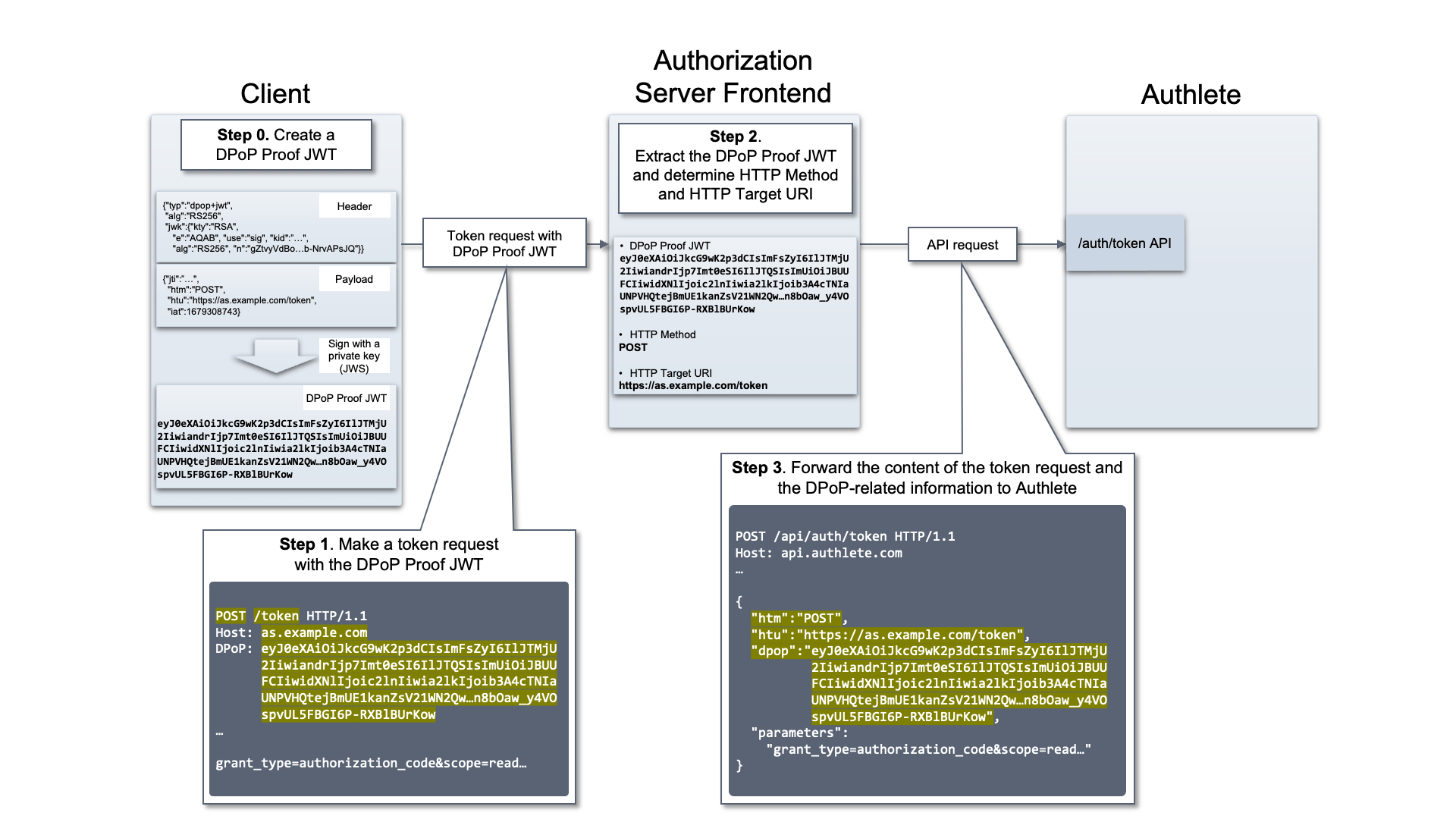
1. Receiving a request that includes a “DPoP Proof JWT”
Let us assume that the authorization server’s token EP receives the following HTTP request. (wrapped for readability)2. Extracting DPoP-related information
The authorization server detects a DPoP header in the request, and extracts HTTP method, HTTP target URI and DPoP Proof JWT. These values are then included in a request to Authlete’s /auth/token API, ashtm, htu and dpop respectively.
The following table shows the values in this example.