
Documentation Index
Fetch the complete documentation index at: https://developers.authlete.com/llms.txt
Use this file to discover all available pages before exploring further.
Introduction
The Internet Engineering Task Force (IETF) published RFC 6749, the core specification of OAuth 2.0, on October 13, 2012. Since then, the OAUTH Working Group of the IETF has continued its work and remains actively engaged in developing new standards.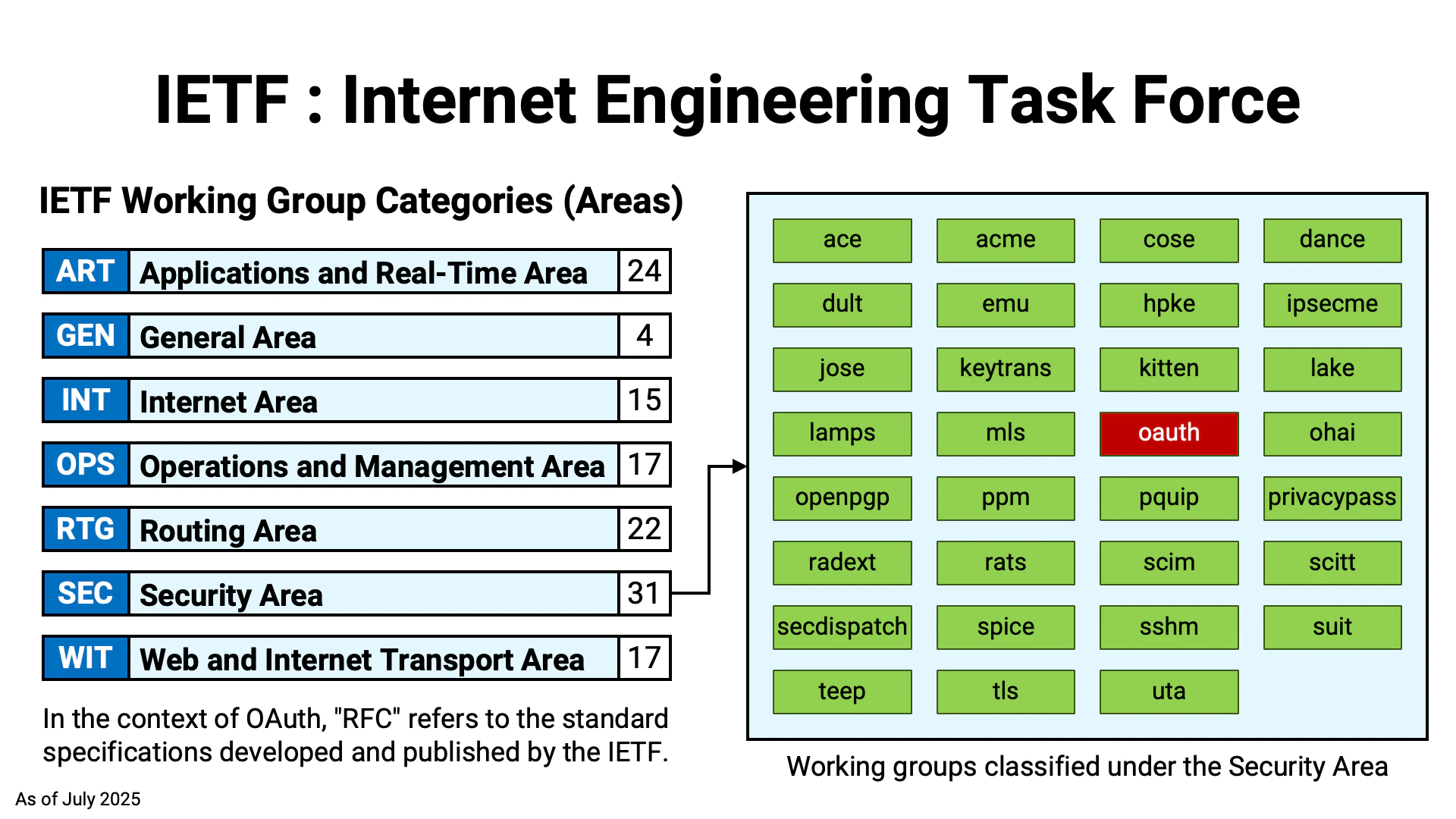
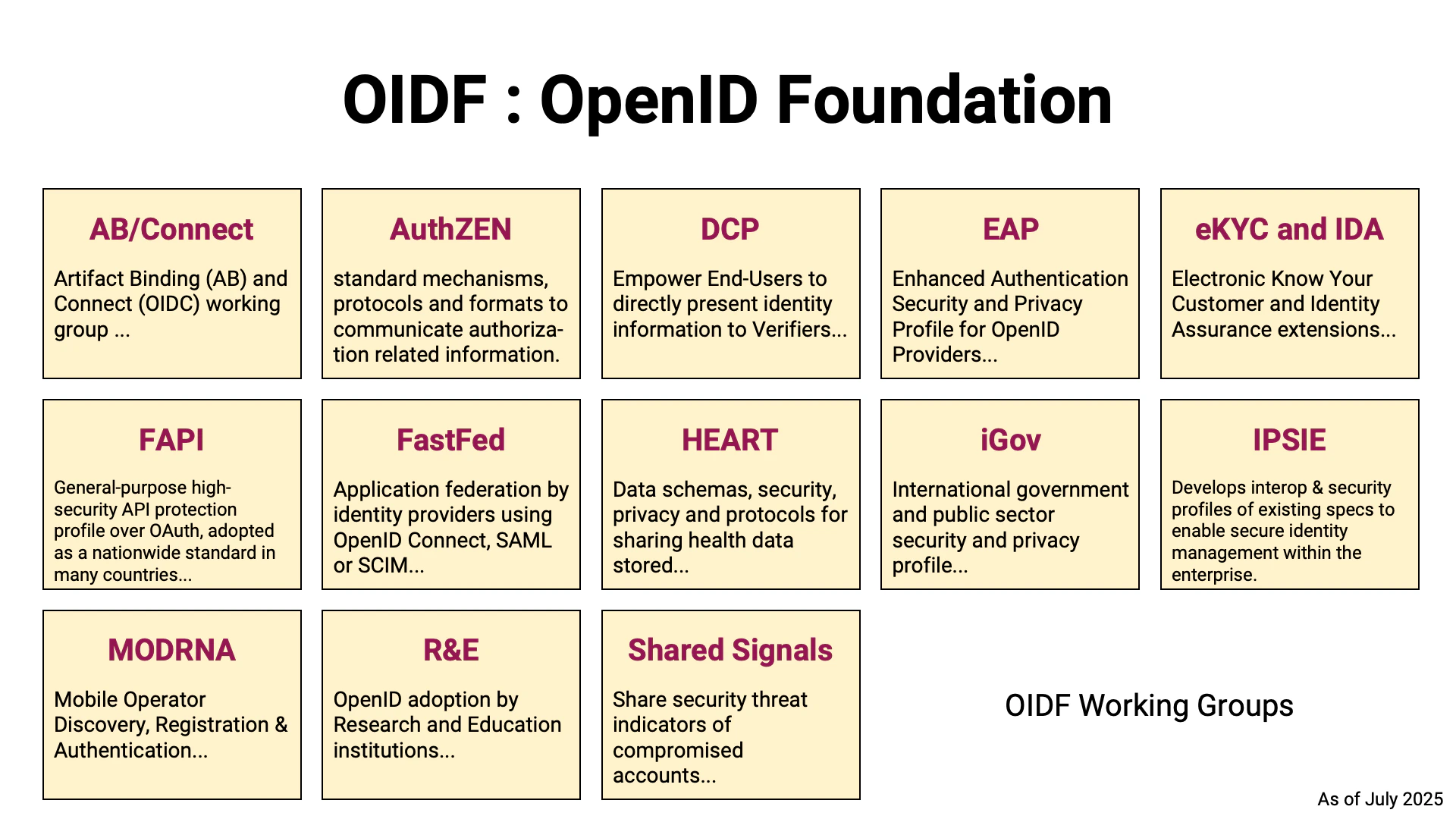
Similarly, FAPI 2.0 Http Signatures relies on the
following RFCs developed by the IETF’s HTTPBIS Working Group:
| Date | RFC | Title |
|---|---|---|
| “2021-02 | “RFC 8941 | Structured Field Values for HTTP★ |
| “2024-02 | “RFC 9421 | HTTP Message Signatures★ |
| “2024-02 | “RFC 9530 | Digest Fields |
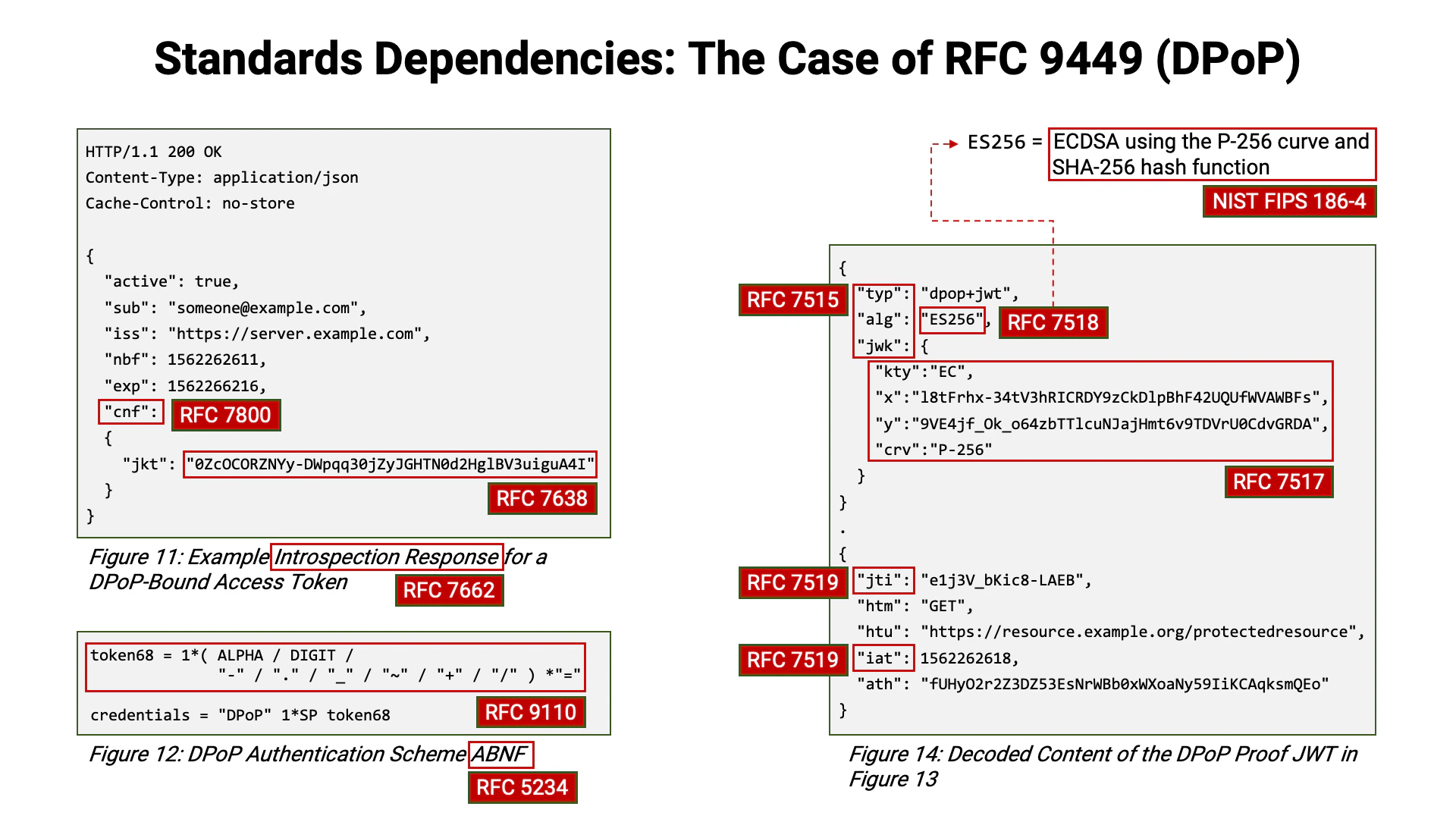
resource parameter (RFC 8707),
sender-constrained access tokens using MTLS (RFC 8705) and DPoP
(RFC 9449), HTTP message signatures (RFC 9421), and
Cedar.
As Authlete is always committed to supporting developers, this article also
covers implementation-oriented considerations, such as:
- How to determine access token expiration while accounting for clock skew between systems
- How to receive the client certificate used in mutual TLS between the reverse proxy and the client
- How to compute the value of the derived component
@target-uri(RFC 9421) when operating behind a reverse proxy - How to obtain the public key used to verify HTTP message signatures
Access Token Usage
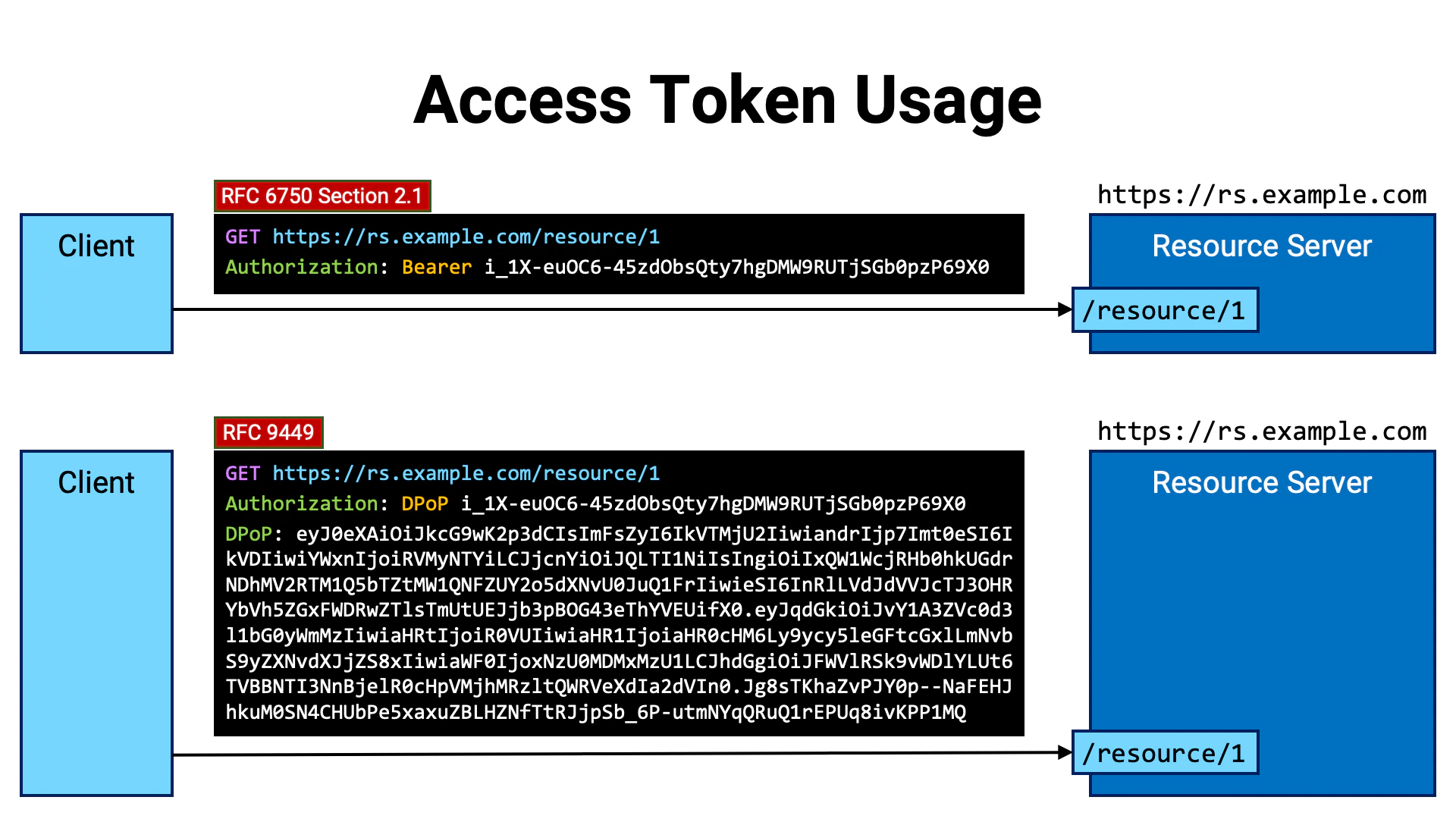
RFC 6750 (Bearer Token Usage) defines three methods for presenting an access token to a resource server:- Using the
Authorizationheader (Section 2.1) - Using a form parameter (Section 2.2)
- Using a query parameter (Section 2.3)
application/x-www-form-urlencoded,
and the third method is generally avoided due to security concerns.
As a result, the first method is used in most cases.
In the method that uses the Authorization header, the value of the header
is formatted as follows:
Bearer part is a fixed string, and the Access Token should
be replaced with the actual access token value.
The following is an example of accessing
https://rs.example.com/resource/1
with the access token
i_1X-euOC6-45zdObsQty7hgDMW9RUTjSGb0pzP69X0.
Bearer is replaced with DPoP.
In addition, a DPoP header must be included. The value of the DPoP header
is a type of JWT (RFC 7519) known as a DPoP proof JWT.
Access Token Information Retrieval
To validate a presented access token, the resource server must first obtain information about the token. If the information is embedded within the access token itself, it can be extracted by reading the contents of the token. On the other hand, if the information is not embedded, the resource server must query the authorization server’s introspection endpoint (RFC 7662) to obtain it.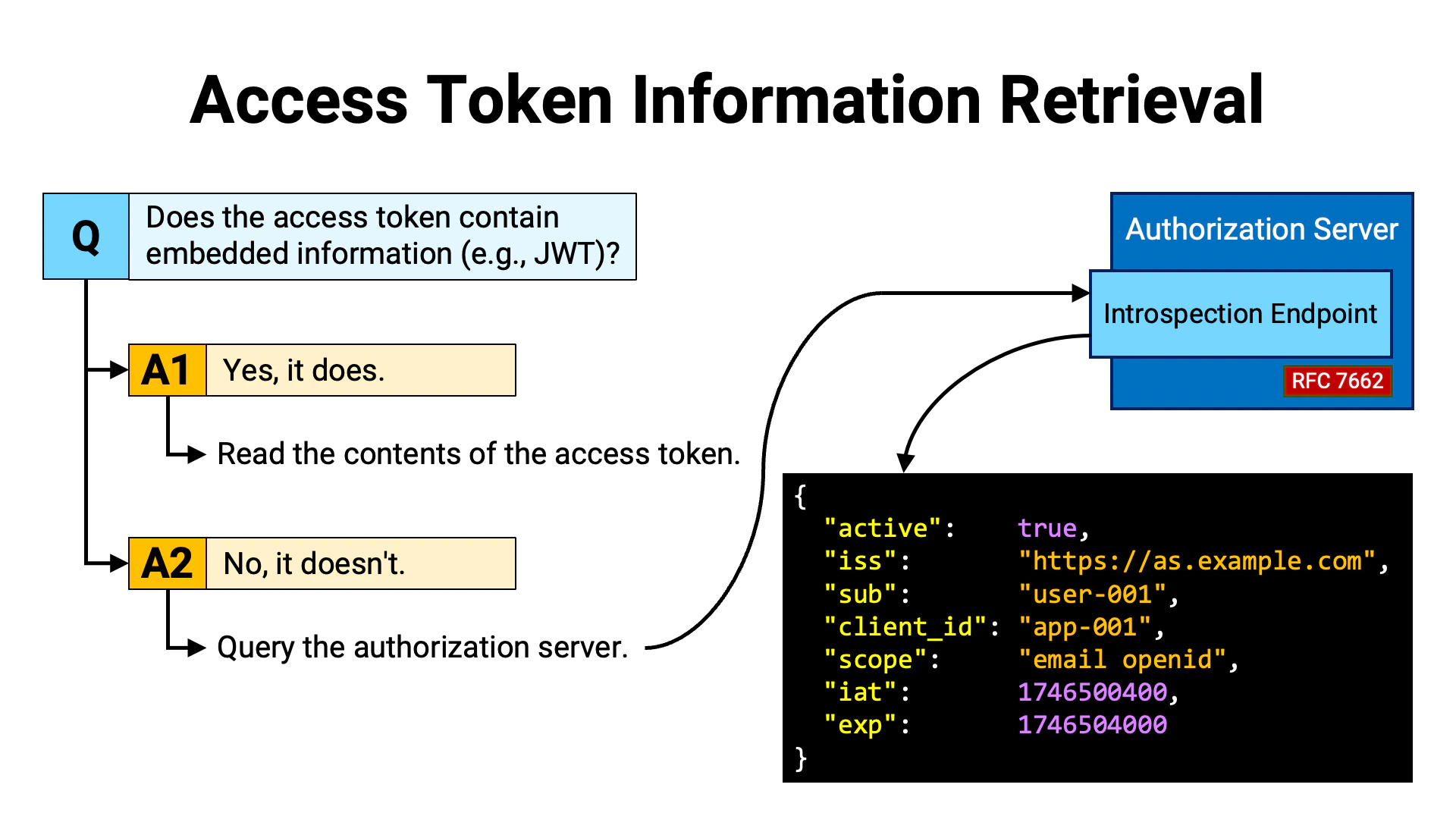
JWT Access Token Signature Verification
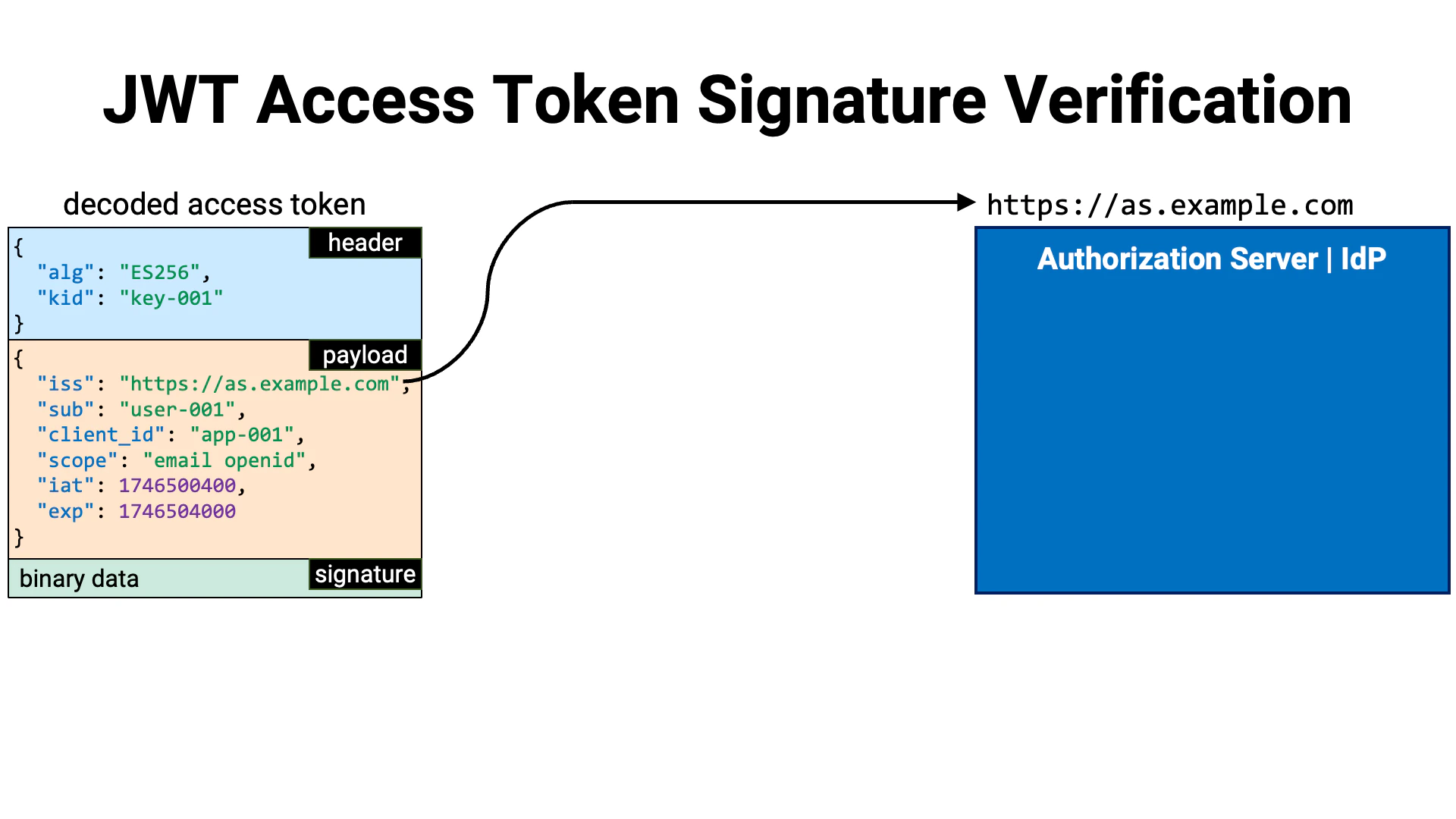
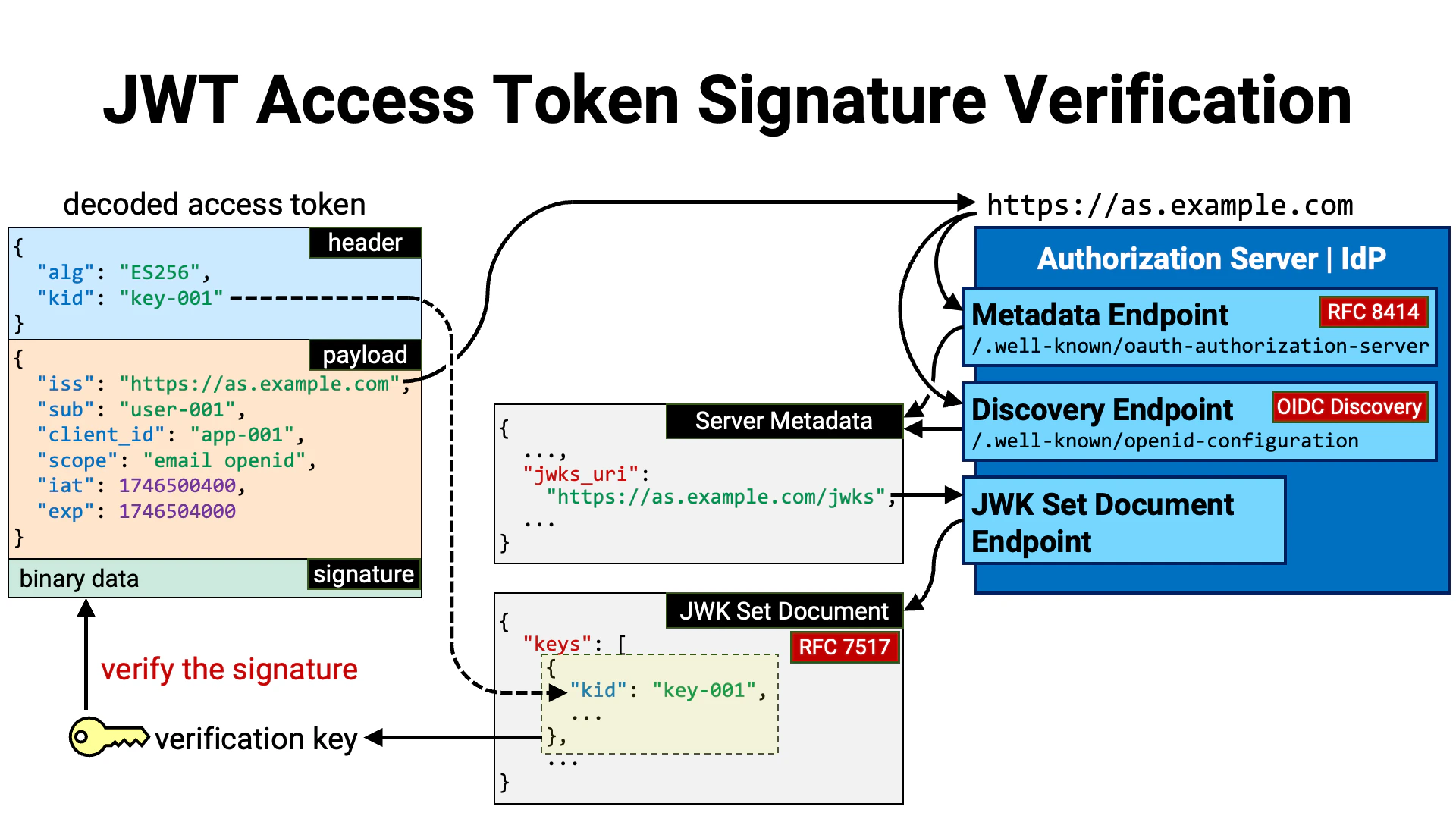
Let’s now walk through the steps for verifying the signature of an access token in JWT format. First, read the value of theiss claim (RFC 7519 Section 4.1.1)
in the payload of the JWT. This claim identifies the issuer of the JWT. Since
access tokens are issued by the authorization server—or by an OpenID Provider
that also serves as the authorization server—the value of the iss claim in
a JWT access token represents the identifier of the authorization server or
OpenID Provider.
According to the relevant specifications (RFC 8414,
OIDC Core, and OIDC Discovery), the identifier
of the authorization server or OpenID Provider must be a URL starting with
https. As a result, the value of the iss claim is a URL that identifies
the authorization server or OpenID Provider (i.e., an HTTP server) that issued
the access token.
/.well-known/oauth-authorization-server
to the issuer identifier. At this location, the server’s metadata can be
retrieved in JSON format.
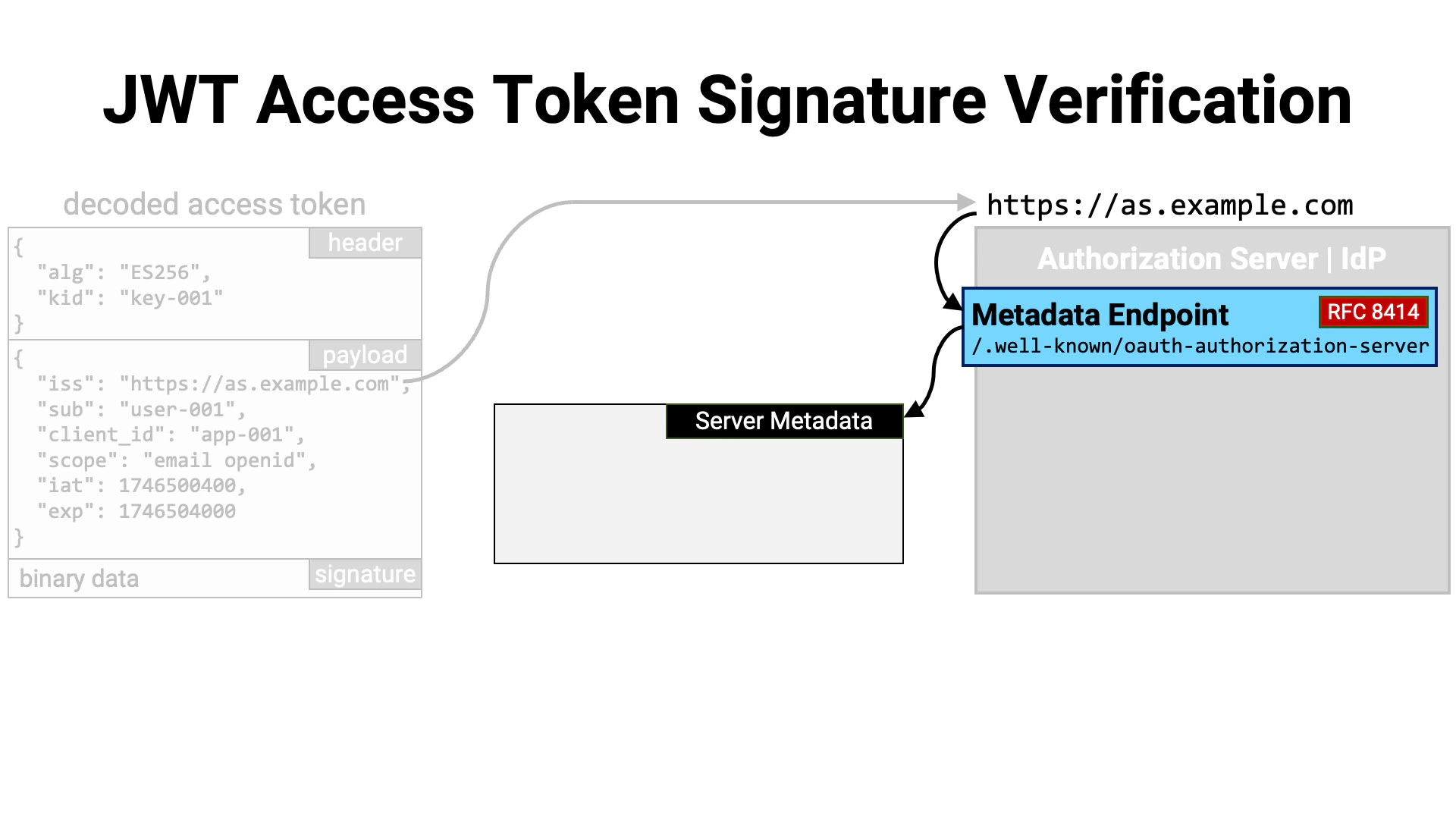
However, if the issuer identifier includes a path component, the metadata
is published at the location obtained by inserting
/.well-known/oauth-authorization-server
between the host and the path. For details, see
RFC 8414,
Section
3.1. Authorization Server Metadata Request./.well-known/openid-configuration
to the issuer identifier.
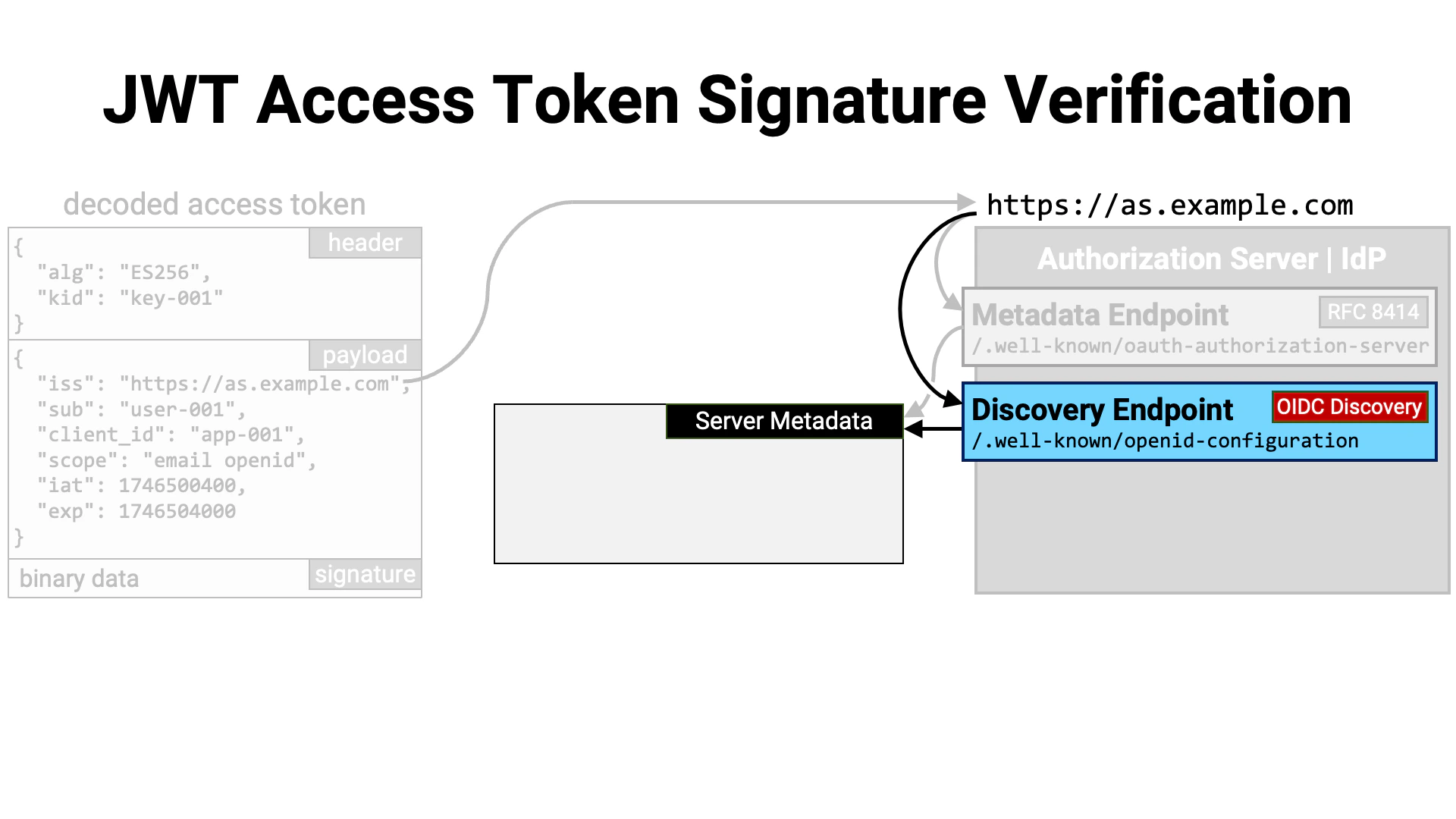
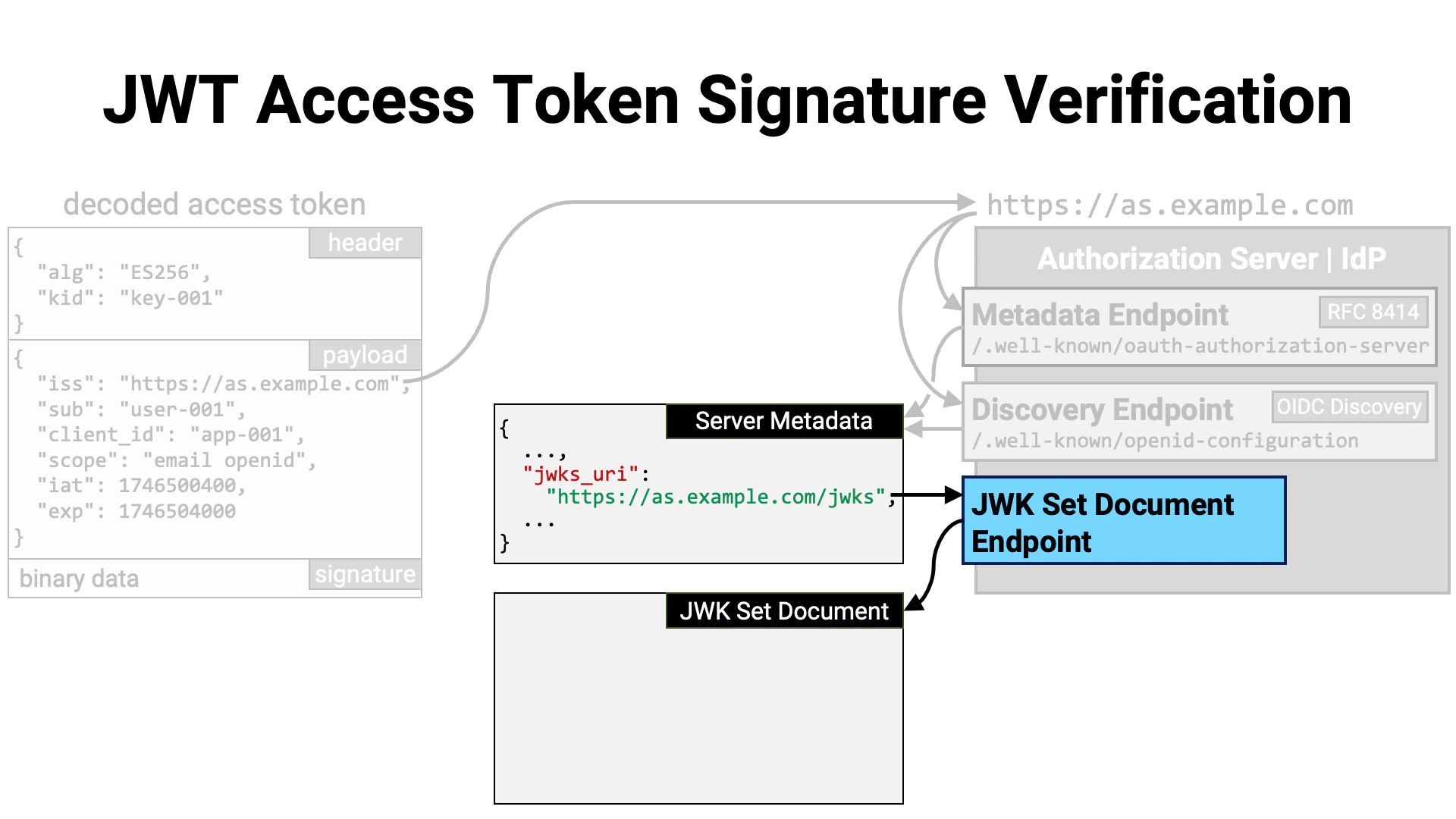
jwks_uri metadata. This field indicates the location
where the server’s JWK Set document is published. The JWK Set document can
be downloaded from this location.
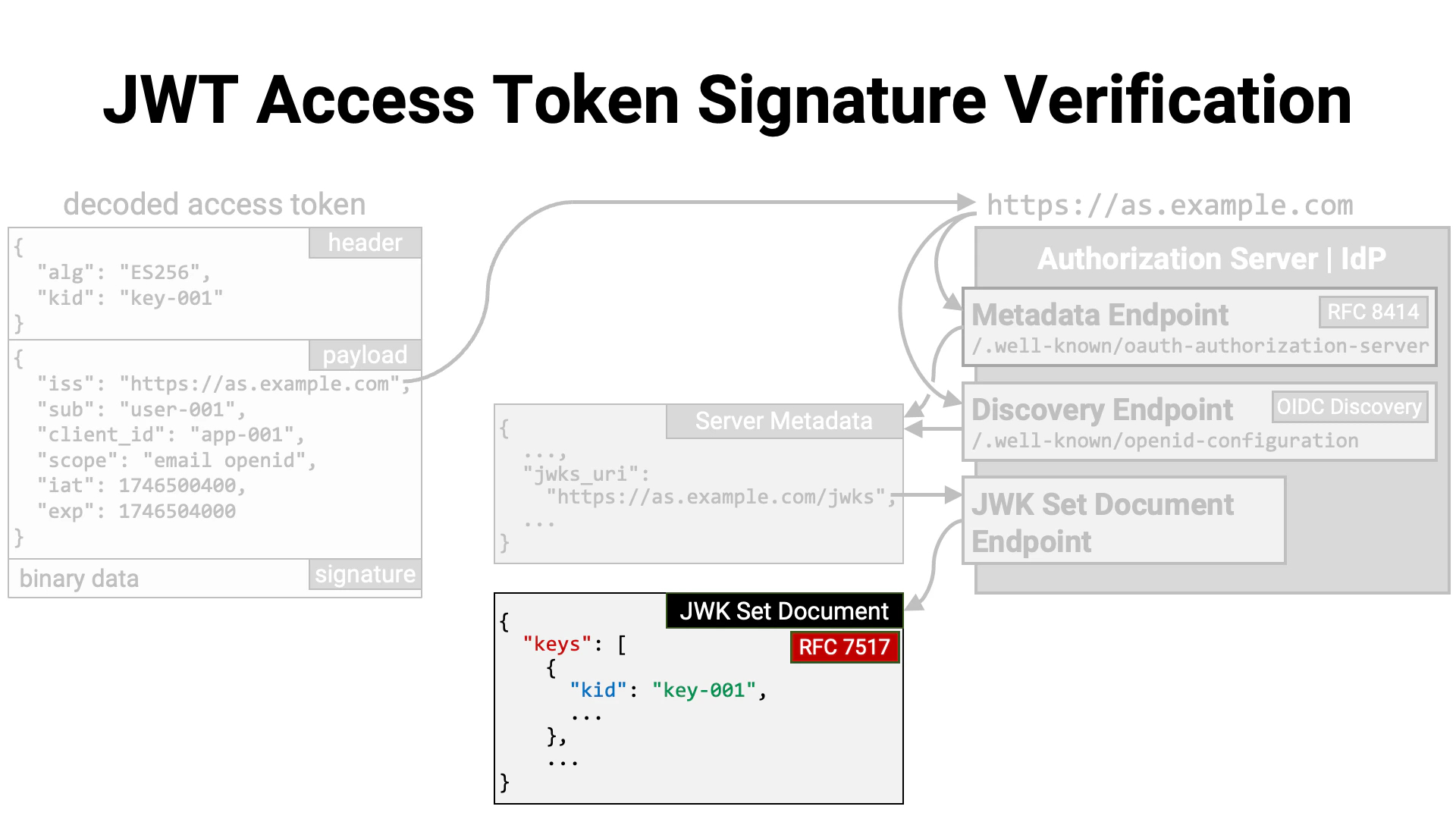
keys. The
value of the keys property is a JSON array of JWKs (RFC 7517).
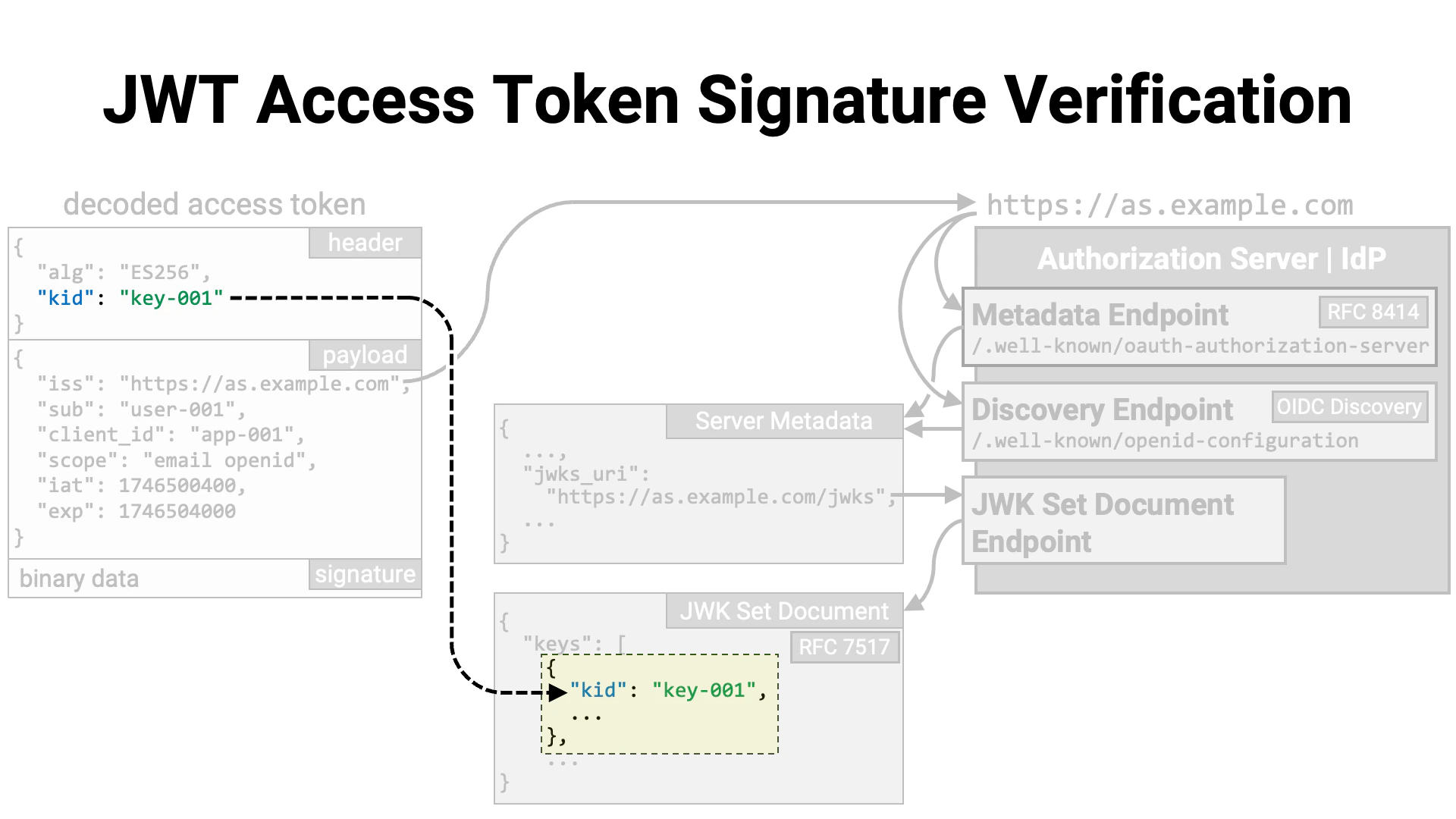
kid parameter
(RFC 7515 Section 4.1.4), the verification key can be
identified by looking for a JWK with the same kid
(RFC 7517 Section 4.5).
kid, the method for identifying the
verification key will depend on the implementation. For example, the key may
be identified by filtering based on parameters such as alg
(RFC 7515 Section 4.1.1, RFC 7517 Section 4.4)
and use (RFC 7517 Section 4.2).
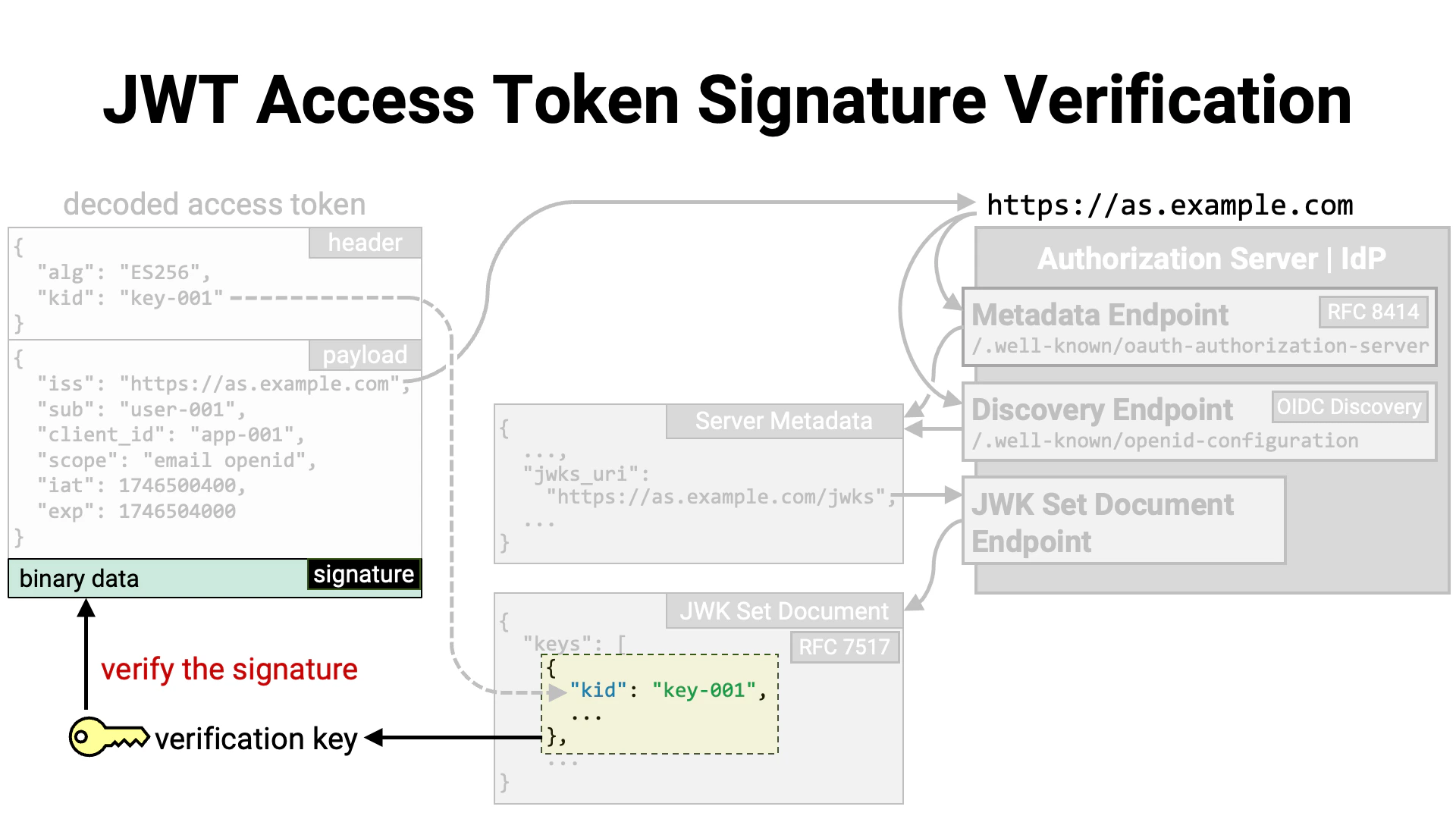
Once the verification key has been identified, it is used to verify the JWT’s
signature. If the verification succeeds, it can be concluded that the JWT
access token has not been tampered with.
Time
An access token can have up to three time-related attributes:- issuance time
- validity start time
- validity end time
iat (Issued At), nbf (Not Before), and exp
(Expiration Time), respectively.
| Name | Introspection Response | JWT Payload | |
|---|---|---|---|
| issuance time | iat | RFC 7662 Section 2.2 | RFC 7519 Section 4.1.6 |
| validity start time | nbf | RFC 7662 Section 2.2 | RFC 7519 Section 4.1.5 |
| validity end time | exp | RFC 7662 Section 2.2 | RFC 7519 Section 4.1.4 |
iat, nbf, and exp—are specified.
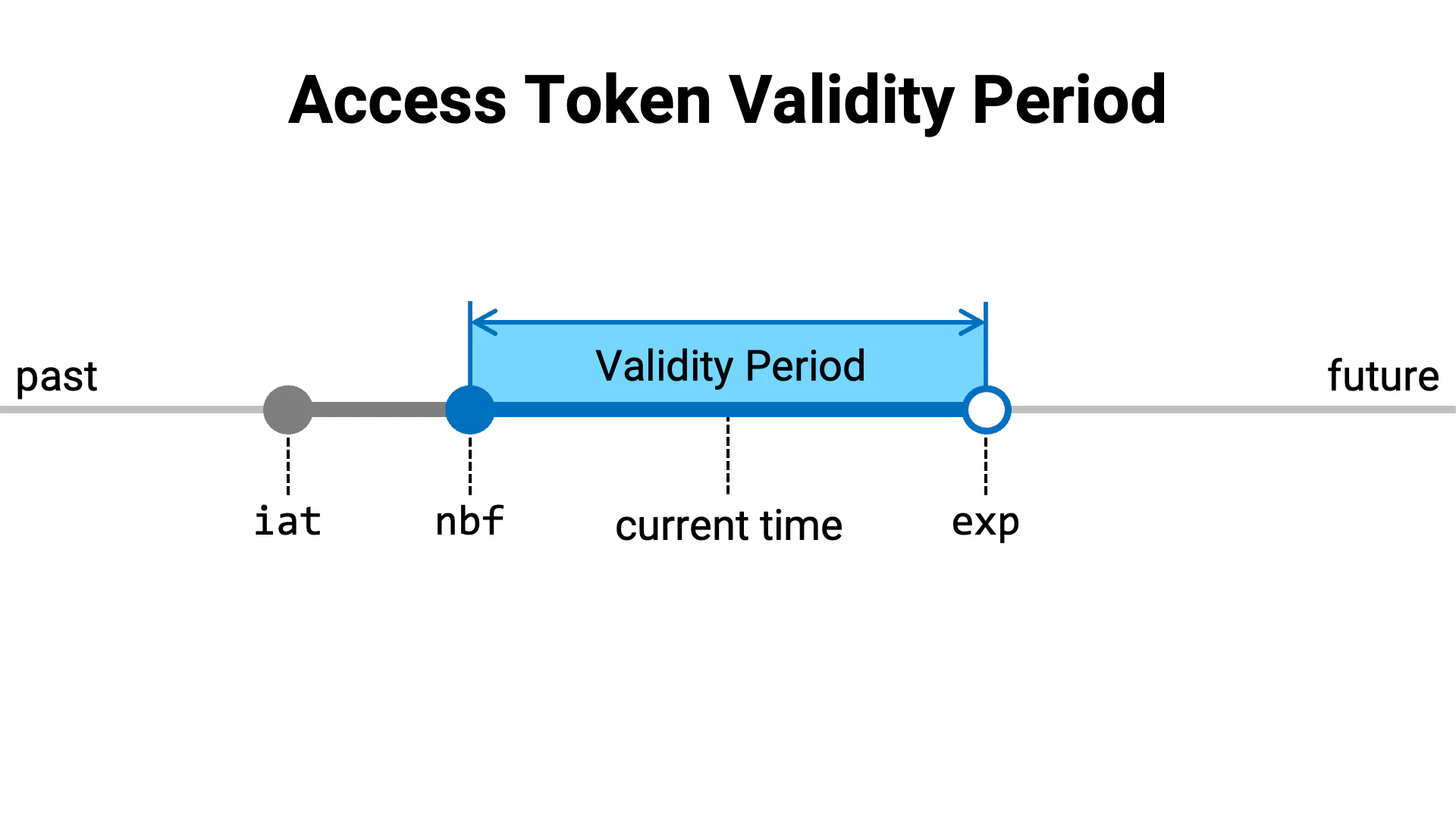
- The issuance time is in the past (i.e., not after the current time).
- The not-before time is in the past (i.e., not after the current time).
- The expiration time is in the future (i.e., after the current time).
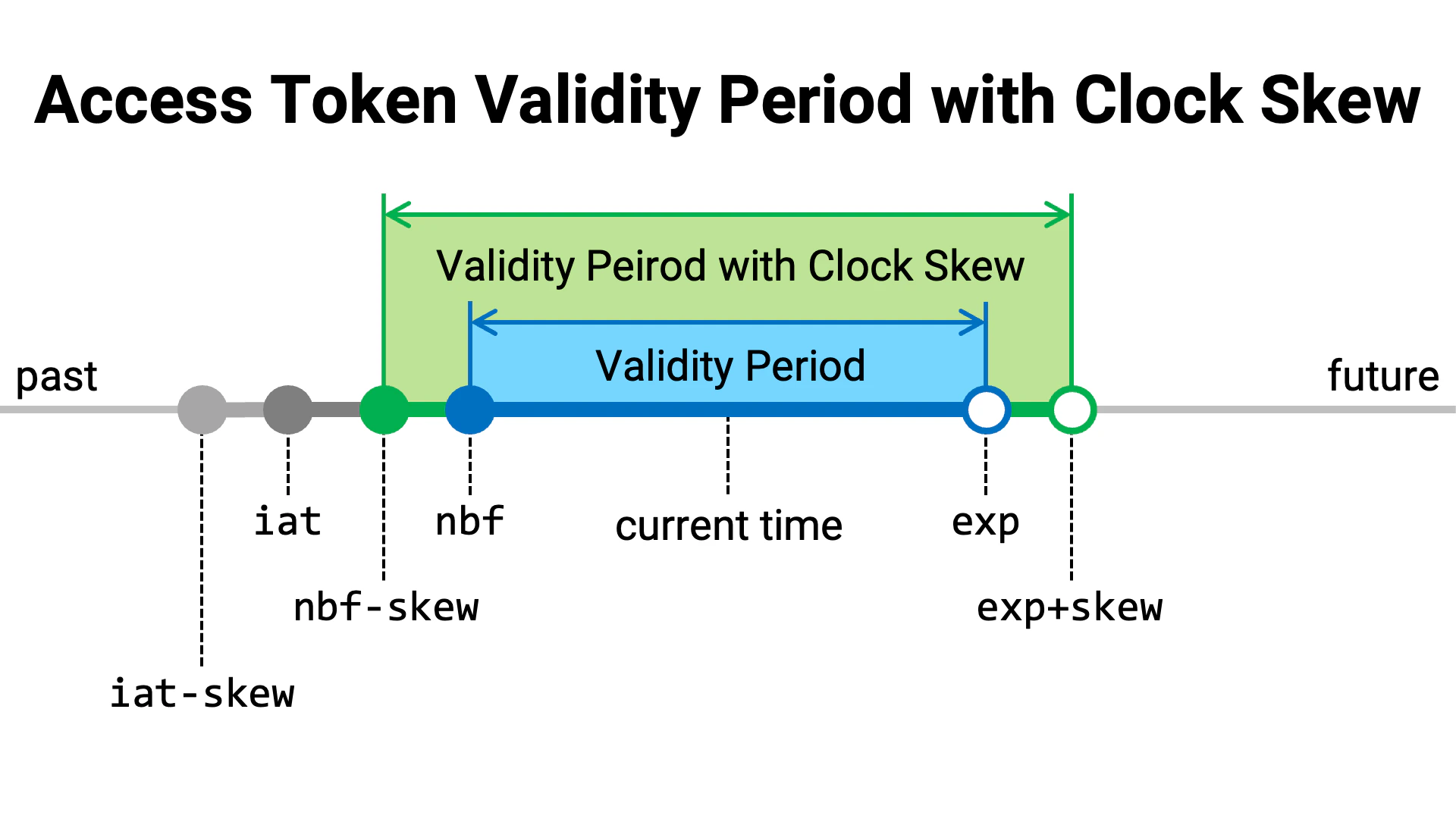
nbf).
You may hear opinions such as, “That kind of issue shouldn’t occur if time
synchronization is done properly using NTP (Network Time Protocol).”
However, in reality, such issues do occur. Insights gained from years of
operating open banking ecosystems in various countries are documented in the
FAPI 2.0 Security Profile, which we will introduce here.
NOTE 3: Clock skew is a cause of many interoperability issues. Even a few hundred milliseconds of clock skew can cause JWTs to be rejected for being “issued in the future”. The DPoP specification [RFC9449] suggests that JWTs are accepted in the reasonably near future (on the order of seconds or minutes). This document goes further by requiring authorization servers to accept JWTs that have timestamps up to 10 seconds in the future. 10 seconds was chosen as a value that does not affect security while greatly increasing interoperability. Implementers are free to accept JWTs with a timestamp of up to 60 seconds in the future. Some ecosystems have found that the value of 30 seconds is needed to fully eliminate clock skew issues. To prevent implementations switching offTechnically, when accounting for clock skew, there are two approaches: tightening the validation (making tokens less likely to be considered valid), and loosening the validation (making tokens more likely to be considered valid). What is typically required in real-world system operations is the latter. With this in mind, when comparingiatandnbfchecks completely this document imposes a maximum timestamp in the future of 60 seconds.
iat and nbf to the current time, the
maximum acceptable clock skew (e.g., 10 seconds) should be subtracted from
the iat or nbf value before comparison. Likewise, when comparing exp
to the current time, the clock skew should be added to the exp value
before comparison.
Scope
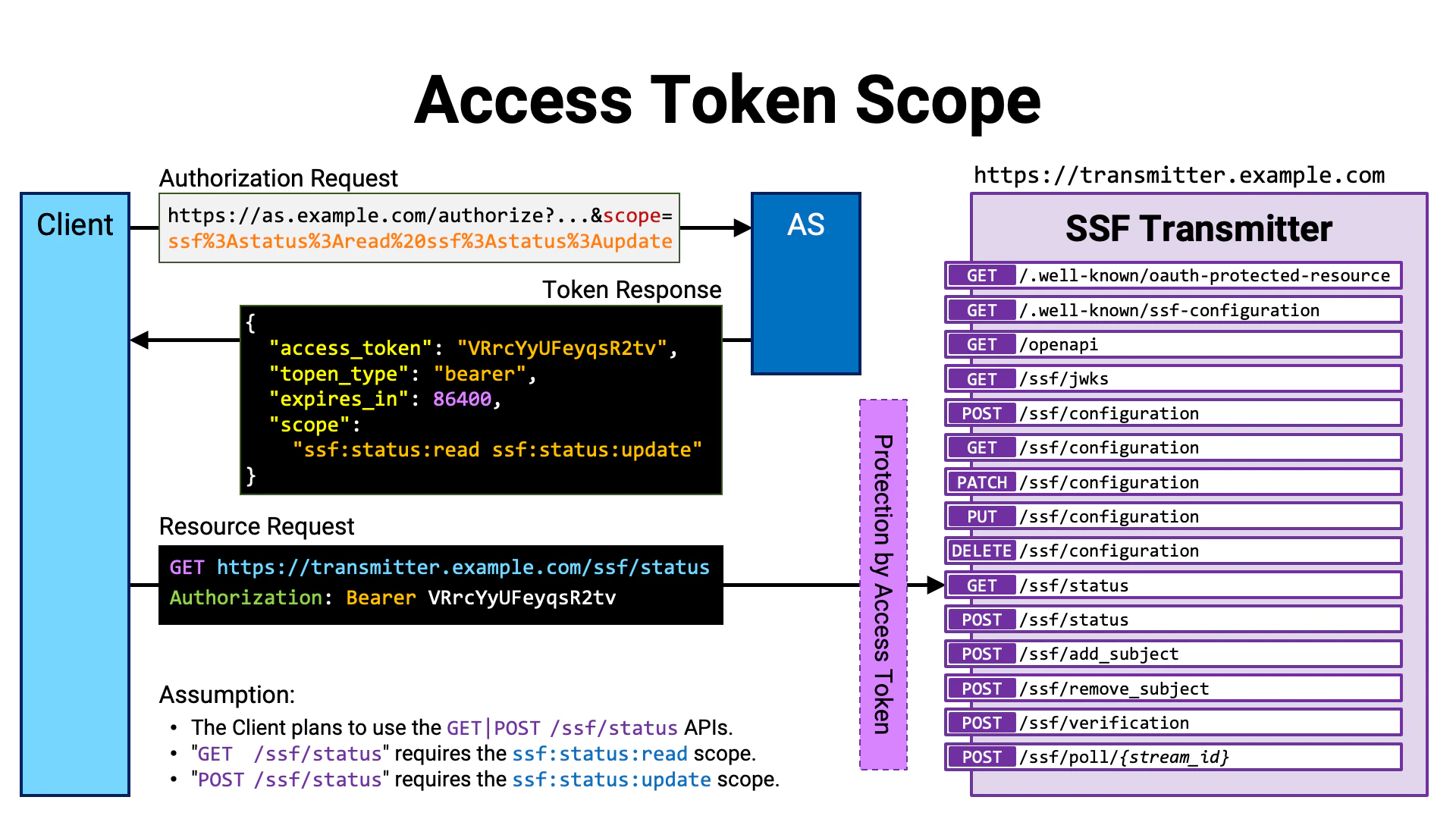
One of the fundamental attributes of an access token defined in RFC 6749 is the scope (RFC 6749 Section 3.3). The scope represents the set of permissions granted to the access token. API sets may require that an access token possess specific scopes, depending on their respective purposes. Which scopes are required is entirely up to the API provider to define. Before proceeding with any processing, the API implementation checks whether the presented access token includes the required scopes.Although the term “API” is used here, other terms such as “protected resource”
or “endpoint” are also used. There is no strict rule regarding which term to use.
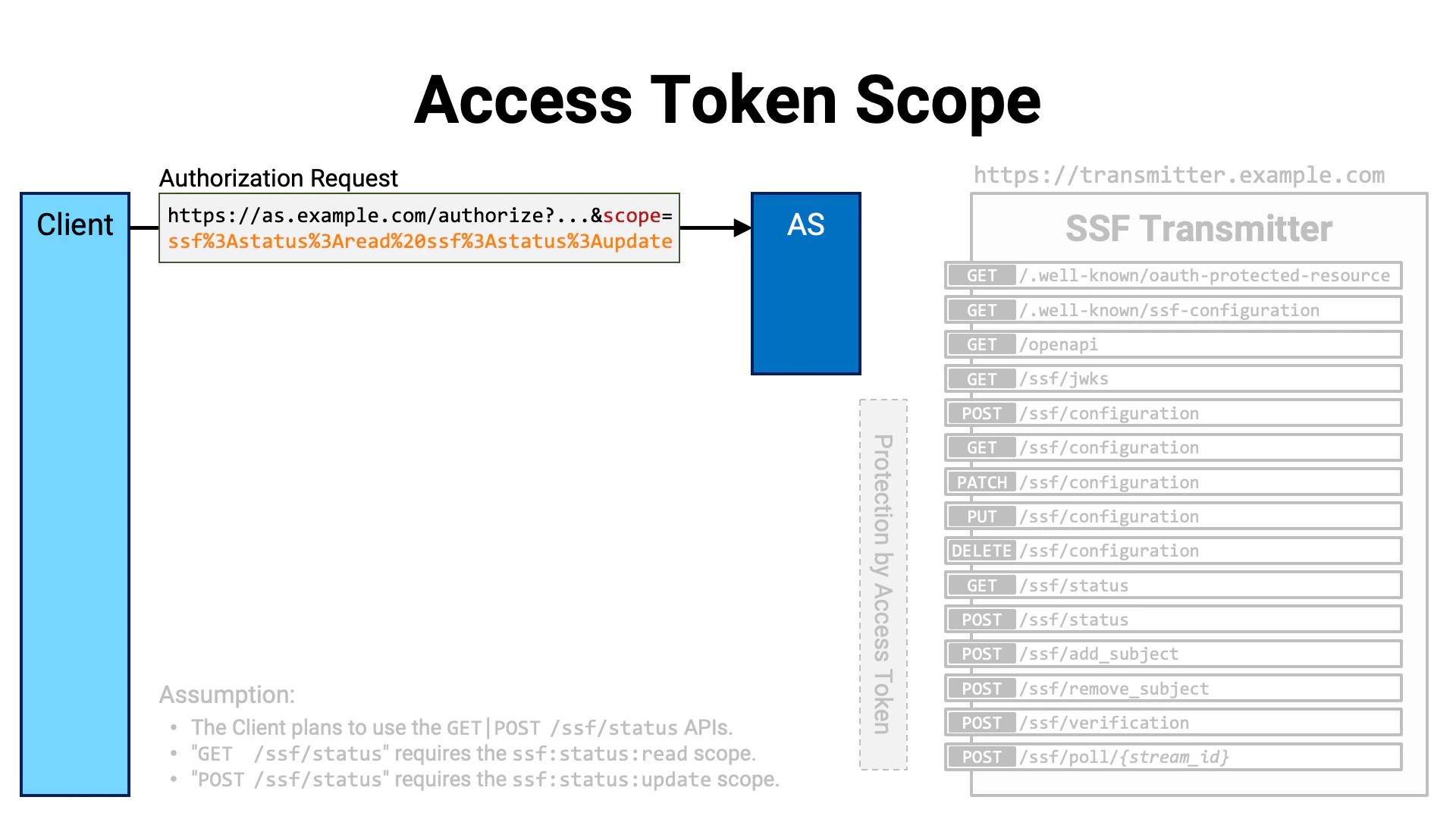
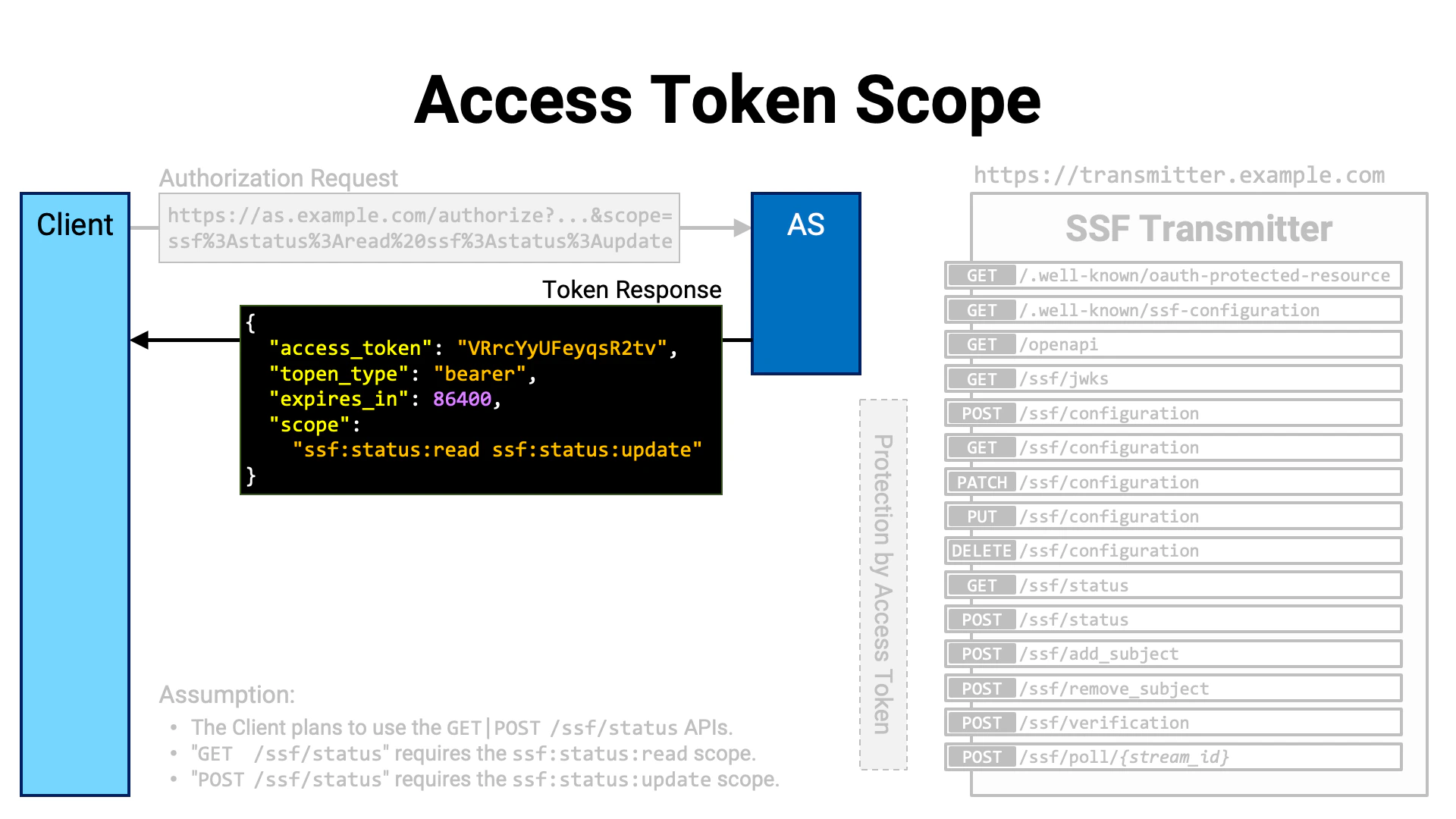
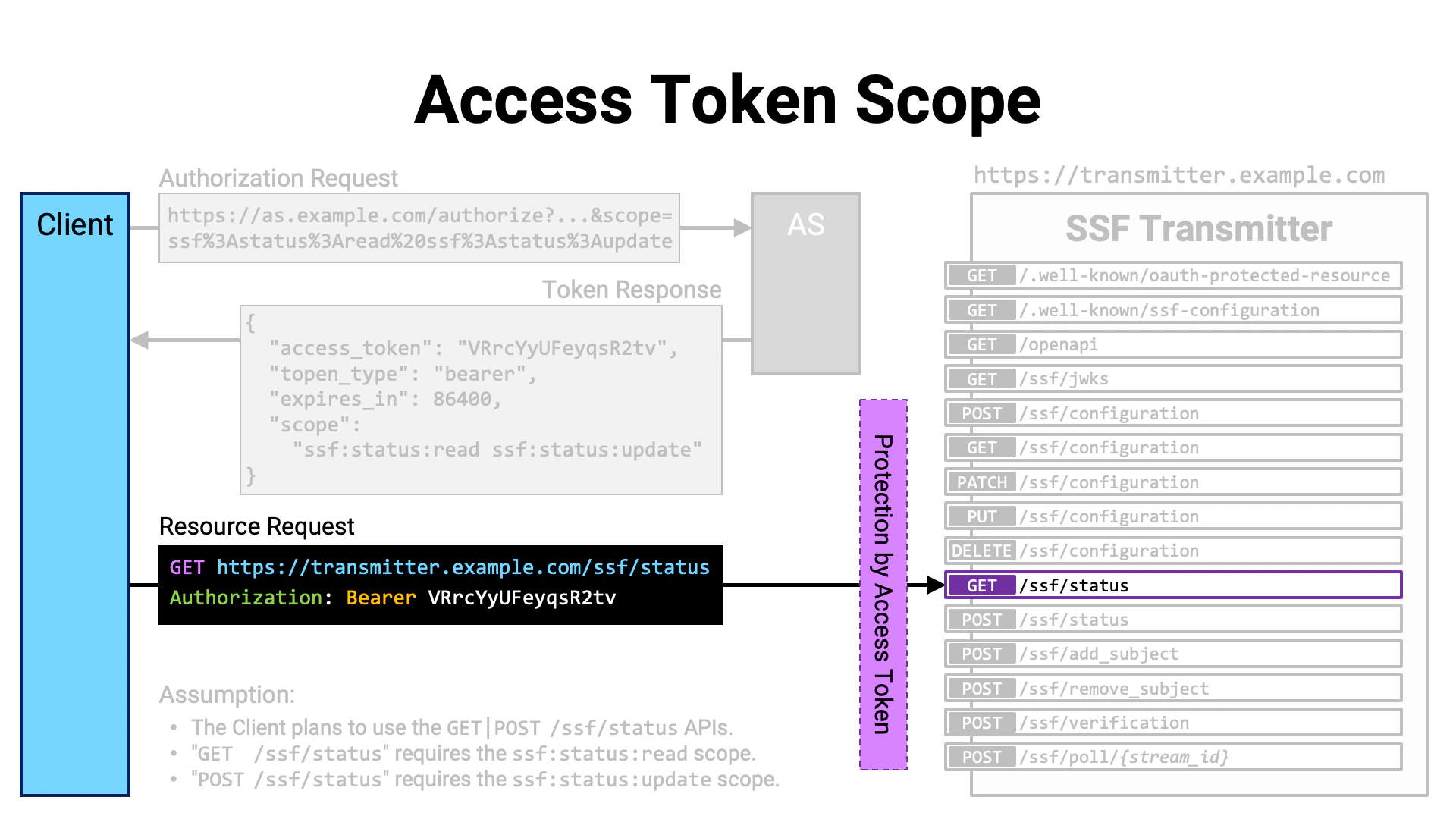
scope request parameter in the authorization request
(RFC 6749 Section 4.1.1).
Let’s look at a concrete example.
Suppose a client application wants to use the GET /ssf/status API and the
POST /ssf/status API provided by a certain server. Assume that the
GET /ssf/status API requires the ssf:status:read
scope, and the POST /ssf/status API requires the
ssf:status:update scope.
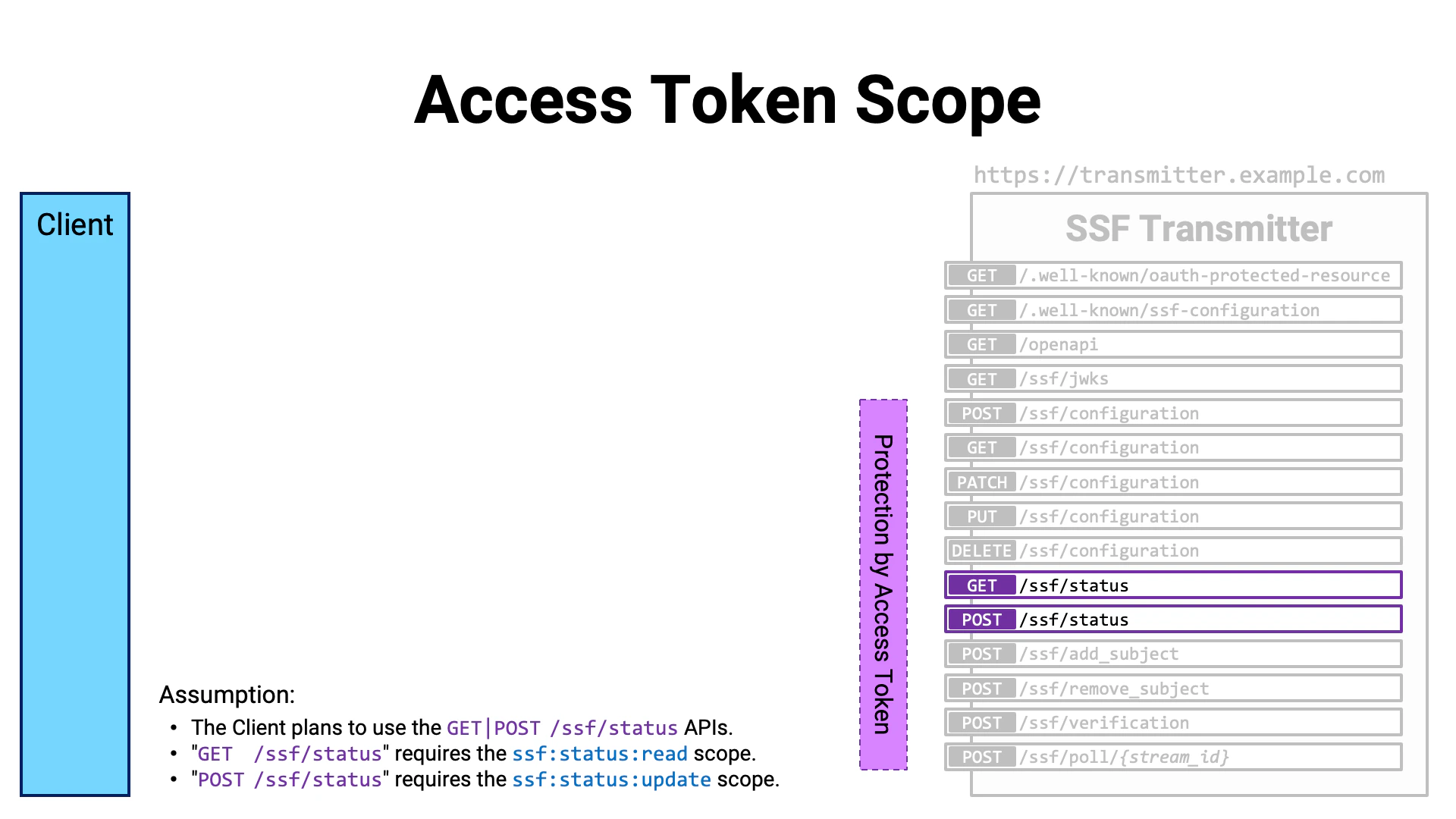
scope request
parameter.
Audience Restriction
There is a method to restrict the audience of an access token. By using this method, for example, it is possible to designate only a specific resource server as the audience, or to specify only a group of endpoints under a certain path hierarchy as the intended audience. This helps reduce the risk of misuse or abuse of the access token. The audience of an access token is represented by theaud parameter, both in
introspection responses (RFC 7662) and in JWT access tokens.
| Name | Introspection Response | JWT Payload | |
|---|---|---|---|
| audience | aud | RFC 7662 Section 2.2 | RFC 7519 Section 4.1.3 |
https://rs.example.com in
the value of its aud property, it means that the access token can be used
only at https://rs.example.com.
https://rs.example.org, and if the APIs on
https://rs.example.org are correctly validating
the aud property of the access token, the token will be rejected.
Restricting the audience of an access token is done using the resource
request parameter defined in Section 2 of RFC 8707
(Resource Indicators for OAuth 2.0).
When a resource request parameter is included in an authorization or token
request, its value is set as the audience of the access token. Below is an
example of how to use the resource parameter, excerpted from
Section 2.1 of RFC 8707. In this example,
https://cal.example.com and
https://contacts.example.com are specified as
the intended audiences of the access token.
Section 3.1
of RFC 6749 states
that “Request and response parameters MUST NOT be included more than once.”
However, the
resource request parameter defined in
RFC 8707 is not
subject to this restriction.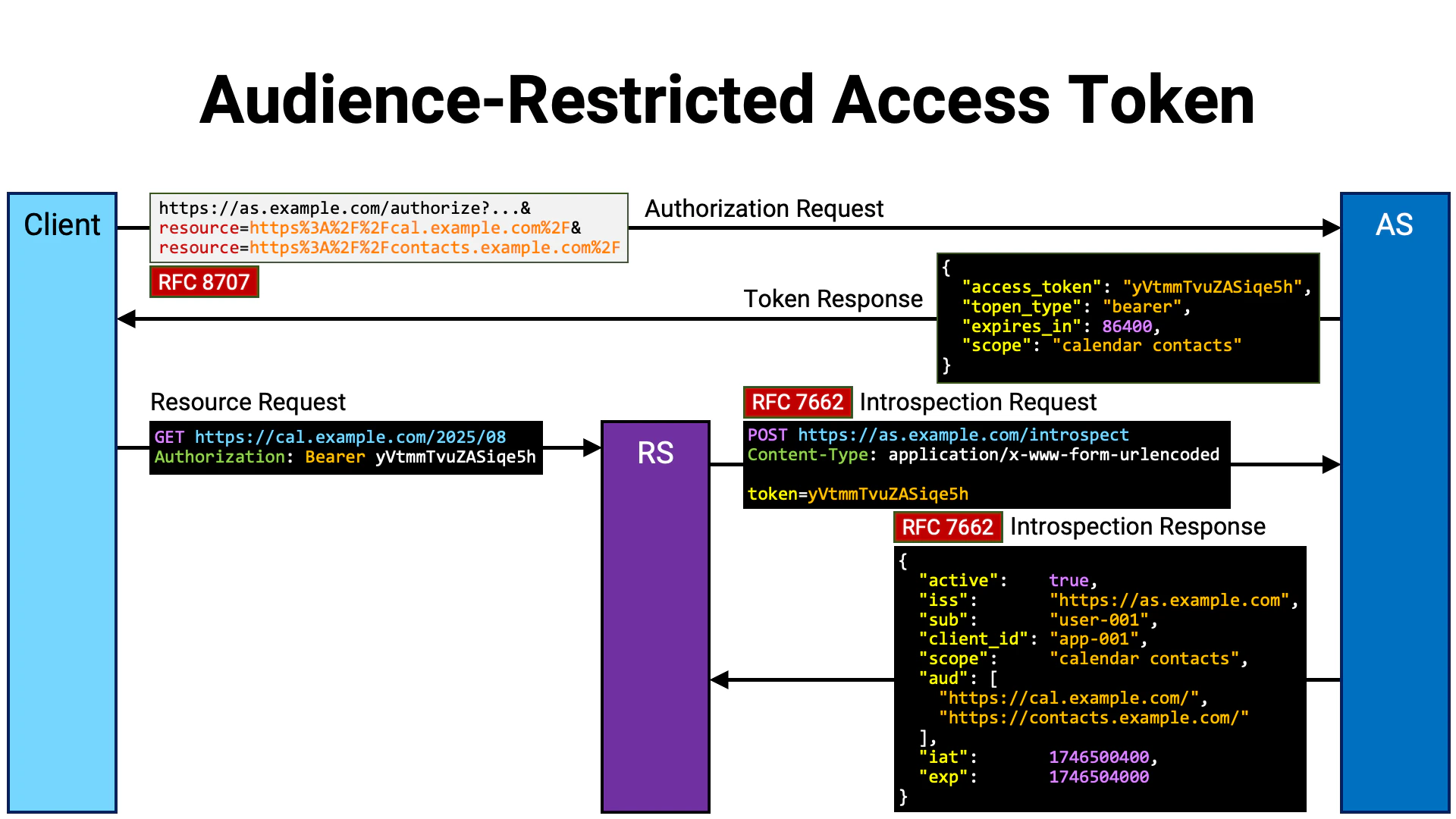
Sender Constraint
Traditional access tokens, if leaked, can be used by unauthorized parties to access protected APIs. This is similar to a situation in which a lost train ticket can be picked up and used by someone else to board the train. One way to mitigate this vulnerability is to verify, at the time of API access, that the entity using the access token is the same as the entity to which the token was originally issued. This is analogous to the check performed when boarding an international flight, where passengers are required to present both a ticket and a passport to ensure that the ticket holder is indeed the rightful user. The proof that shows the presenter is the legitimate holder of the access token is referred to as Proof of Possession (PoP). By requiring client applications to present a PoP along with the access token, resource servers can ensure that merely possessing the token is not sufficient to gain access, thereby preventing unauthorized use even if the token is stolen. By requiring PoP, the sender of the access token is effectively constrained. For this reason, access tokens that must be accompanied by PoP at the time of use are referred to as “sender-constrained” access tokens.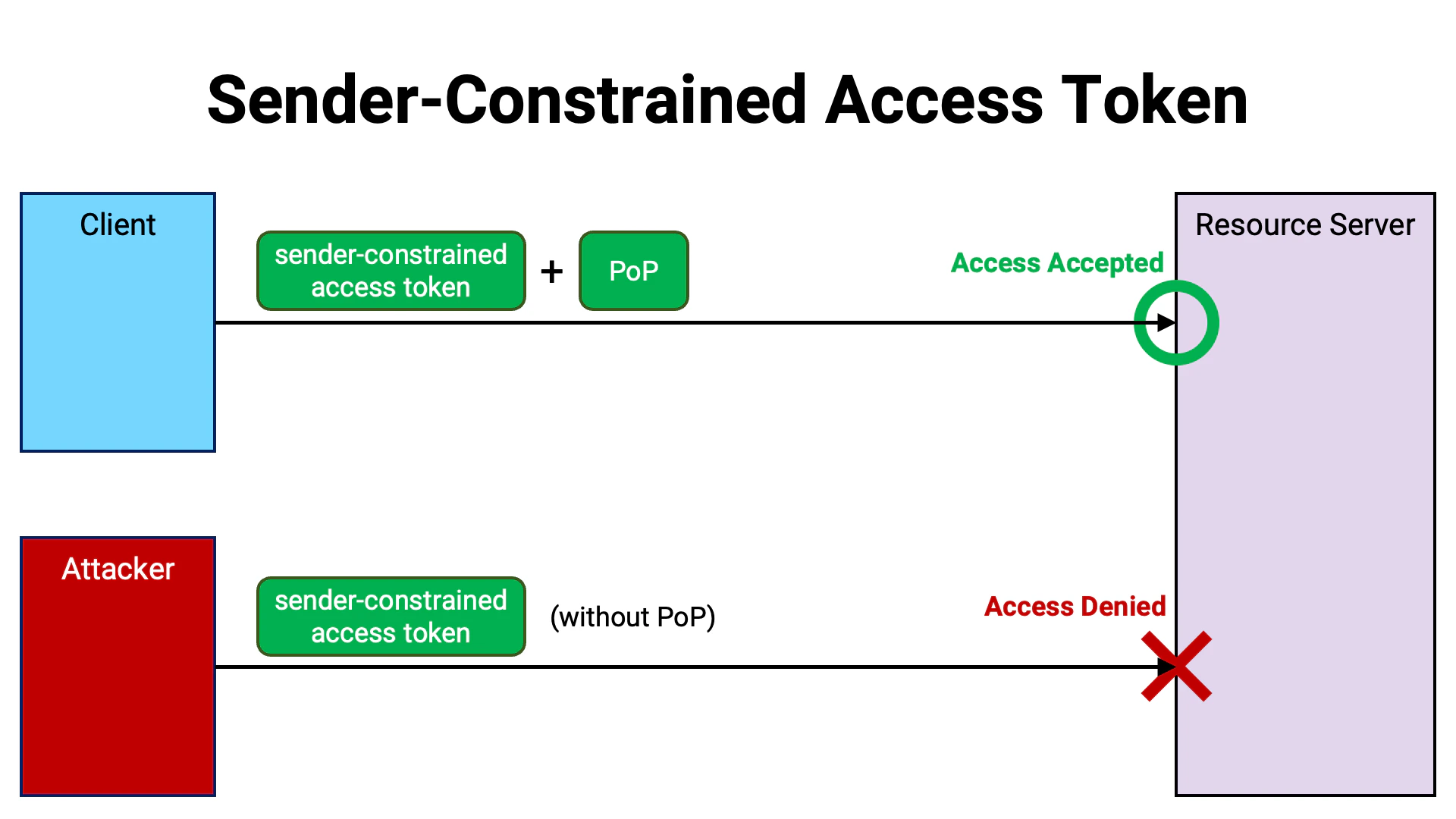
MTLS
RFC 8705 Section 3 defines a method (hereafter referred to as MTLS) for implementing PoP using an X.509 certificate (RFC 5280) of the client application (hereafter referred to as the client certificate).For information on X.509 certificates, please refer to the explanation in
“Illustrated
X.509 Certificate”.
Mutual TLS Connection
When using MTLS, it is a prerequisite that the TLS connection between the client application and the authorization server’s token endpoint, as well as the TLS connection between the client application and the resource server’s API, are mutual TLS connections. In addition, the client application is required to present the same certificate in both of these TLS connections.
By definition of the protocol, a client will not present a client certificate
during the establishment of a TLS connection unless requested by the server.
In other words, the client cannot initiate a mutual TLS connection on its own.
Therefore, to enable a mutual TLS connection, it must be configured on the
server side.
Certificate Binding
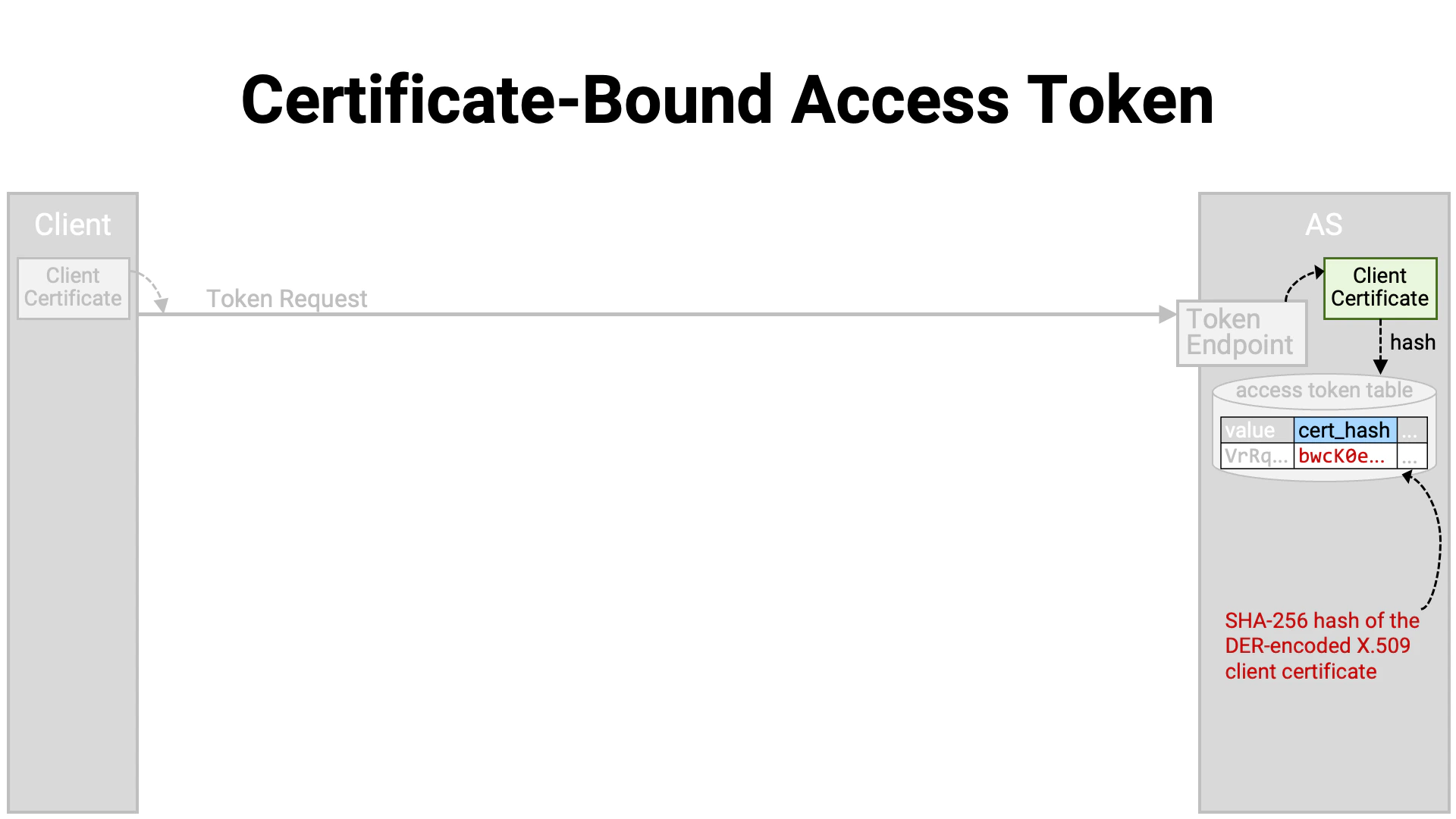
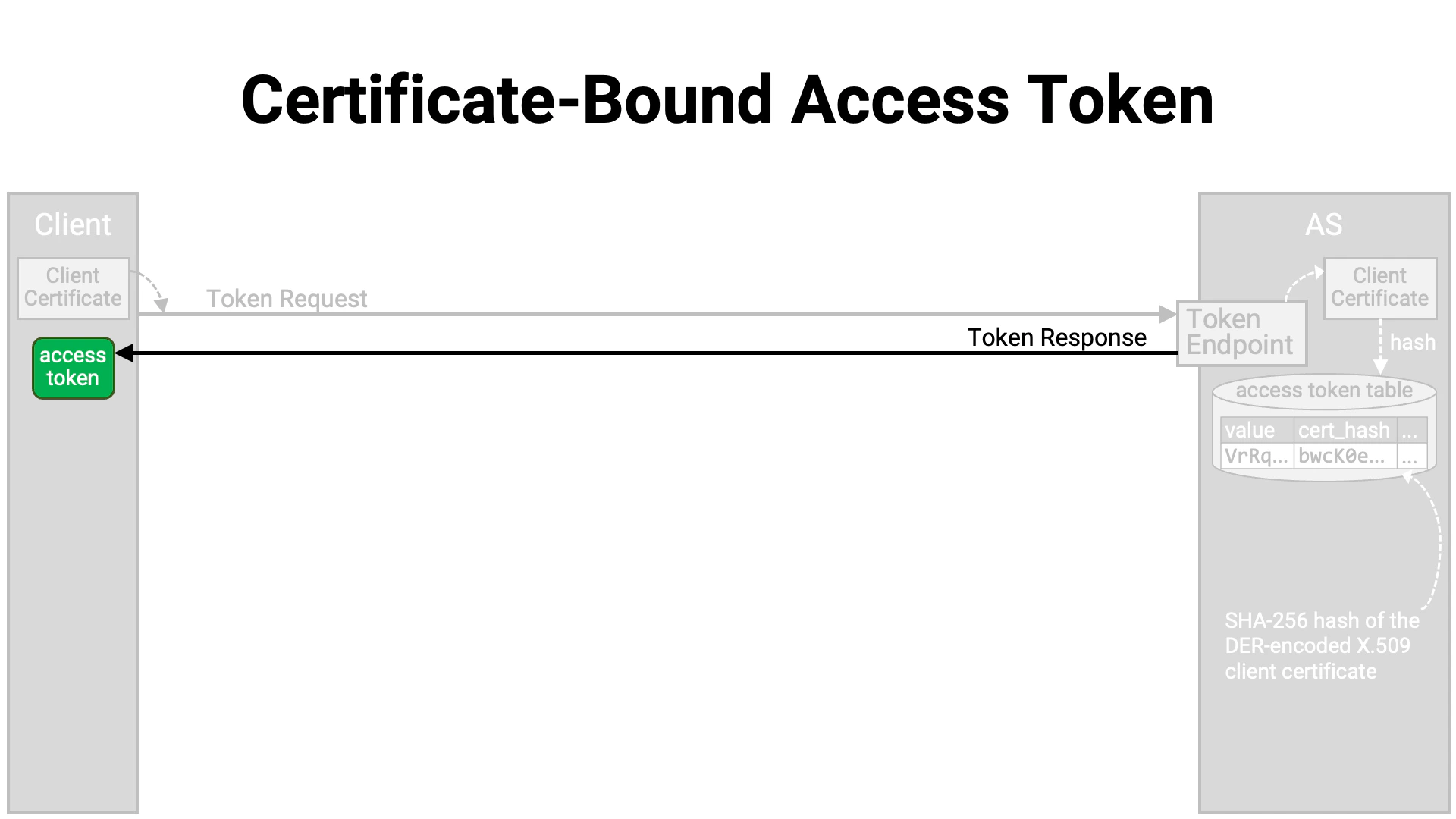
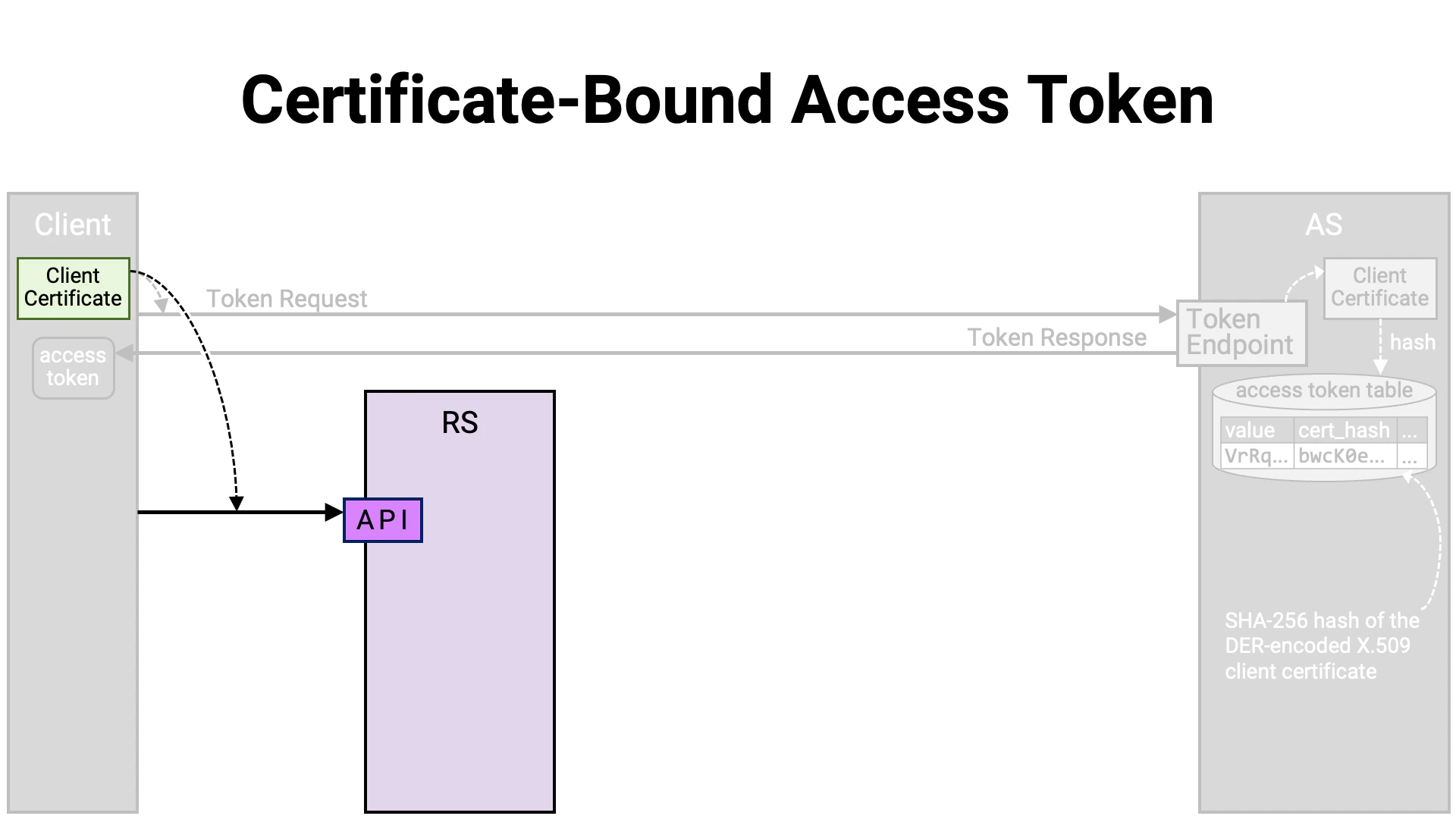
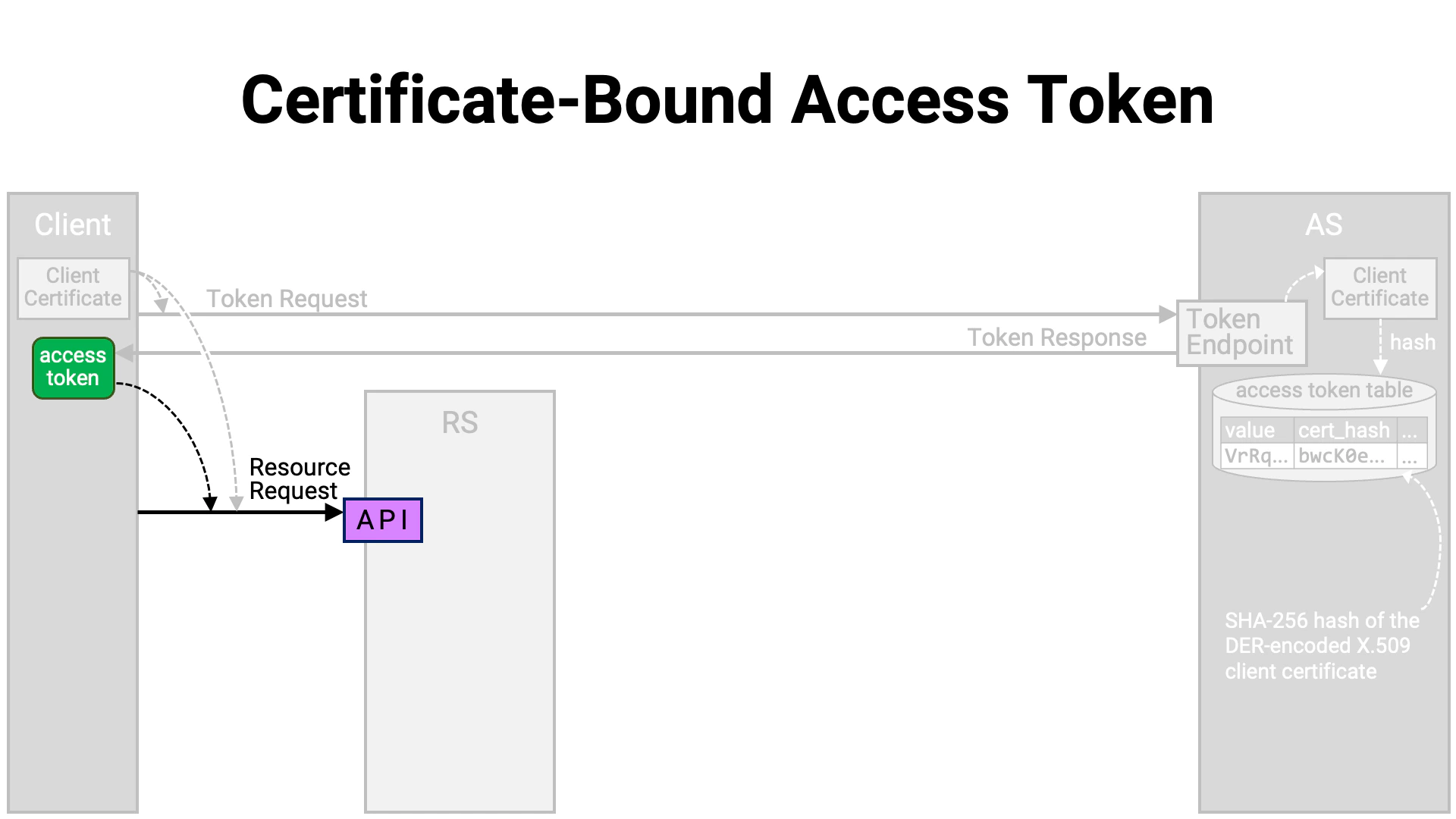
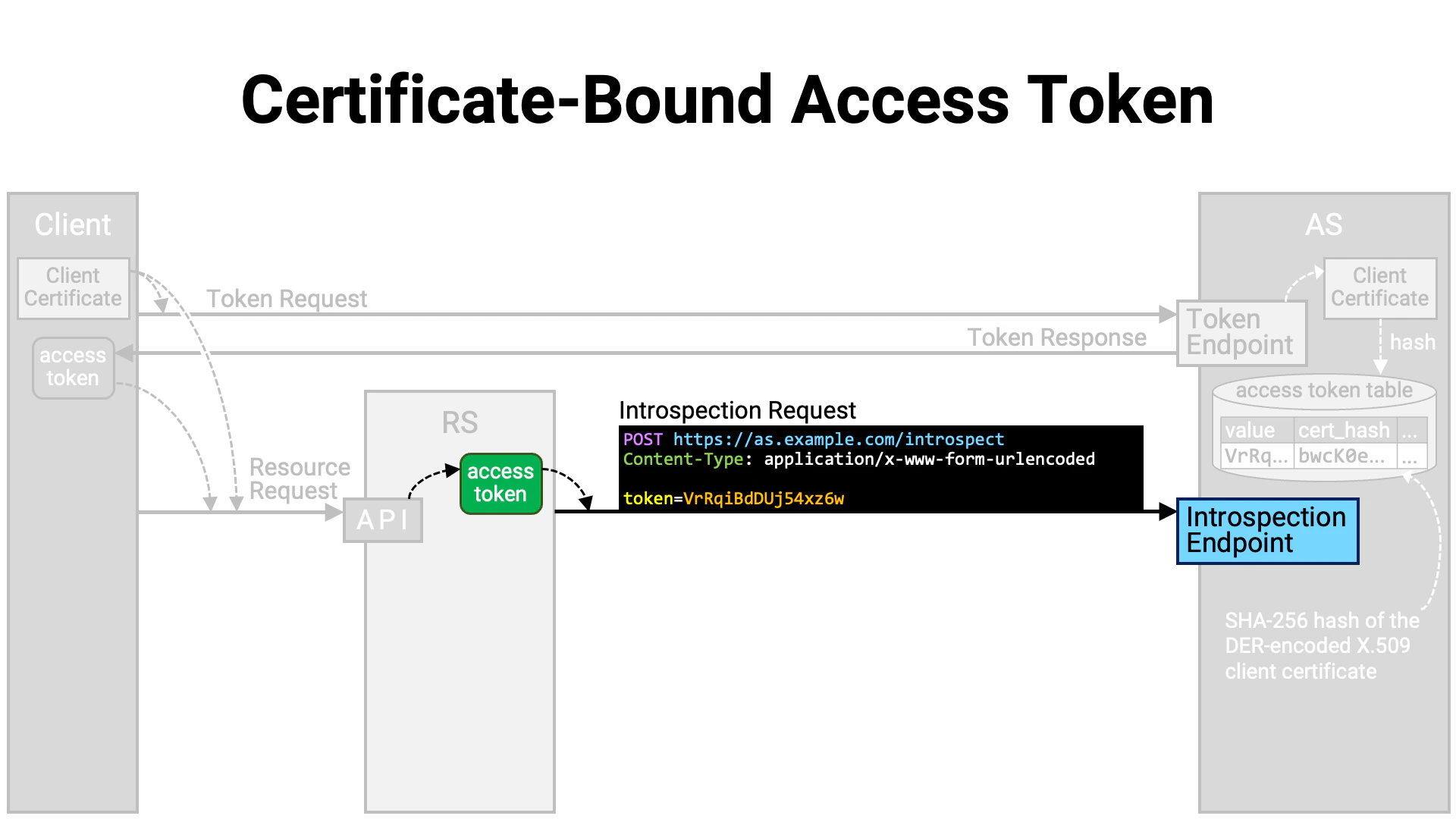
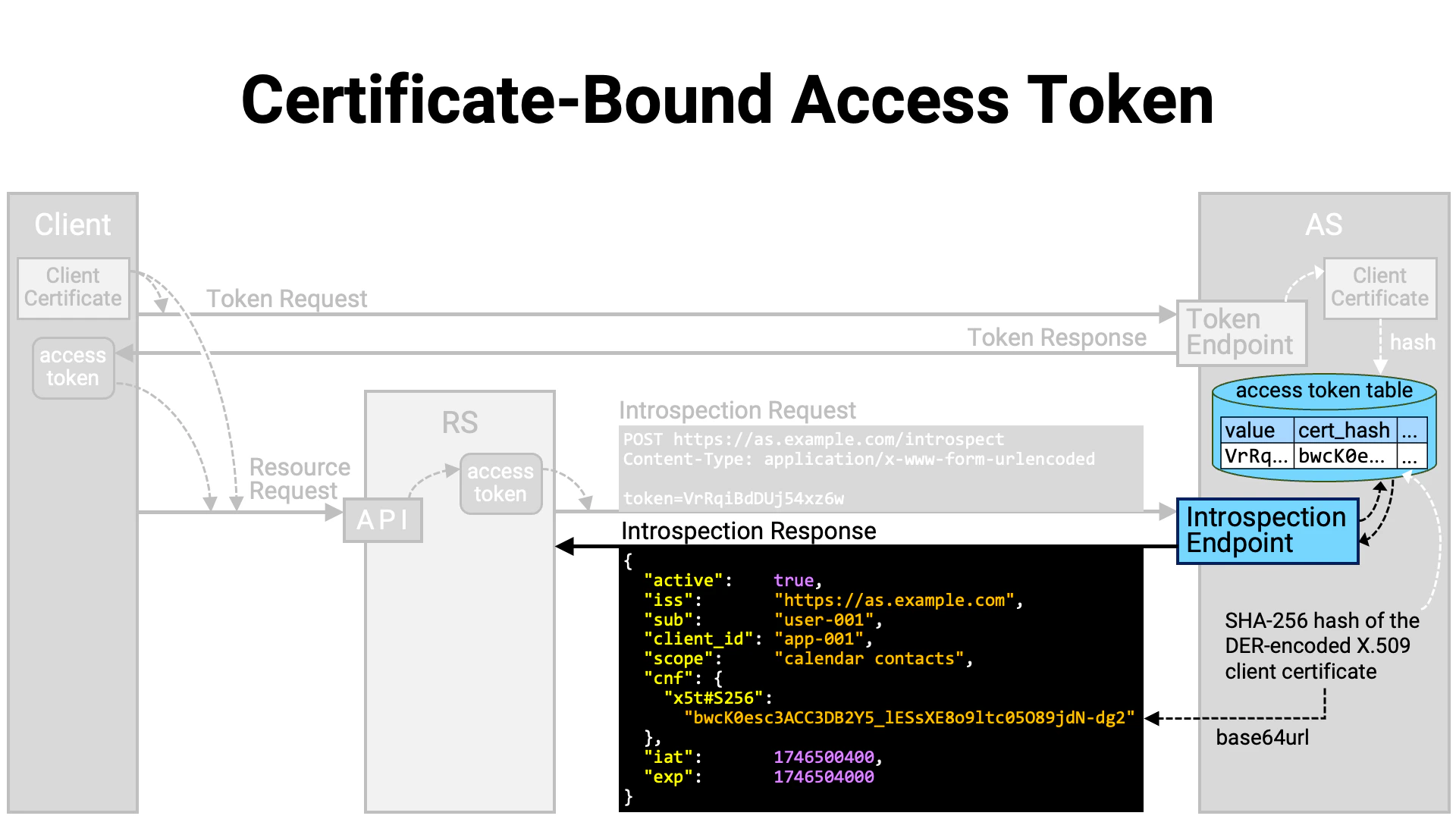
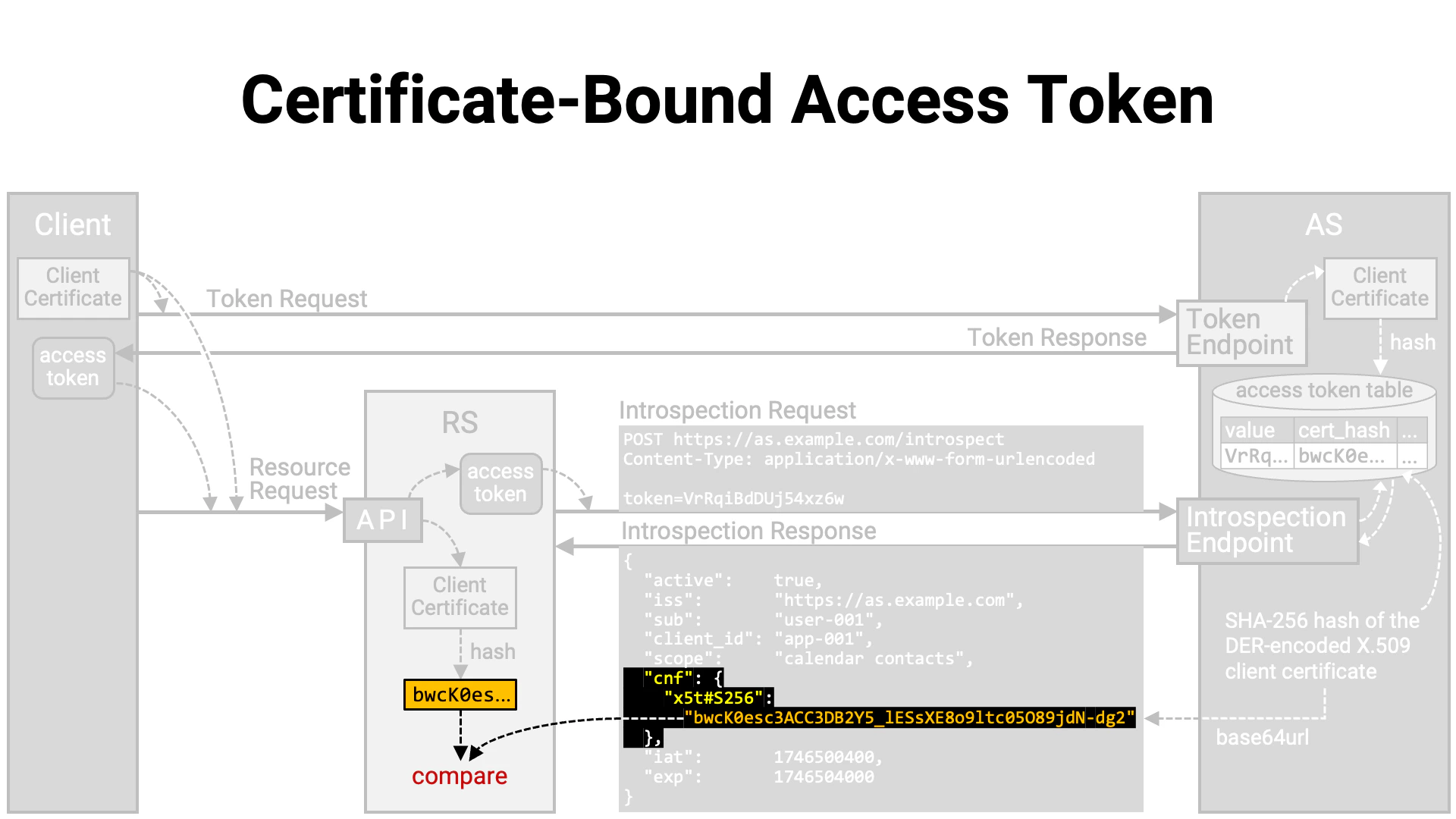
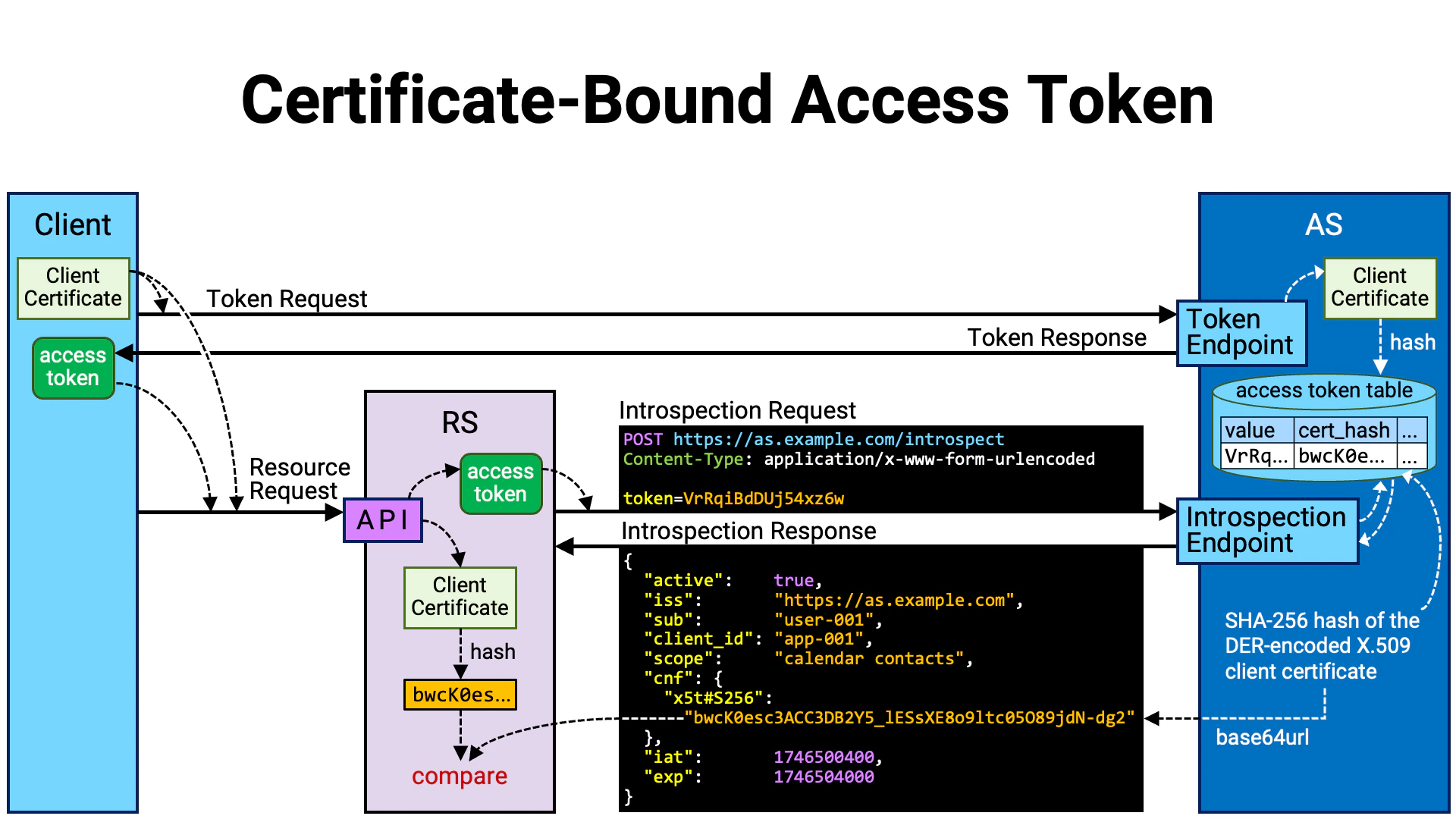
The basic idea behind MTLS is to associate the access token with “the client certificate used in the mutual TLS connection of the token request” and remember it. Later, during a resource request, the server checks whether “the client certificate used in the mutual TLS connection of the resource request” is the same as the one associated with the access token included in the request. If they match, the client application making the resource request is considered to be the same as the one that made the token request. If they do not match, the client application making the resource request is deemed not to be the legitimate holder of the access token, and the resource request is rejected. Now, let’s walk through the procedure by which a sender-constrained access token is achieved using MTLS. The client application establishes a mutual TLS connection with the authorization server’s token endpoint and sends a token request. Since it is a mutual TLS connection, the client presents its client certificate to the server.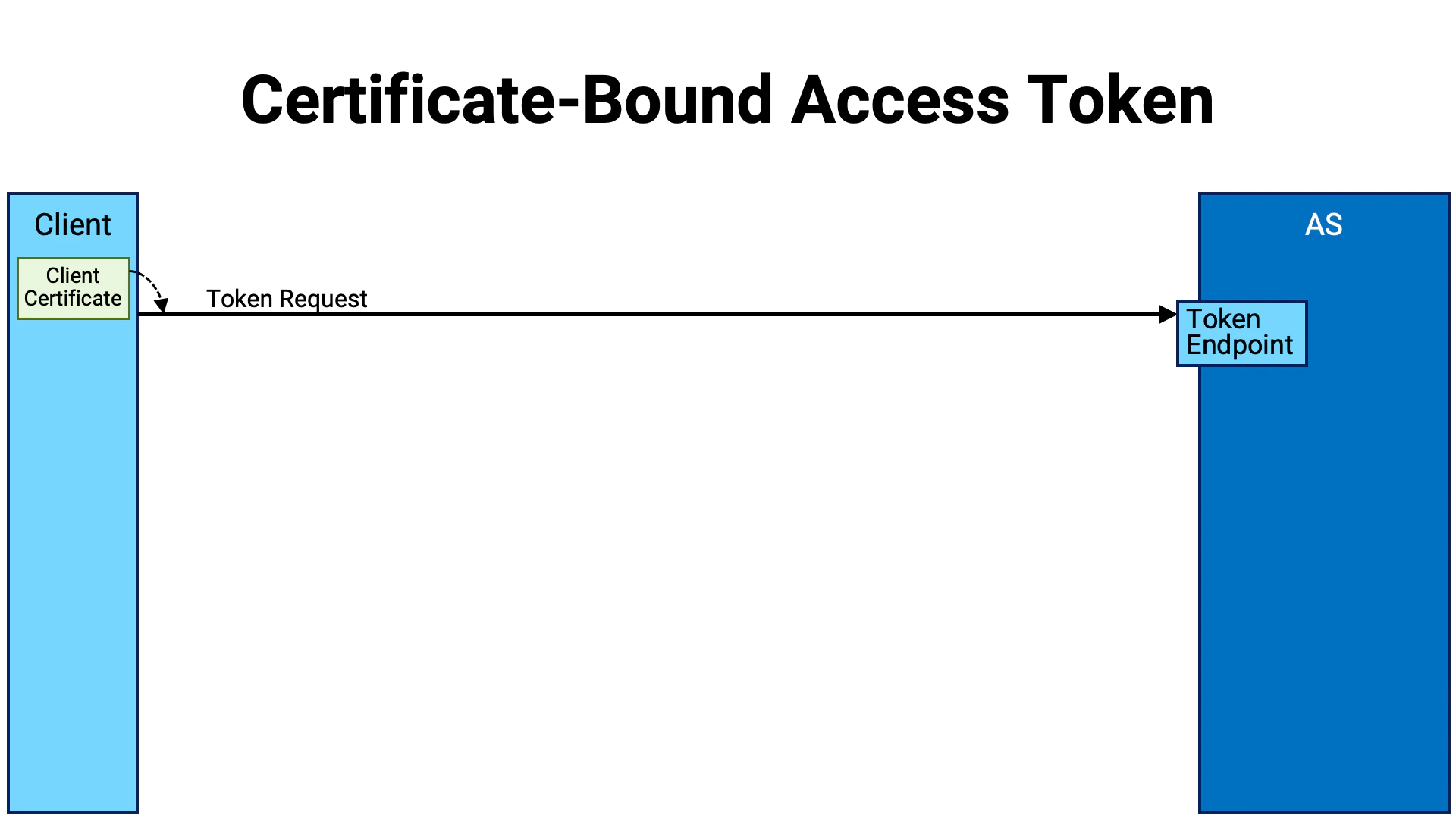
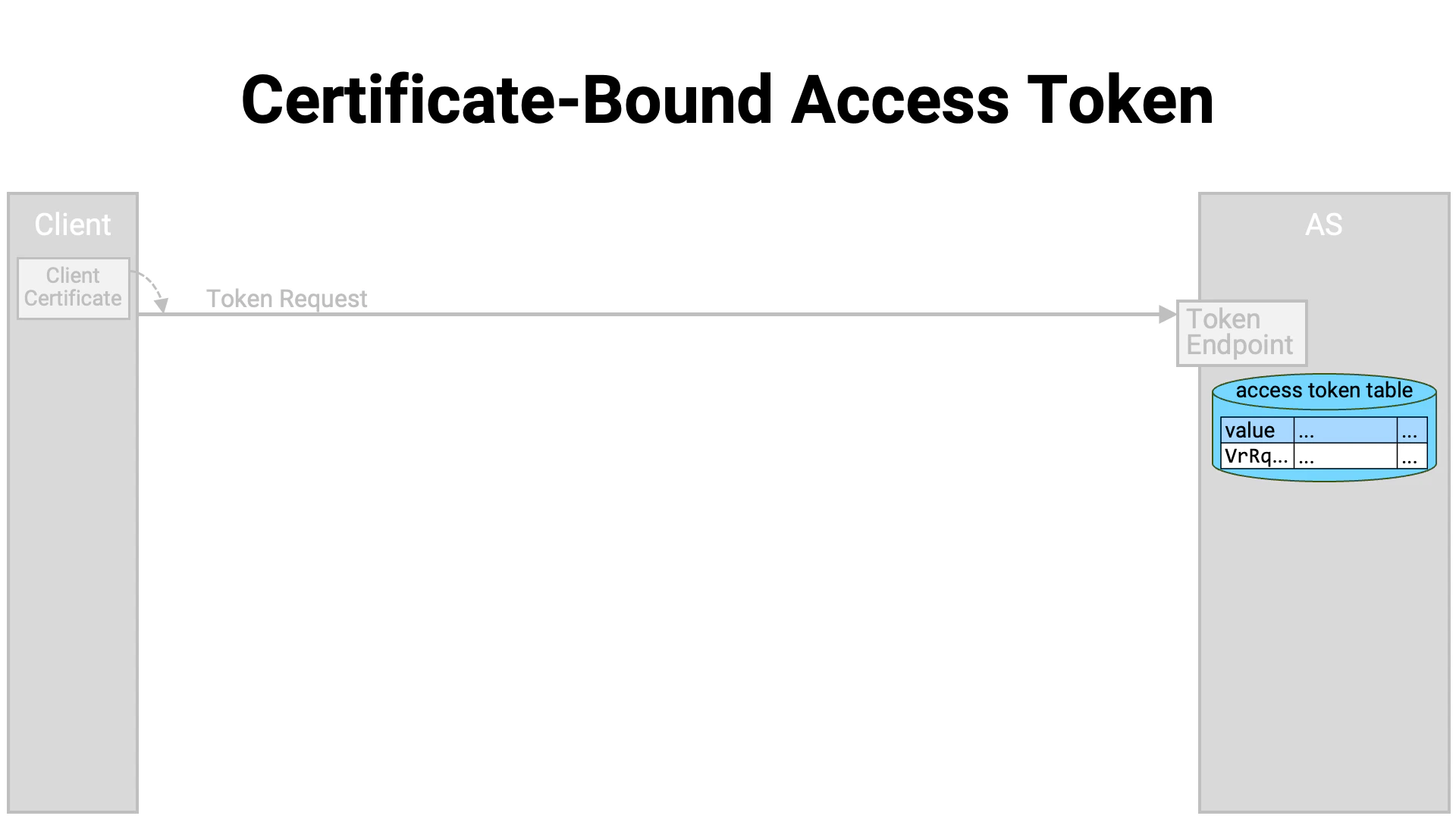
x5t#S256 sub-property within the top-level cnf property.
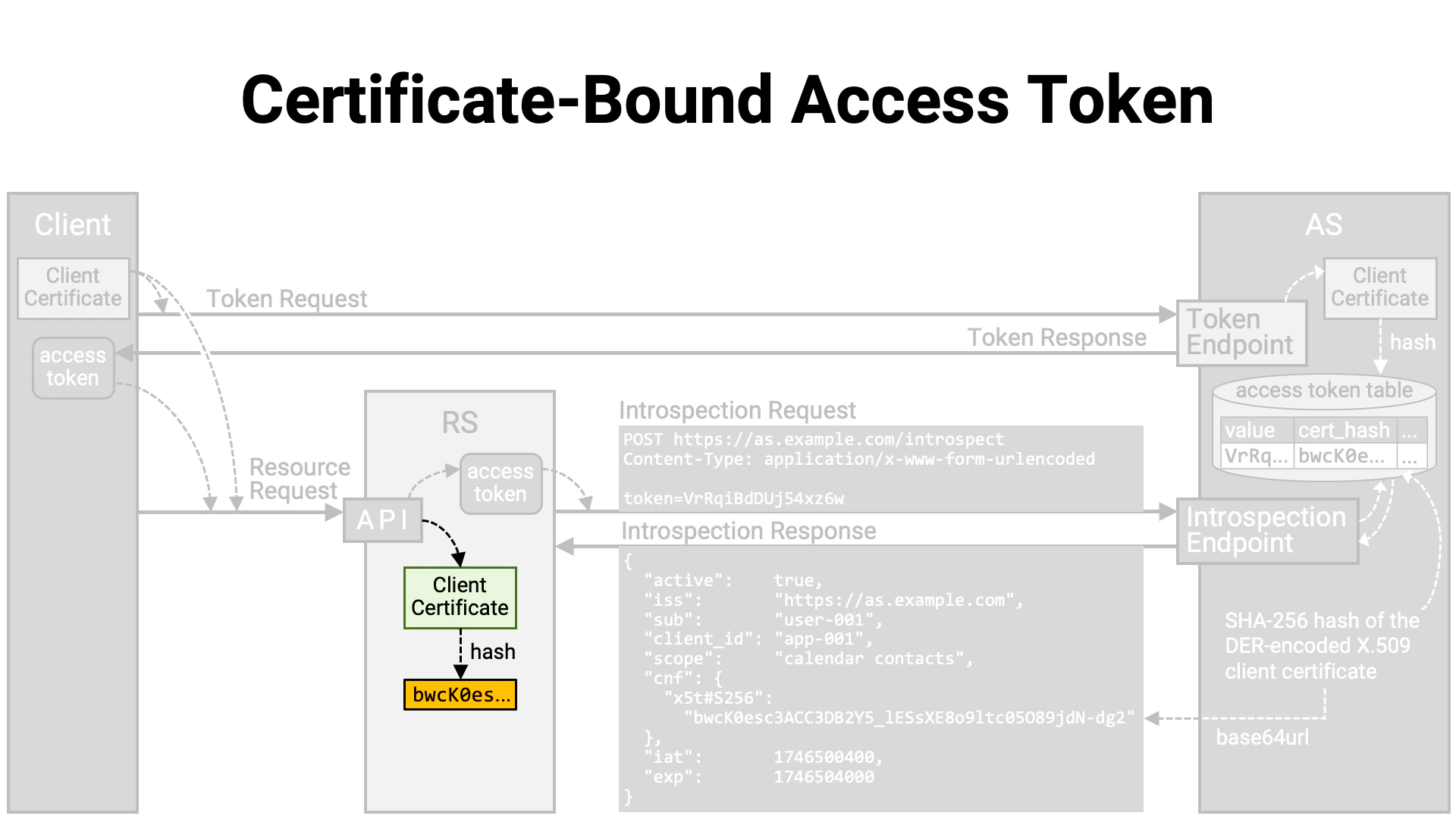
Next, the API implementation extracts the client certificate from the mutual
TLS connection with the client application and computes its hash value.
Client Certificate Forwarding
When deploying a TLS-protected application server, it is common to place a reverse proxy between the client and the application server. The reverse proxy handles the TLS connection with the client, terminates it there, and then forwards the client’s requests to the application server sitting behind it. In such a setup, the application server does not establish a TLS connection directly with the client. Therefore, even if the client establishes a mutual TLS connection with the reverse proxy, the application server cannot access the client certificate presented during that connection. If the application server’s logic needs to refer to the client certificate (for example, to generate or validate a certificate-bound access token), the certificate must somehow be forwarded from the reverse proxy to the application server.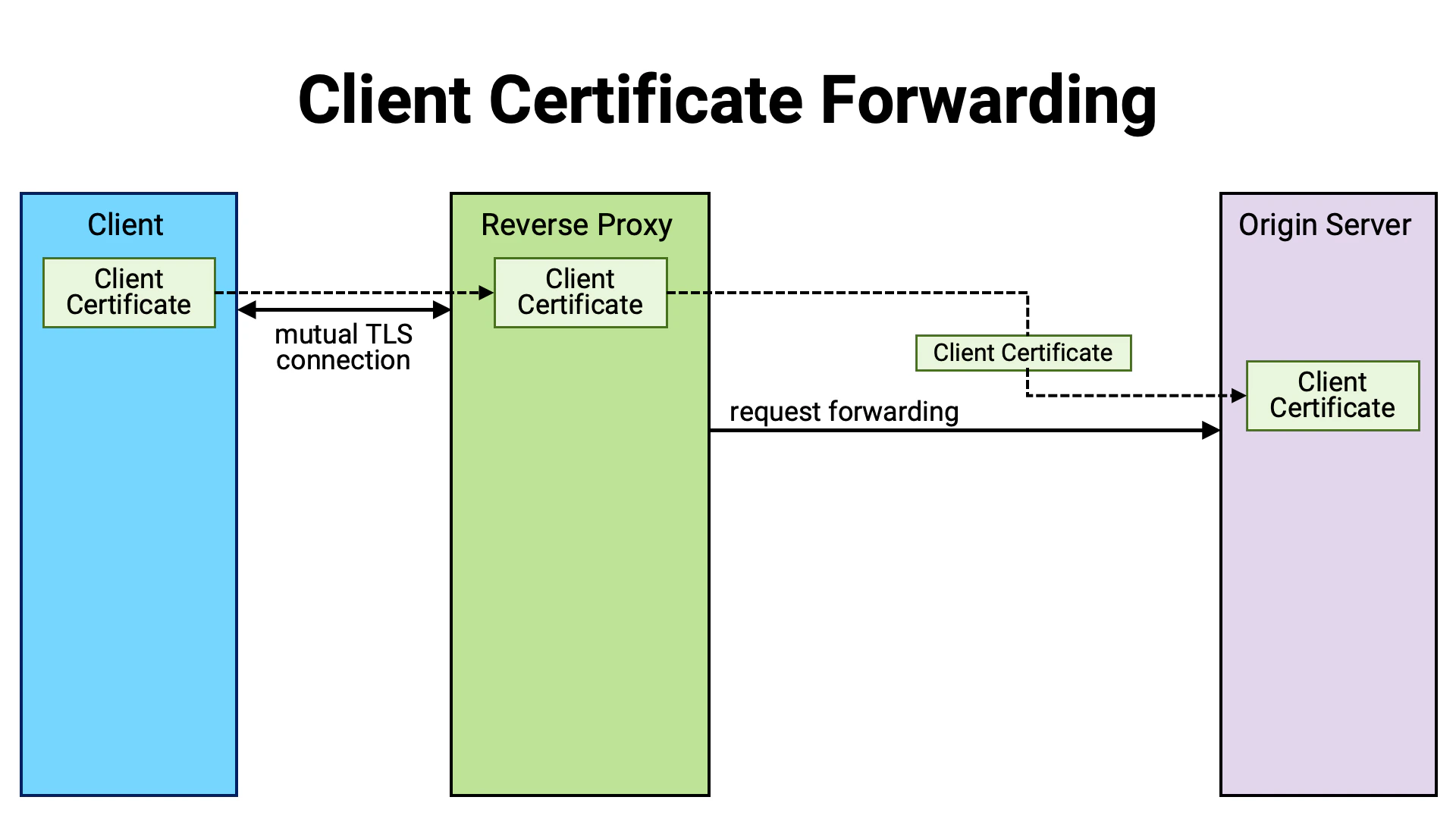
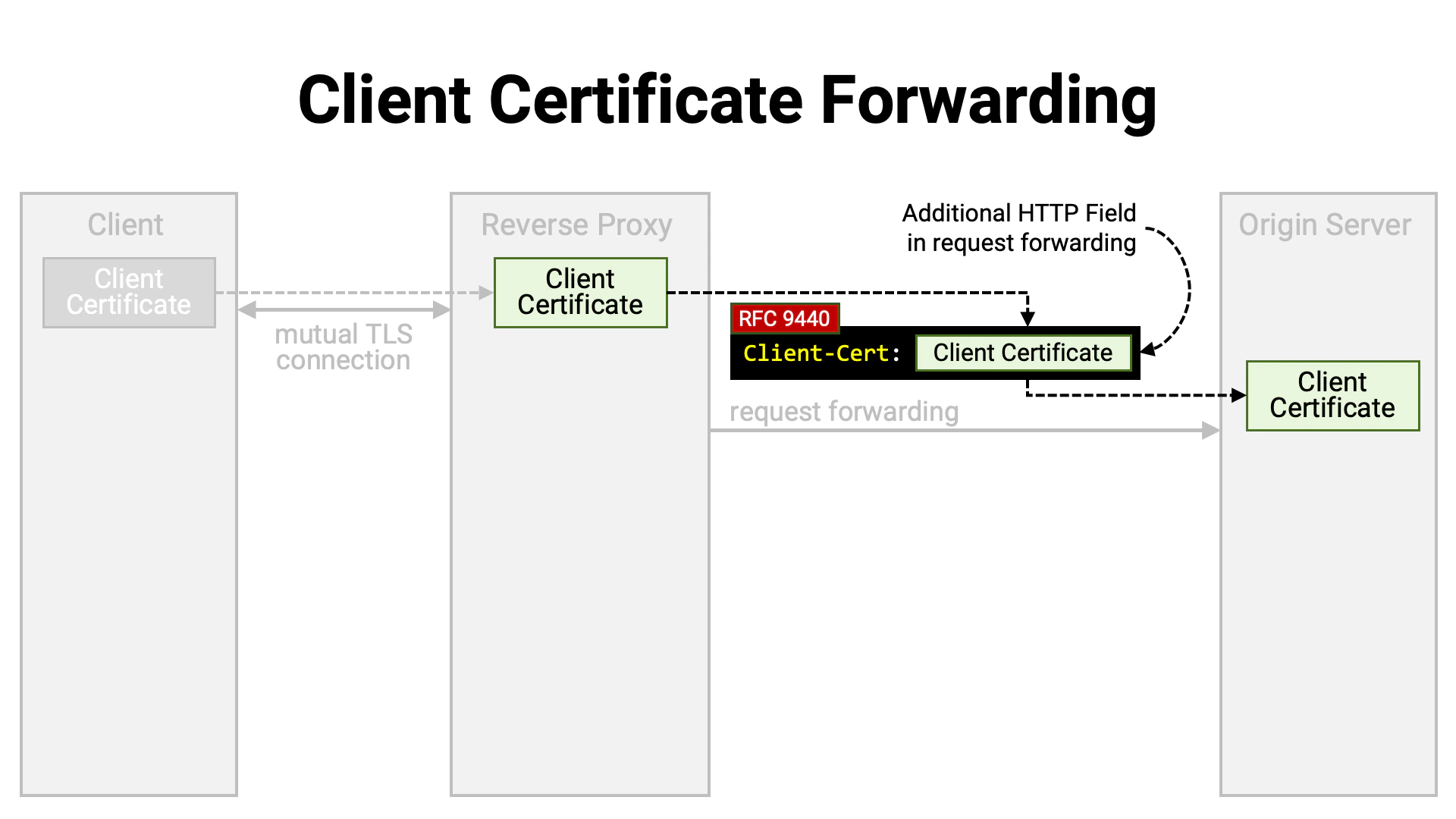
X-Ssl-Cert)—to the forwarded request. RFC 9440 defines and
standardizes the use of Client-Cert as the name of this HTTP header.
BEGIN / END boundaries were
included—resulting in low interoperability. RFC 9440 specifies the
format as “a byte sequence (RFC 8941 Section 3.3.5)
representing the DER-encoded (X.690) client certificate.”
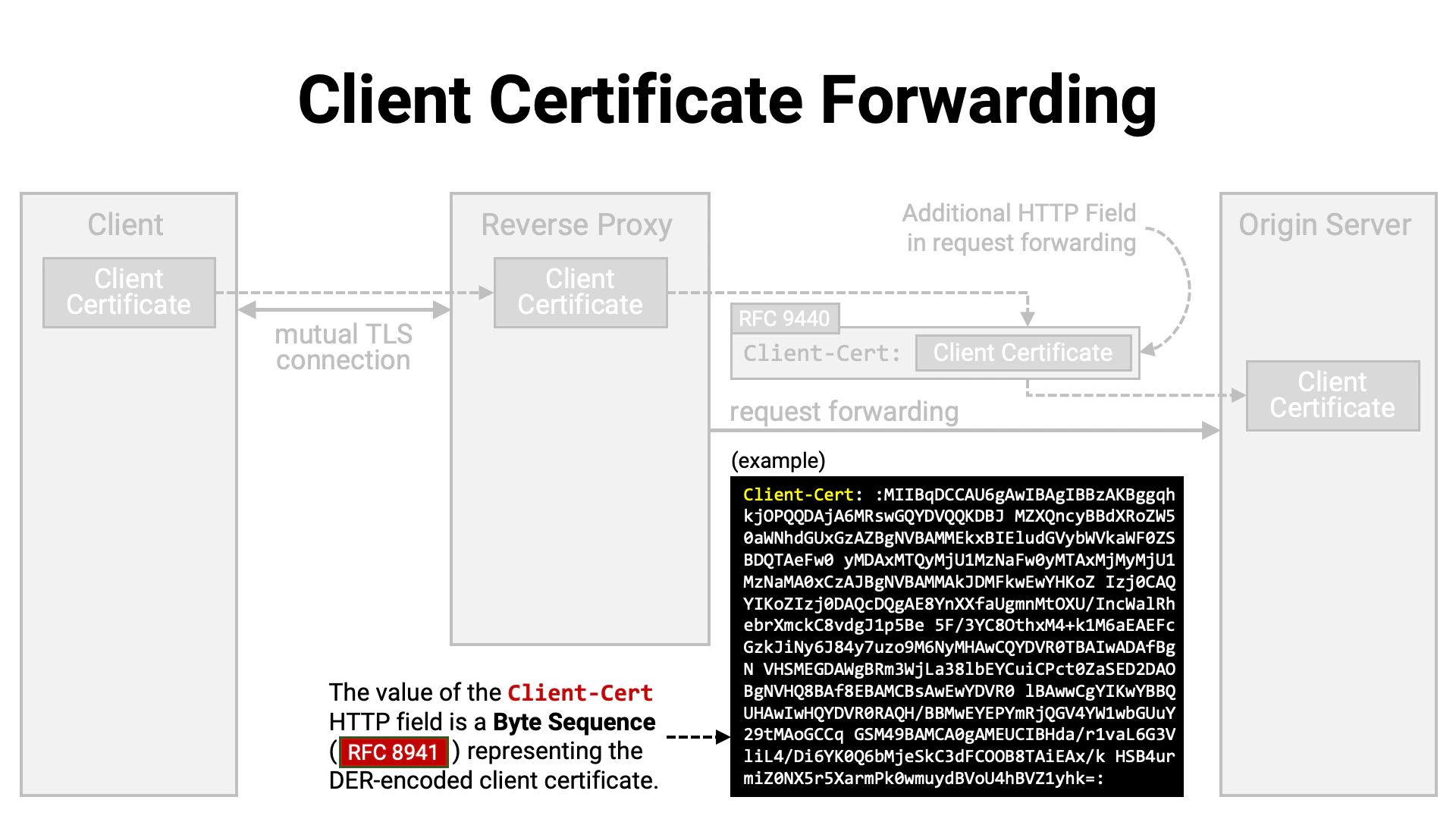
To briefly describe the format of a
Byte Sequence
defined in RFC 8941,
it is expressed as
:{base64}:—the original data is
encoded in Base64 (RFC 4648)
and enclosed by colons (:) on both sides.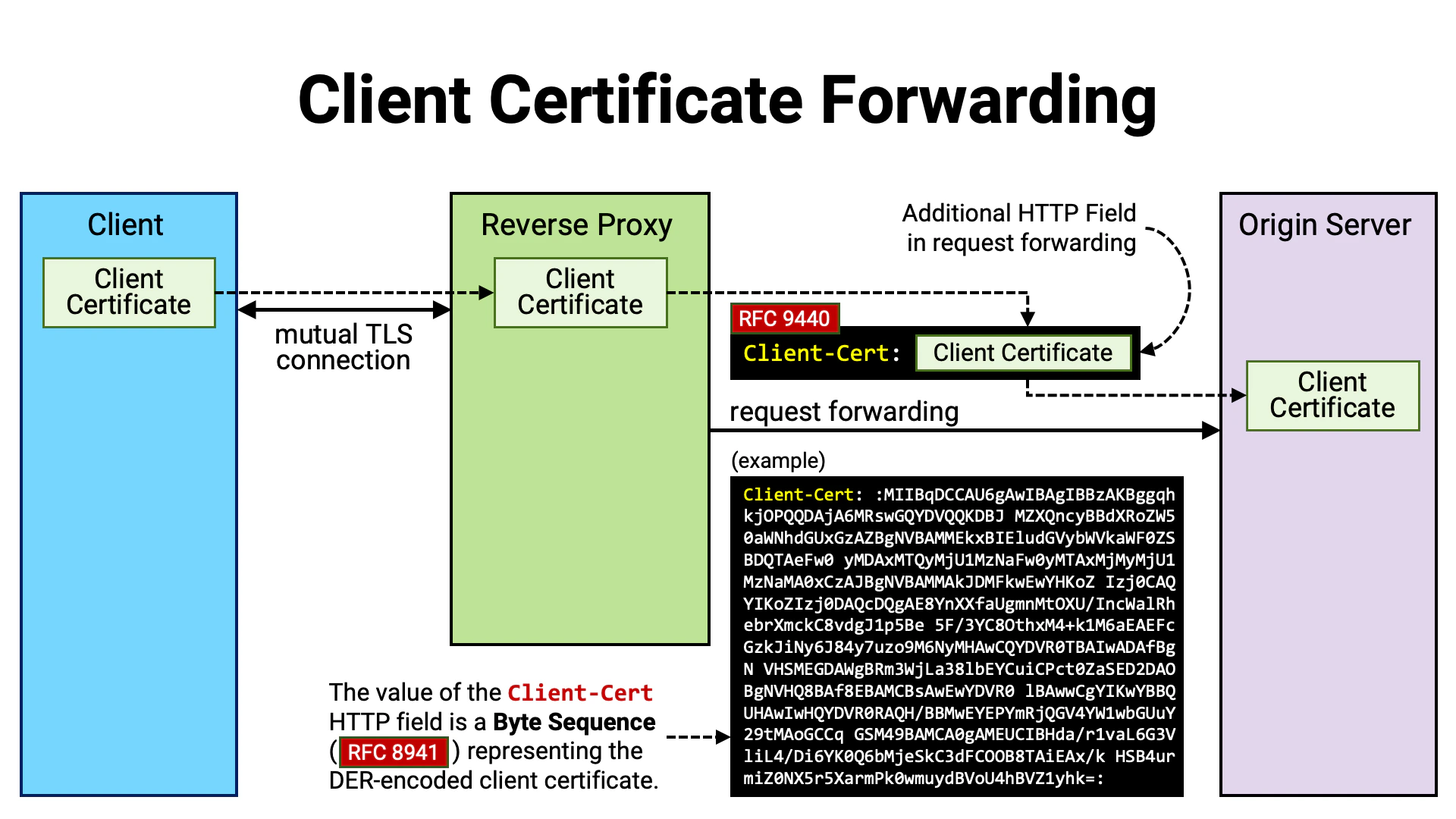
DPoP
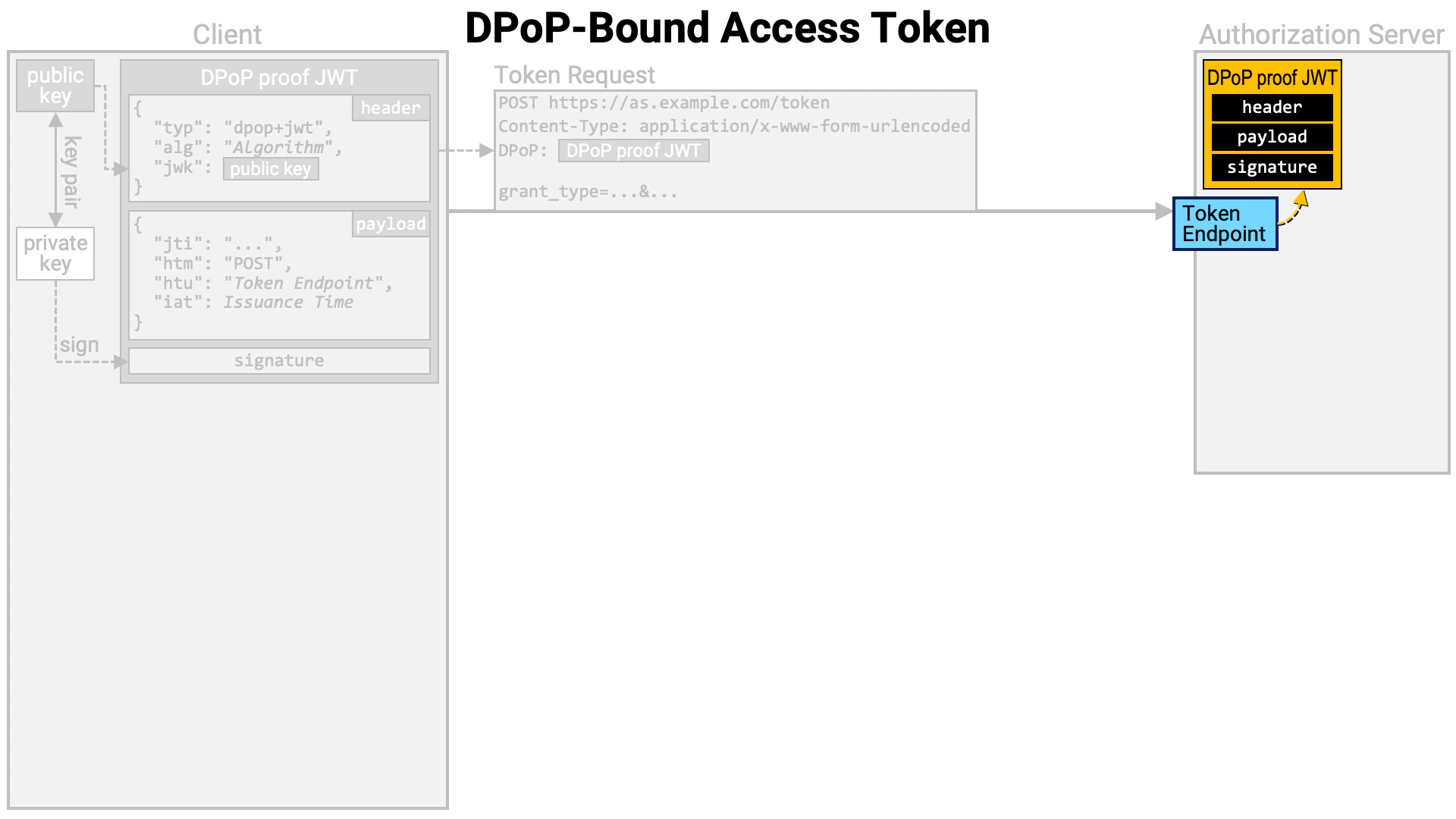
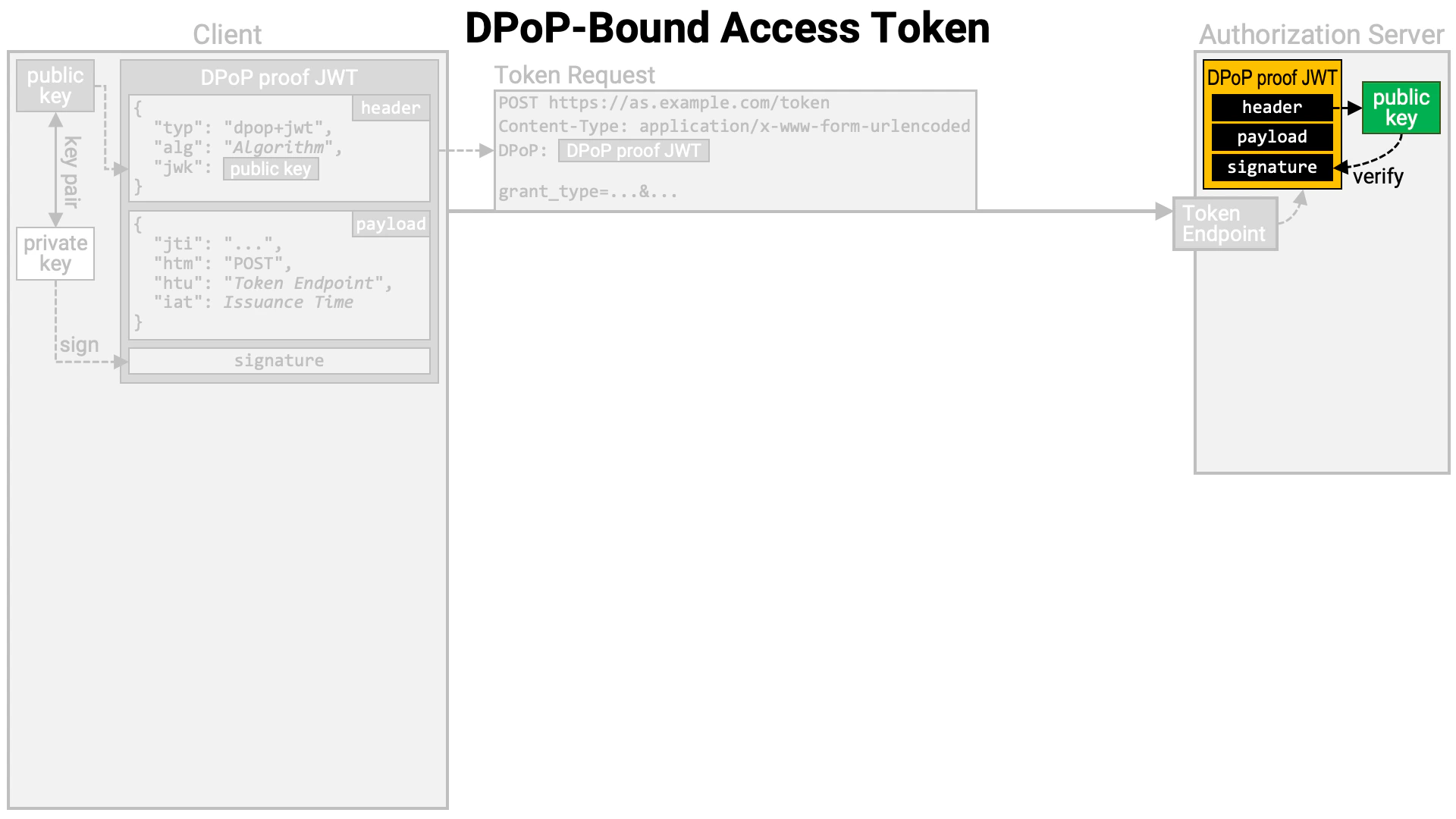
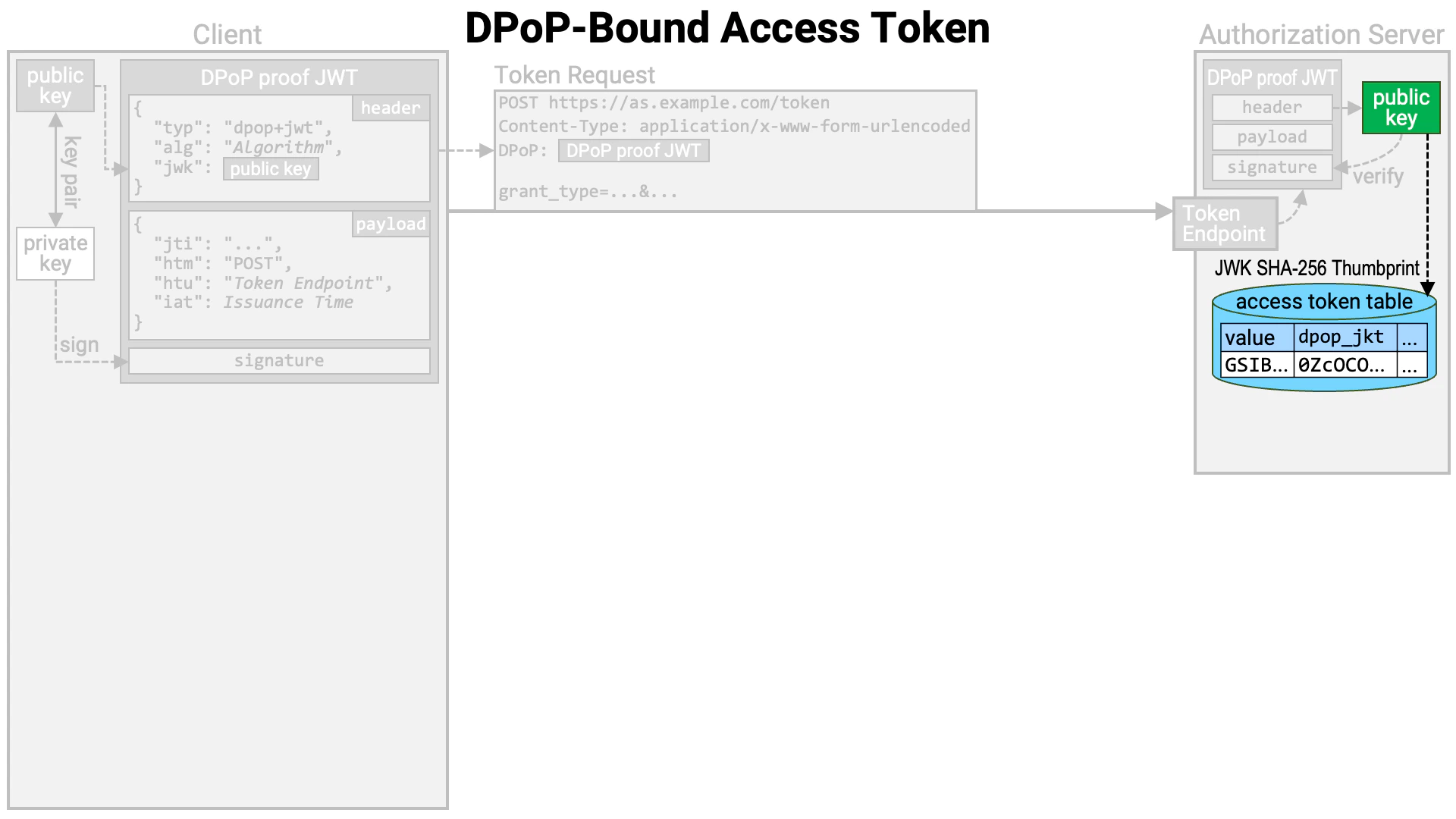
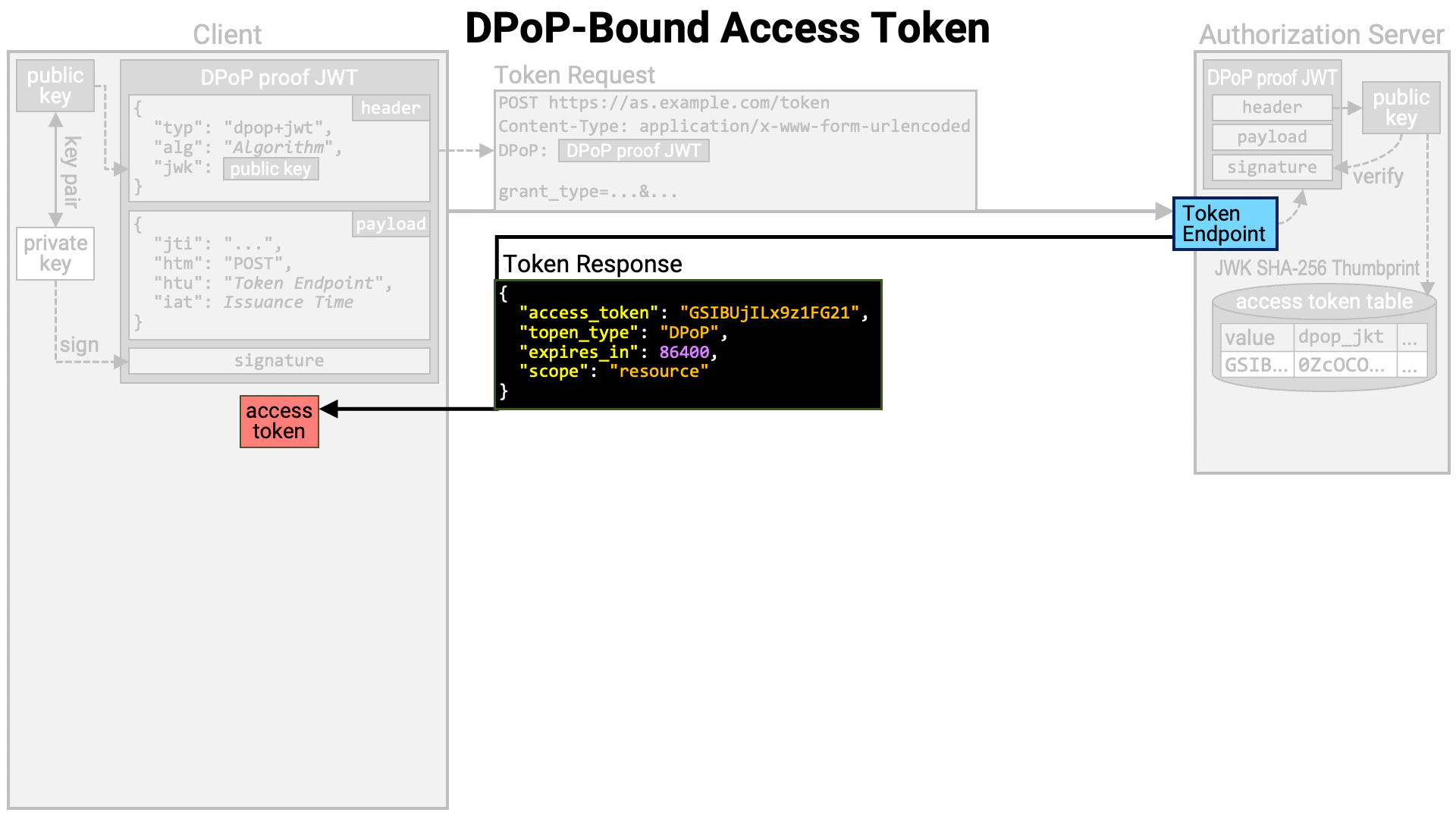
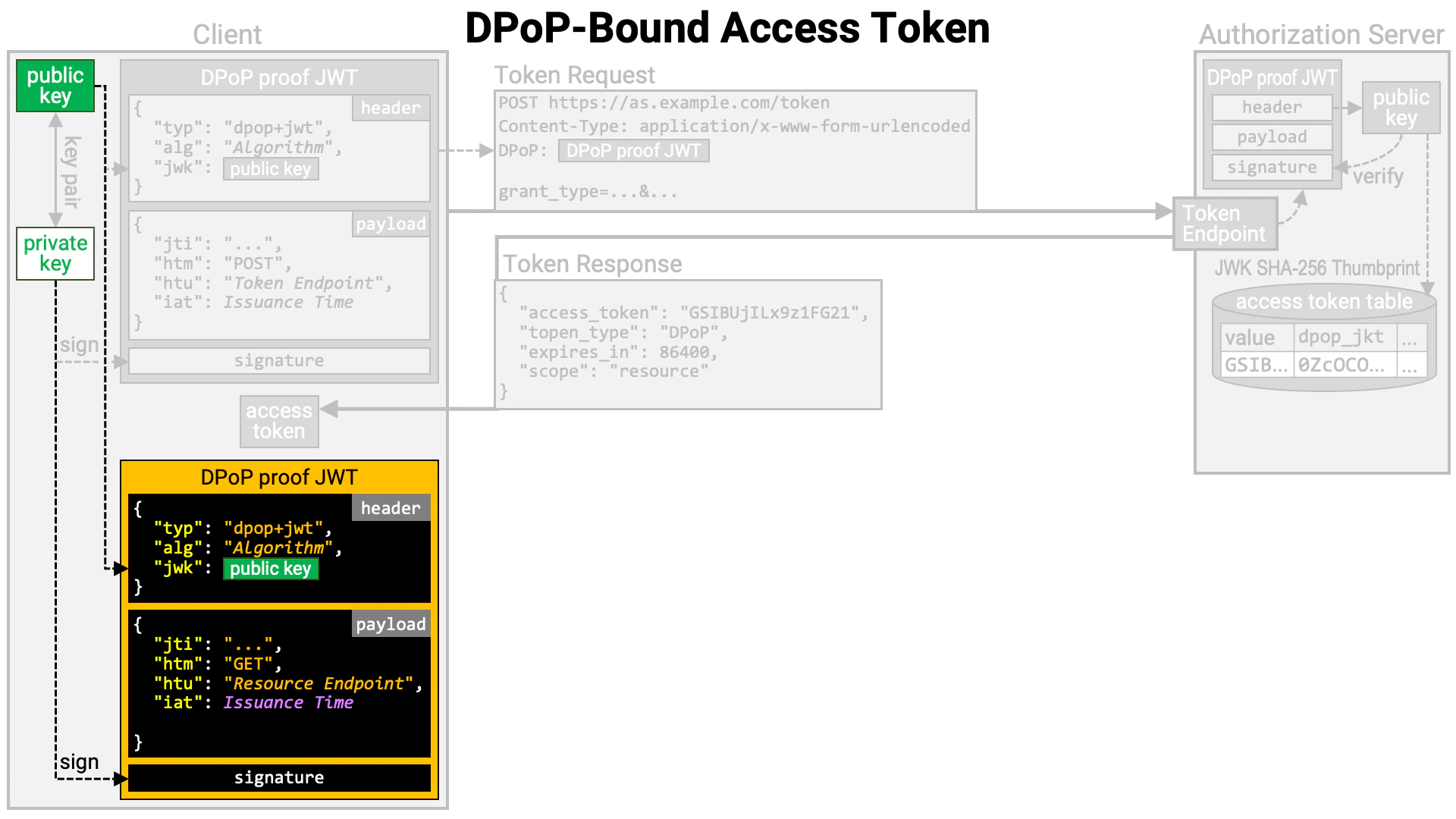
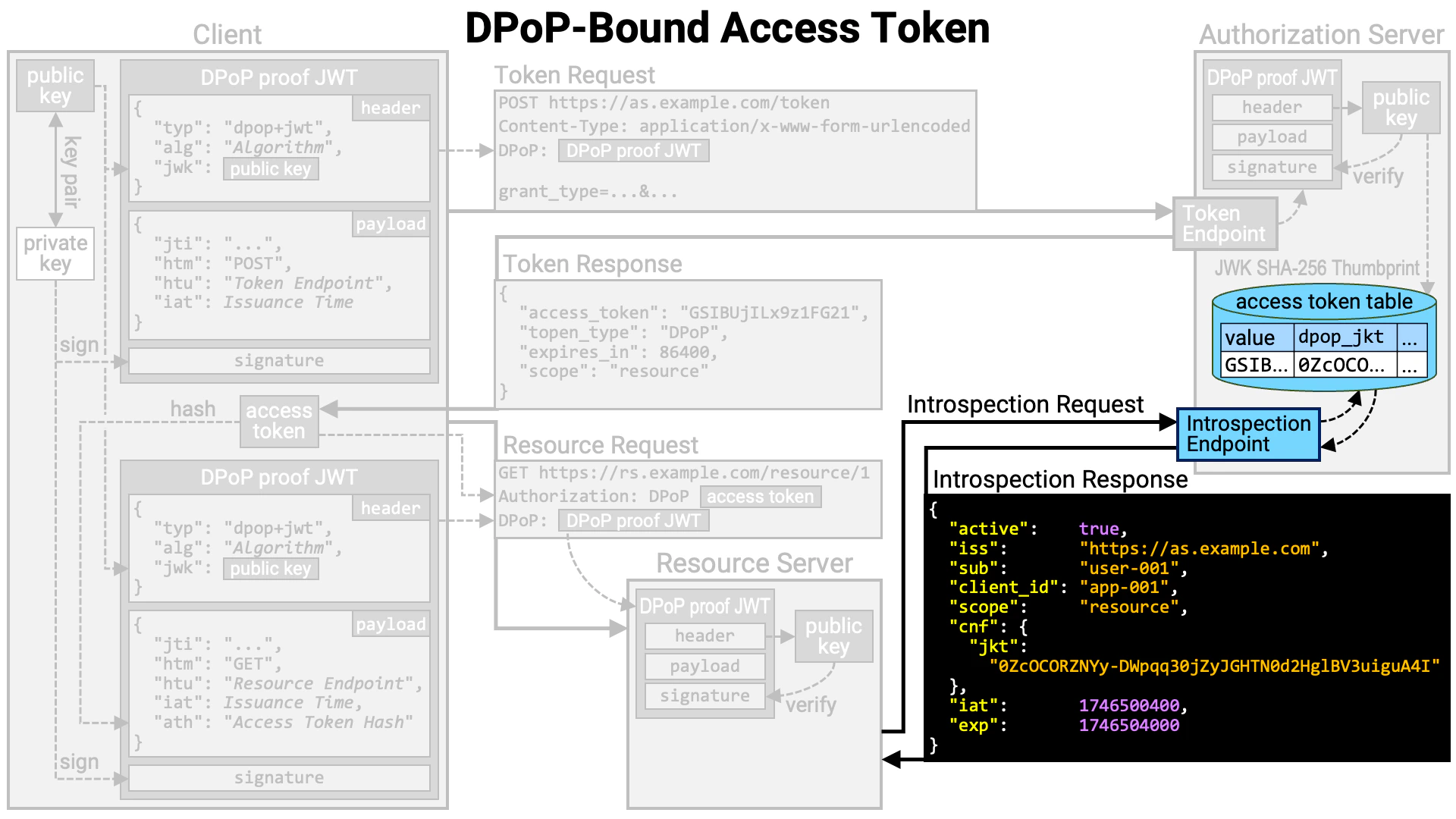
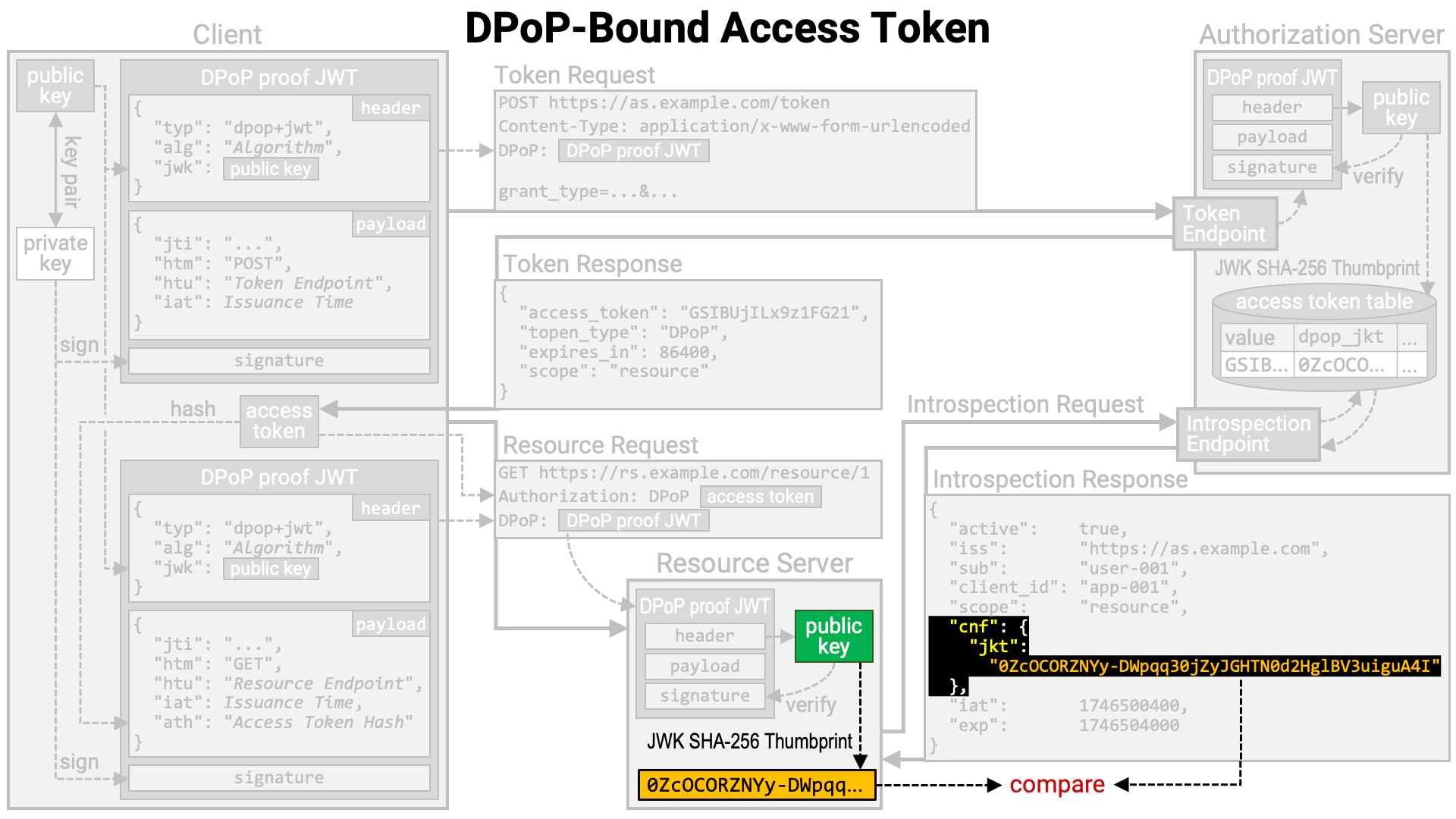
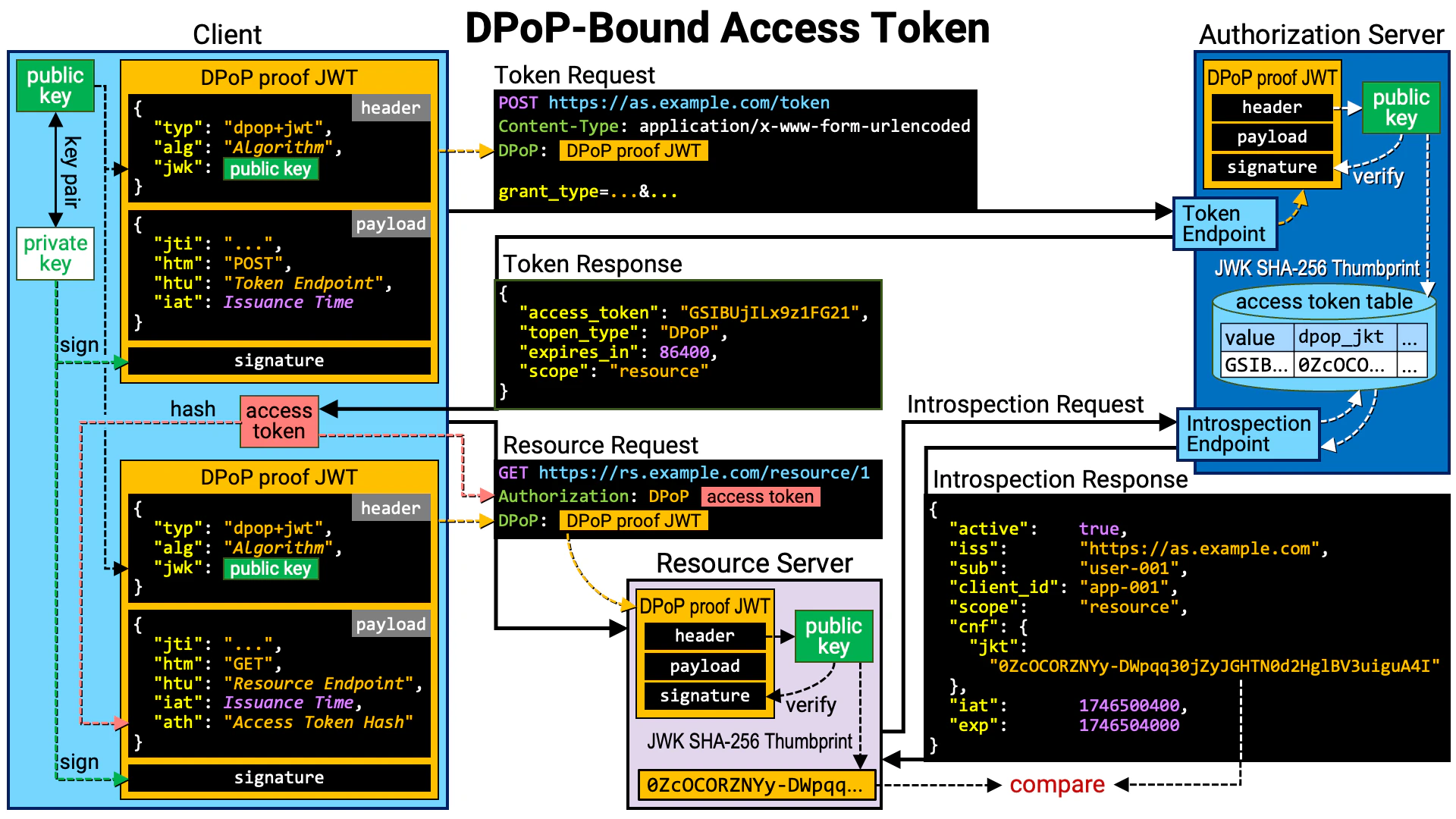
RFC 9449, commonly referred to as DPoP, is one method for implementing sender-constrained access tokens. In DPoP, at the time of access token issuance, the public key from a key pair prepared by the client application is bound to the access token. Then, when the access token is used, the client is also required to present “proof” that it possesses the private key corresponding to the public key bound to the access token, thereby enforcing the sender constraint. This proof is generated by signing data—into which the public key is embedded—with the corresponding private key. In other words, it is a self-signed token. The recipient of the self-signed token extracts the embedded public key and verifies the token’s signature using that public key. If the verification succeeds, it can be concluded that the entity that generated the token possesses the corresponding private key. Let us now take a closer look at the detailed steps of DPoP.DPoP Binding
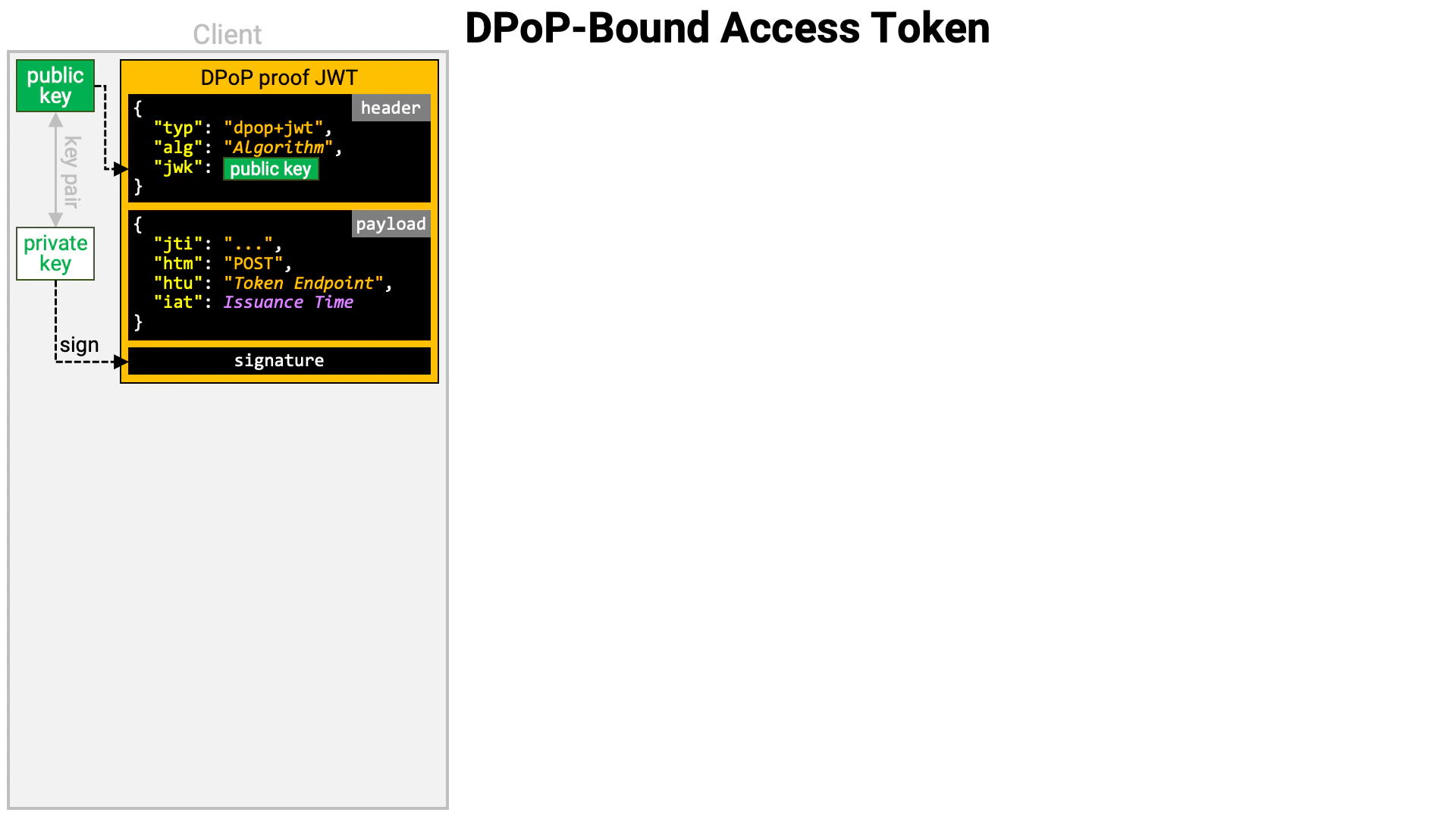
The client application first generates a key pair. The public key of this key pair will be bound to the access token generated in the subsequent process.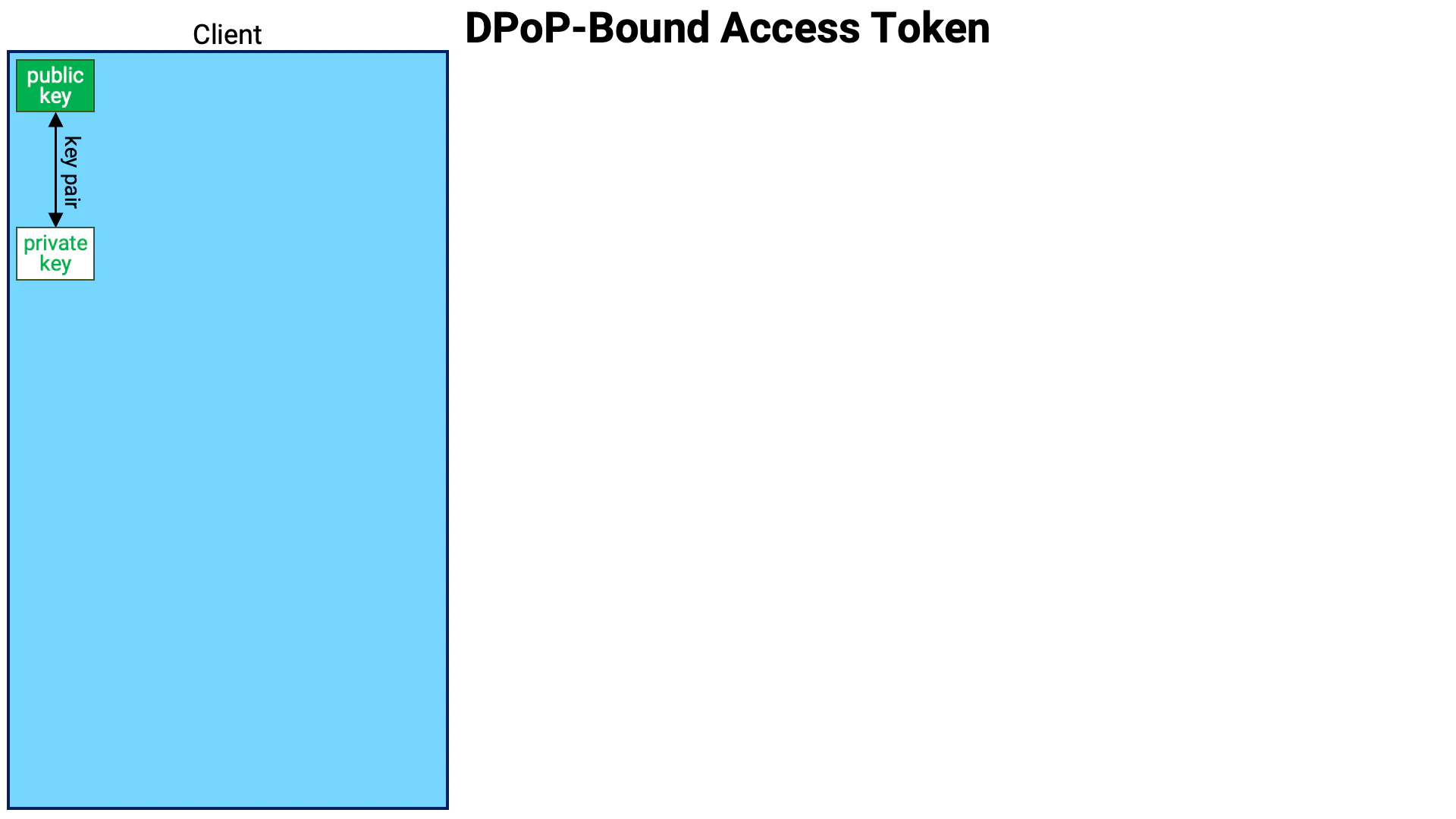
- The format is JWT.
- The
typheader parameter value isdpop+jwt. - The
jwkheader parameter contains the public key to be bound to the access token. - The
htmclaim value is the HTTP method of the request to be sent. - The
htuclaim value is the target URI of the request to be sent (excluding query and fragment parameters). - The
jticlaim andiatclaim are also required. - The proof is signed with the private key that pairs with the public key specified in the
jwkheader parameter.
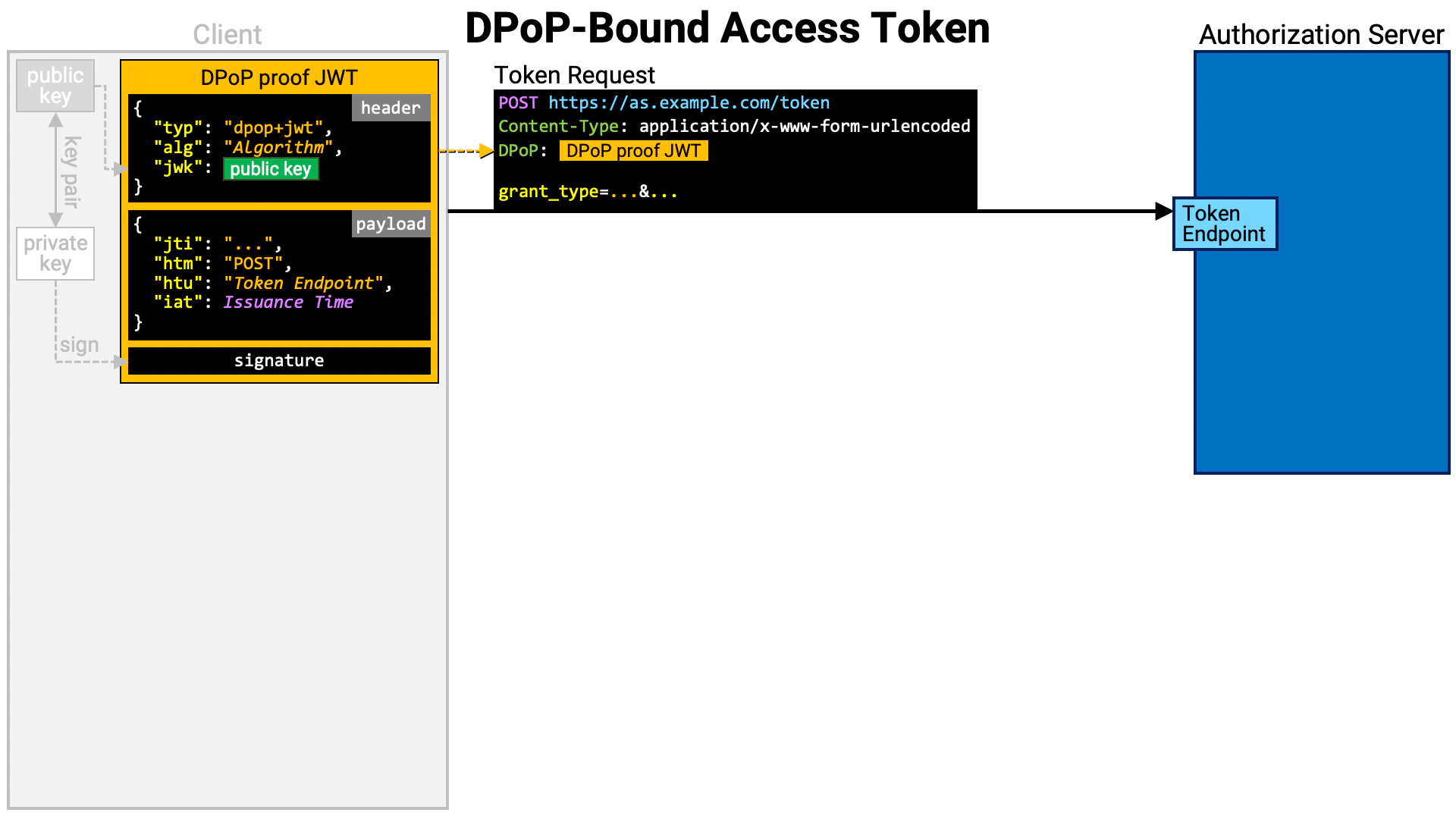
DPoP
header of the request.
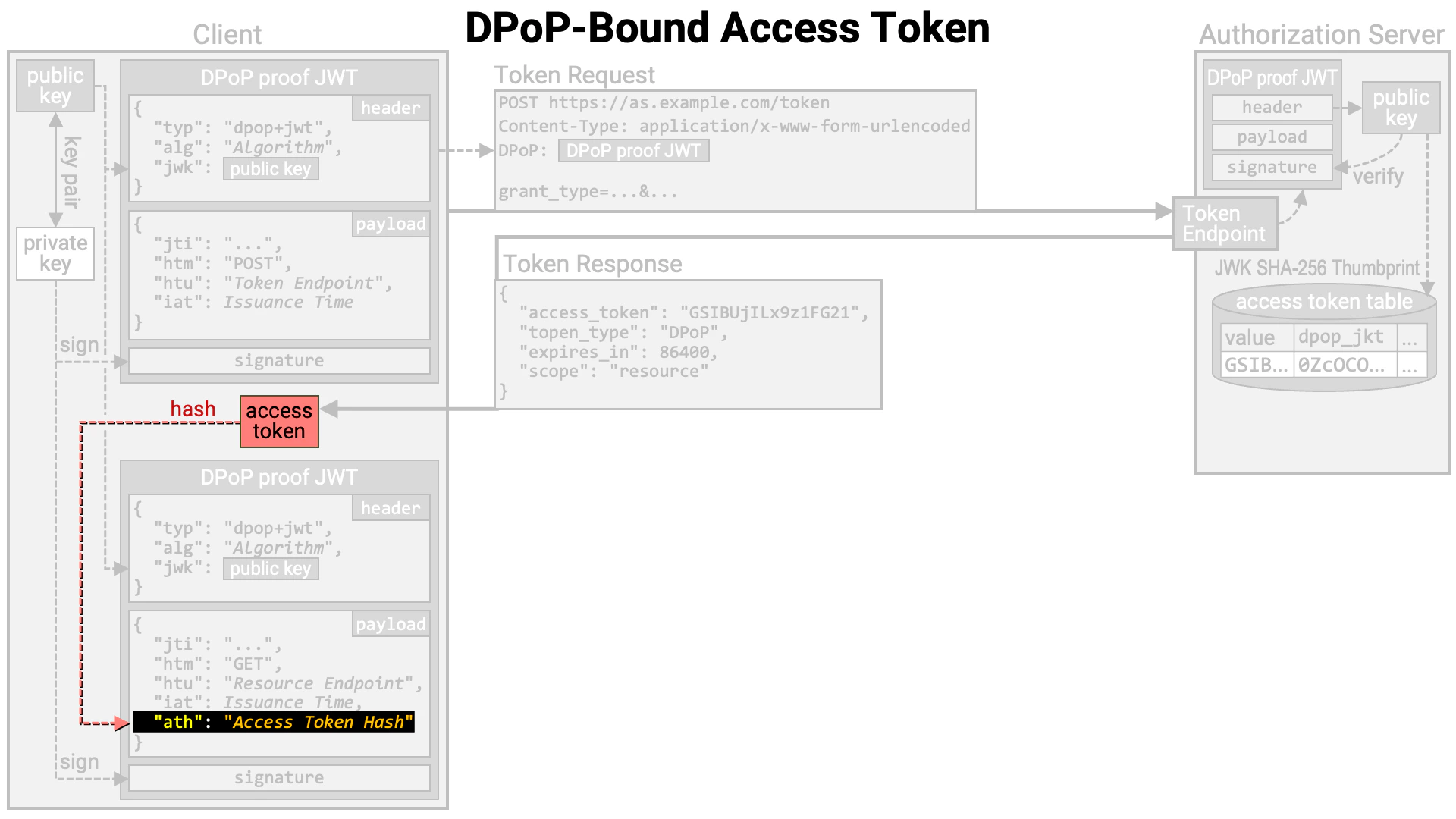
ath claim in the JWT payload.
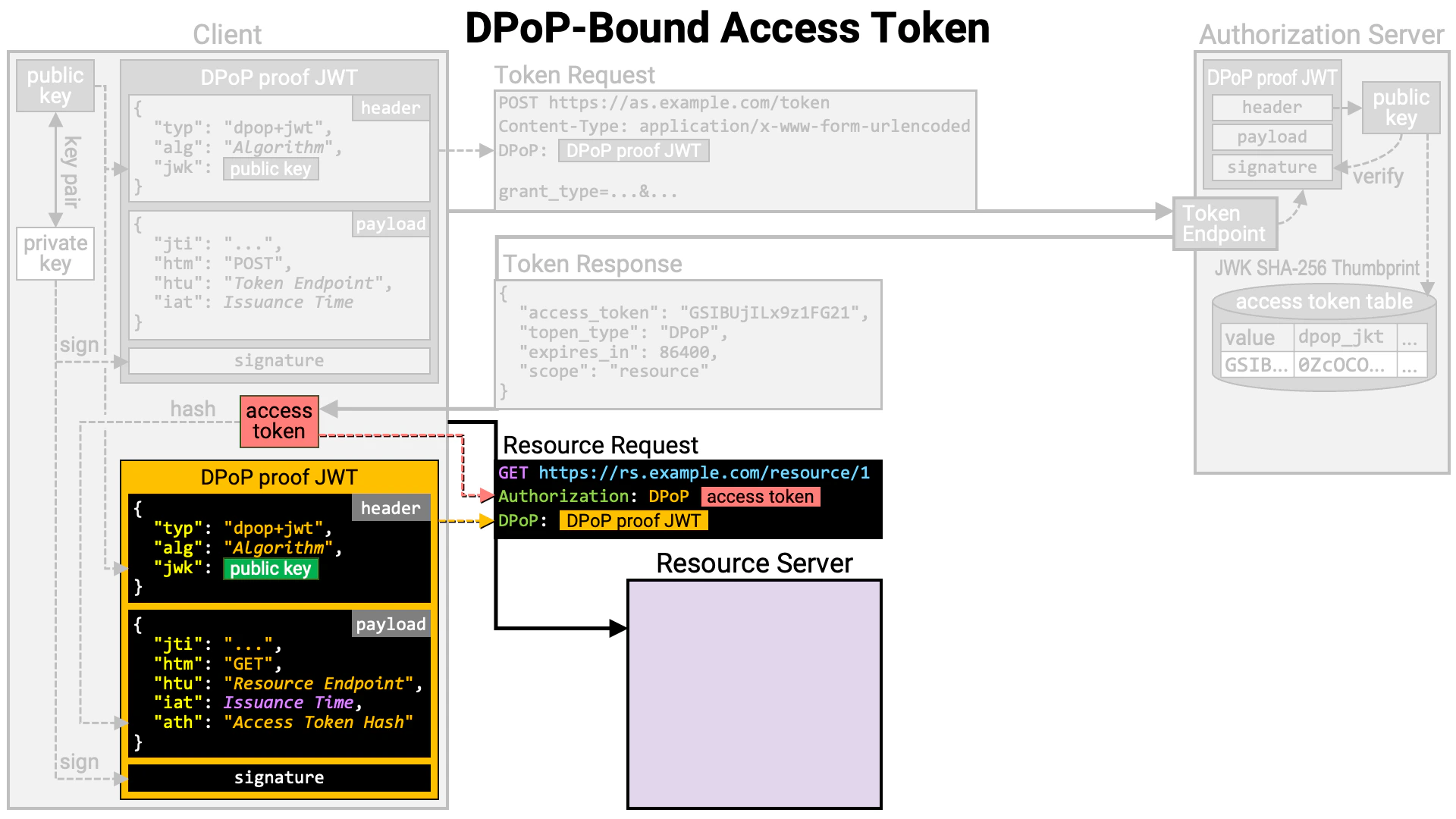
Authorization header, and the DPoP proof
JWT is included in the DPoP header. Note that the scheme part of the
Authorization header value should be DPoP (not Bearer as specified in
RFC 6750).
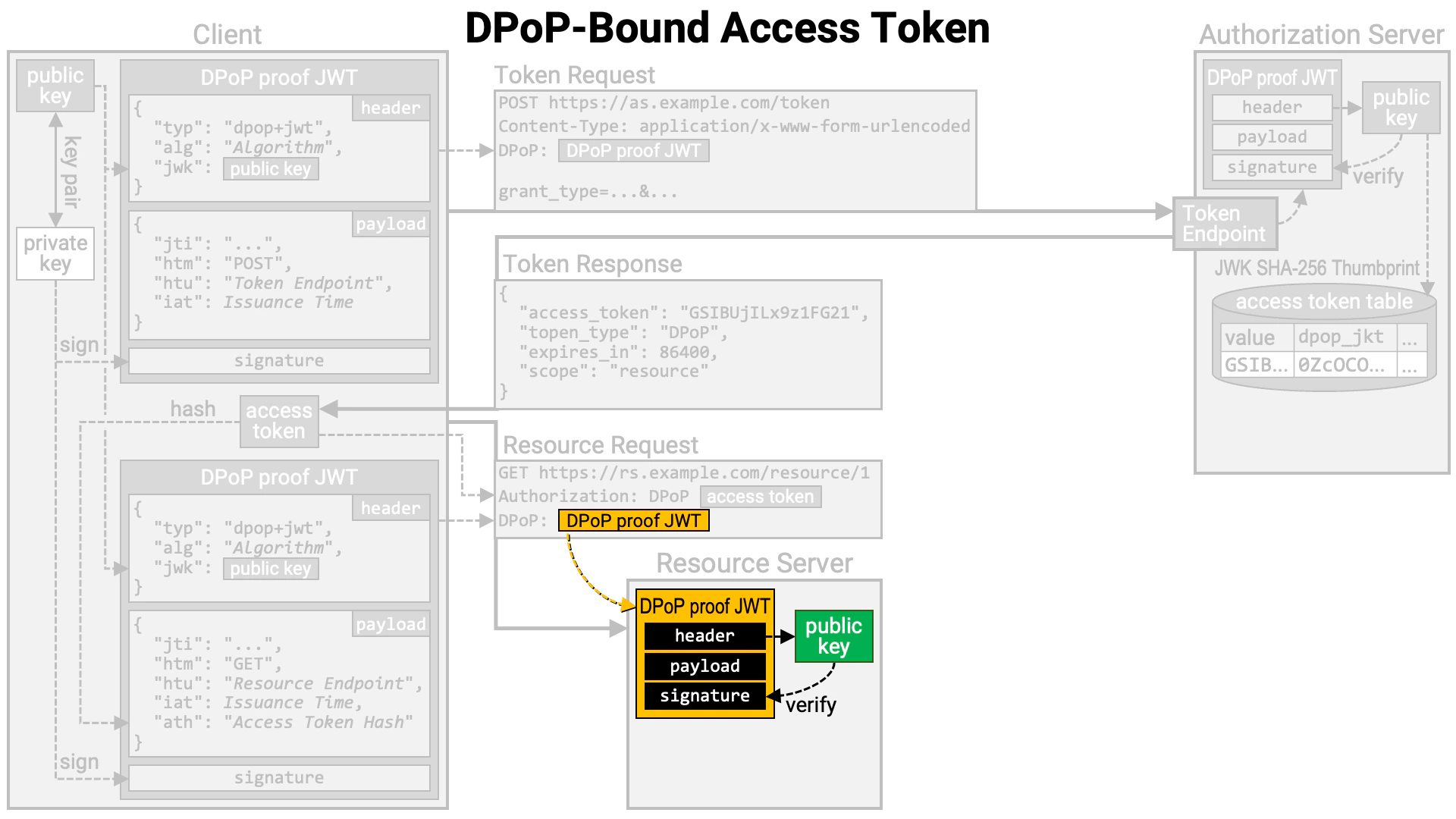
jkt sub-property
within the cnf property (RFC 7800).
DPoP Nonce
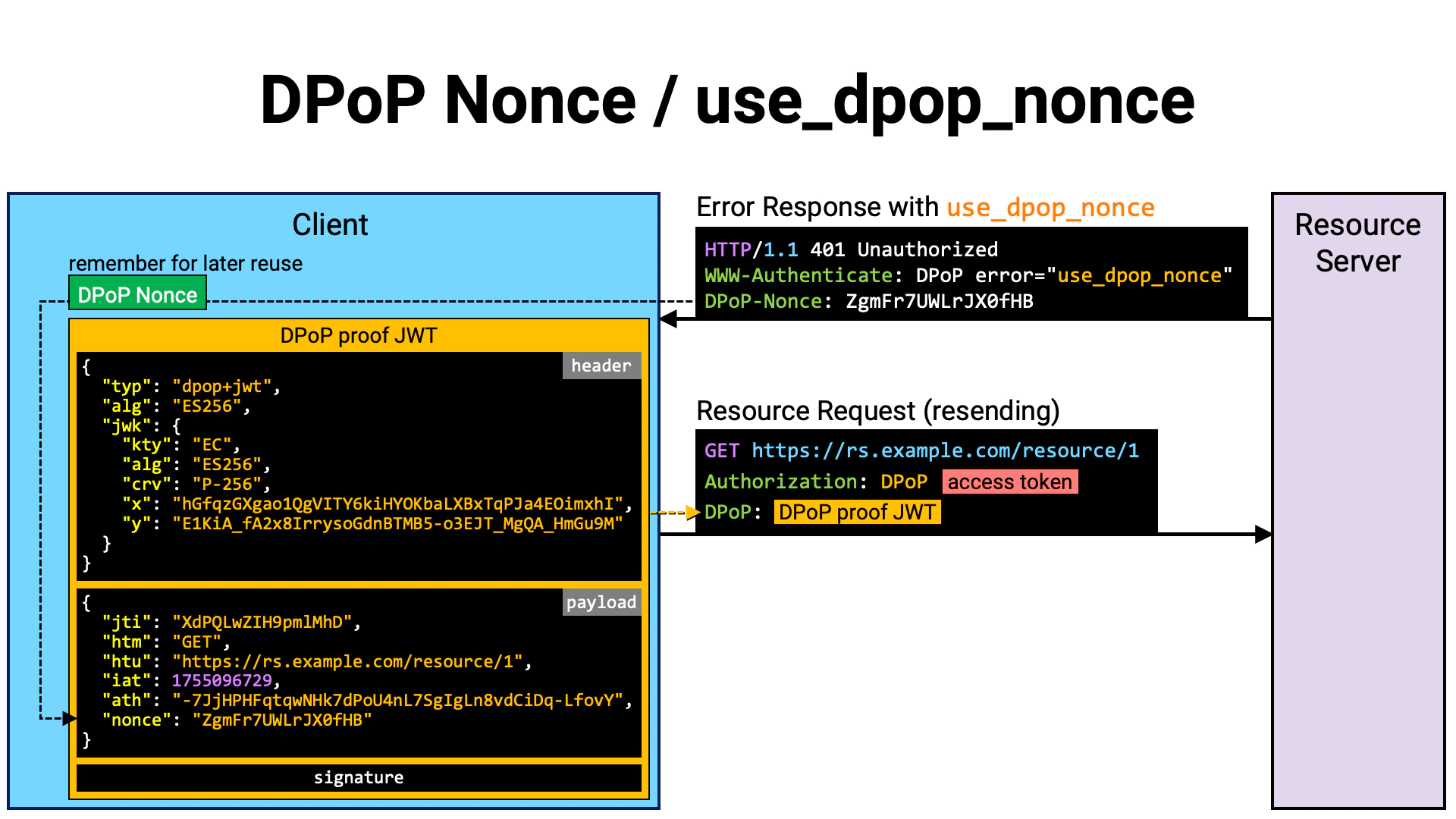
A server may require that a nonce value it provides be included in the DPoP proof JWT. By setting a lifetime for the nonce value, the server can control the validity period of the DPoP proof JWT (RFC 9449 Section 8); by making the nonce value unpredictable, the server can make it more difficult to pre-generate a DPoP proof JWT and use it elsewhere (RFC 9449 Section 11.2). Requiring a nonce has security advantages like these. If a DPoP proof JWT without anonce claim is sent to a resource server that
requires a nonce, a use_dpop_nonce error will be returned with a DPoP-Nonce
header.
DPoP-Nonce header and creates a DPoP proof JWT that includes this value as
the nonce claim. It then resends the resource request with the newly created
DPoP proof JWT attached.
invalid_dpop_proof error.
DPoP-Nonce header whose value differs from
the nonce value previously used, it is possible that the error was caused by
the nonce being outdated. In this case, it is worth regenerating the DPoP proof
JWT and attempting to resend the resource request.
Target URI
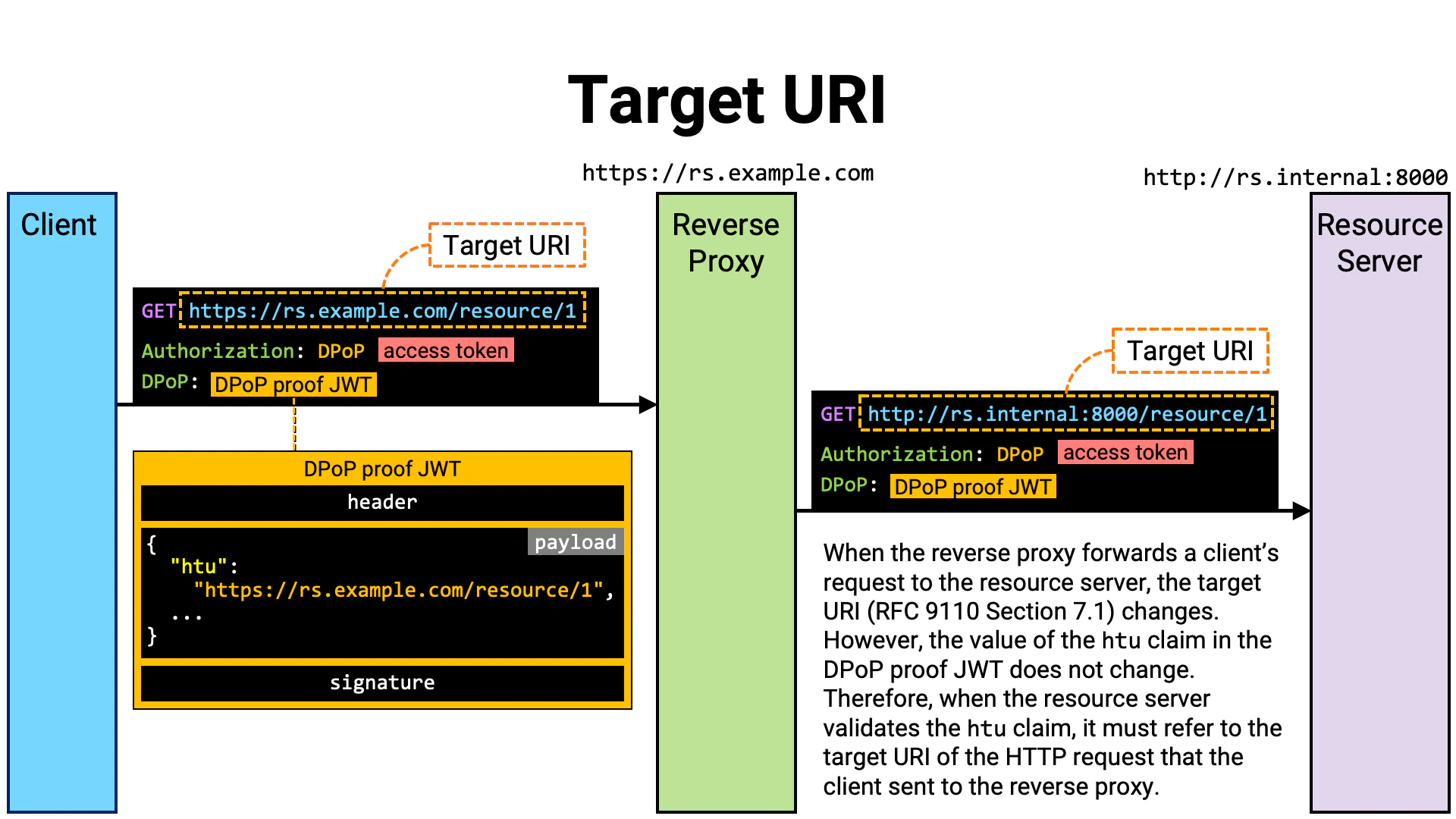
If a resource server supports DPoP, it must ensure that the value of thehtu
claim in a received DPoP proof JWT matches the target URI of the request
(excluding the query and fragment parameters). To perform this check, the
resource server needs to know the absolute URI of the request.
Similarly, if the resource server supports HTTP Message Signatures
(RFC 9421), it needs the absolute URI of the request in order to
use it as the value of the @target-uri derived component
(RFC 9421 Section 2.2.2).
However, if the resource server is running behind a reverse proxy, it cannot
directly know the absolute URI of the request. This is because the HTTP request
visible to the resource server is not the one originally sent by the client
application, but rather the one forwarded by the reverse proxy. In most cases,
the scheme, host name, and port number differ from those of the original
request (the request that the client application sent to the reverse proxy).
Since the request received by the resource server differs from the one sent by
the client, comparing the target URI of the resource server’s received request
with the htu claim in the DPoP proof JWT will not match, causing all resource
requests containing DPoP proof JWTs to be rejected. Likewise, the value of the
@target-uri derived component as seen by the client application will not
match the @target-uri as recognized by the resource server, causing HTTP
Message Signature verification to fail and all resource requests to be rejected.
Therefore, verification of DPoP proof JWTs and HTTP Message Signatures at the
resource server must be based on the target URI of the request as received by
the reverse proxy, rather than the target URI of the request as received by the
resource server itself.
Target URI Resolution
When a reverse proxy forwards an HTTP request, it is common practice to add custom HTTP headers containing information about the original HTTP request. For this purpose, theForwarded HTTP header was defined by the
RFC 7239 Forwarded HTTP Extension. For example, to convey that the
scheme of the original request was https and the host name was
rs.example.com, the reverse proxy would add a
Forwarded header like the following:
Forwarded HTTP header standardized what had previously been achieved
using non-standard HTTP fields such as X-Forwarded-For, X-Forwarded-By,
and X-Forwarded-Proto. Therefore, the use of the Forwarded header is
recommended.
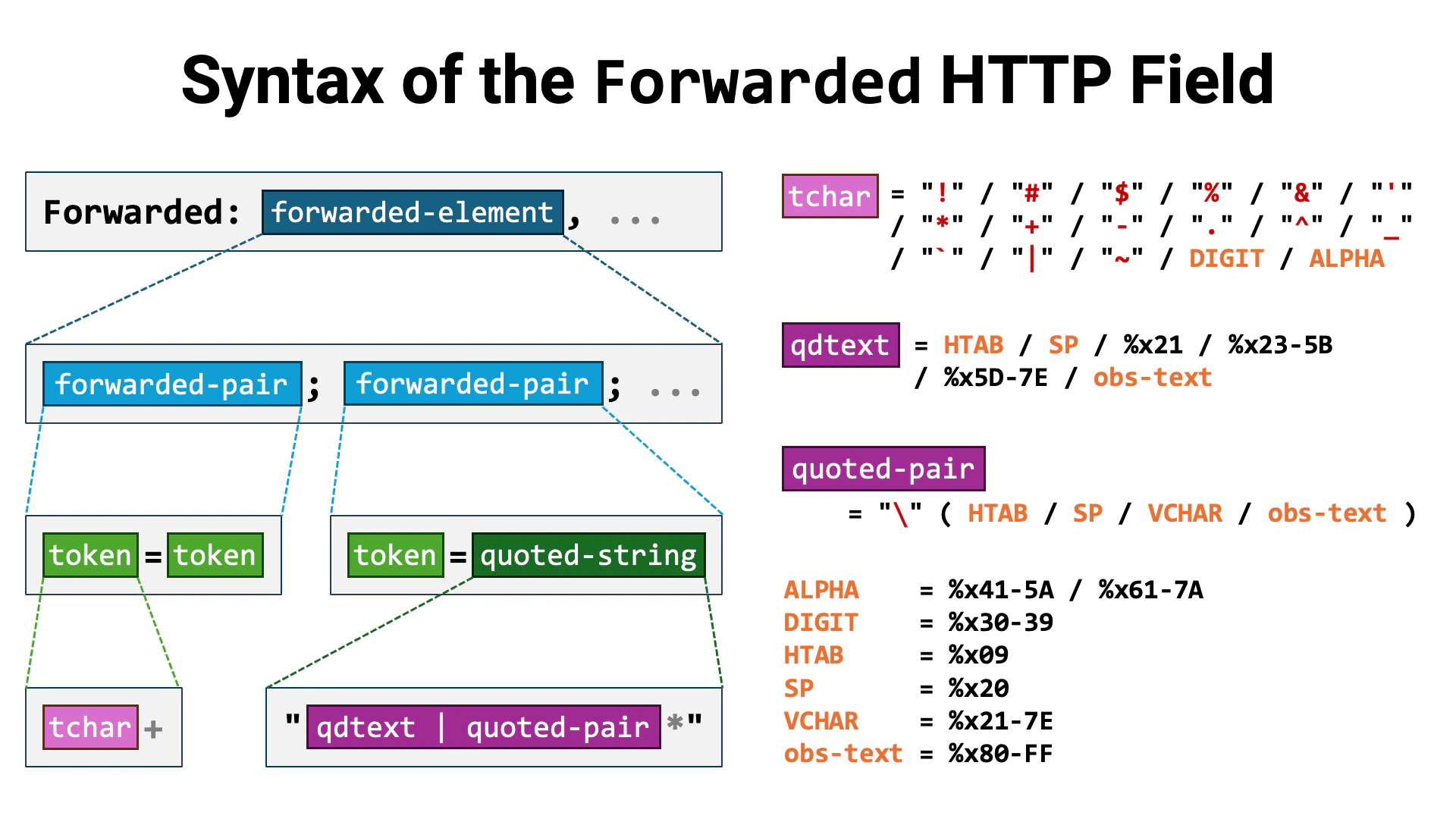
However, the syntax of the Forwarded header value is unexpectedly complex.
While it is not impossible, parsing it with regular expressions is difficult,
and since it does not conform to the general syntax defined in
RFC 8941, generic libraries cannot be used either. In the end,
you need to implement a dedicated parser specifically for the Forwarded HTTP
header (e.g., http-field-parser).
| Header Name | Reference |
|---|---|
Front-End-Https | [Microsoft] Helping to Secure Communication: Client to Front-End Server |
X-Forwarded-For | MDN Web Docs / X-Forwarded-For |
X-Forwarded-Host | MDN Web Docs / X-Forwarded-Host |
X-Forwarded-Port | [AWS] HTTP headers and Classic Load Balancers # X-Forwarded-Port |
X-Forwarded-Proto | MDN Web Docs / X-Forwarded-Proto |
X-Forwarded-Protocol | MDN Web Docs / X-Forwarded-Proto |
X-Forwarded-Ssl | MDN Web Docs / X-Forwarded-Proto |
X-Url-Scheme | MDN Web Docs / X-Forwarded-Proto |
Forwarded HTTP header or widely used custom HTTP
headers are incomplete as a means of determining the target URI, since they
do not include information about the path or query components.
To use the @target-uri derived component in HTTP Message Signatures, query
component information is required. Unfortunately, as of now, there is no
standardized header or widely adopted custom header that conveys the absolute
URL including the path and query components.
It would be desirable to see the adoption of some kind of custom HTTP header
that represents the absolute URL (e.g., X-Forwarded-URL), the definition of
a standardized HTTP header (e.g., Target-URI), or the addition of a new
HTTP Forwarded Parameter.
HTTP Message Signature
It is common for HTTP messages to be delivered via multiple intermediary servers. During this relay process, operations such as TLS termination or the addition, consolidation, and modification of HTTP headers are often performed. Under such conditions, methods to ensure the integrity and authenticity of HTTP messages end-to-end between the sender and the recipient have long been studied. In general, digital signatures are the means to achieve integrity and authenticity. However, in the case of HTTP messages, since parts of the message may be modified during transit, simply signing the entire HTTP message does not work. Therefore, it is necessary to select only the portions meaningful to both the sender and the recipient, normalize them so as not to be affected by intermediary modifications, and then apply a signature to that subset. For this purpose, numerous competing proposals emerged, some of which were actually implemented and deployed. Ultimately, the specification adopted by the IETF became RFC 9421 HTTP Message Signatures.HTTP Message Component
In RFC 9421, the portions of an HTTP message that can be part of the signature input are referred to as HTTP message components. The most straightforward HTTP message components are HTTP fields. For example, theContent-Type HTTP field and the Date HTTP field are both HTTP message
components.
There are also HTTP message components derived from attributes other than HTTP
fields. These are called derived components. The HTTP method, target URI, and
HTTP status code are all examples of derived components.
The choice of which components to include in a signature is left up to the
application, depending on its particular purpose. For instance, the
FAPI 2.0 HTTP Signatures specification requires that
the following components be included in the signature when signing an HTTP
request:
- HTTP method
- Target URI
AuthorizationHTTP fieldDPoPHTTP field (if present)Content-DigestHTTP field (if the message has a body)
Signature Base
In HTTP message signatures, the string that serves as the input to the digital signature is called the signature base. The signature base consists of a list of identifier–value pairs of HTTP message components to be signed, followed by metadata about the signature itself. Before generating or verifying an HTTP message signature, the signature base must first be constructed. For the precise syntax of the signature base, see RFC 9421, Section 2.5. Creating the Signature Base.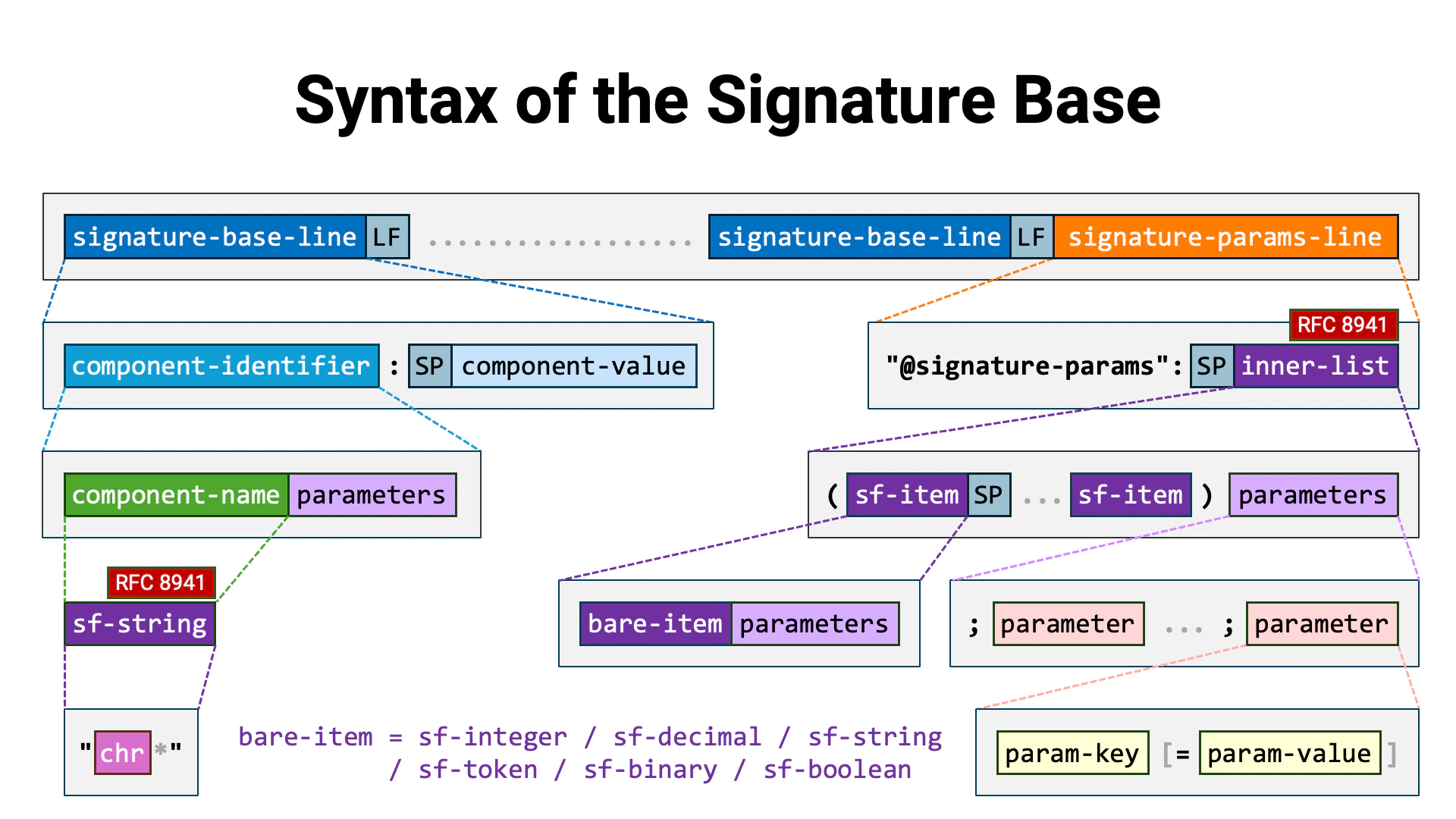
@, such as @method. Lines 4 through 6, on the other
hand, consist of HTTP fields and their values.
The final line of the signature base (line 7 in this example) contains metadata
about the signature. It always begins with "@signature-params":, followed by
an Inner List (RFC 8941 Section 3.1.1). This Inner List
enumerates the component identifiers of the HTTP message components included in
the signature. In this example, the following six are listed:
"@method""@authority""@path""content-digest""content-length""content-type"
;), represents the optional parameters of the
Inner List. In this example, the created parameter and the keyid parameter
are included. These parameters are defined in
RFC 9421 Section 2.3.
Signing Method
The signing method abstractly represented asHTTP_SIGN in
RFC 9421 Section 3.3 takes the signature base (M) and the
signing key (Ks) as input and produces the signature (S) as output.
| Algorithm Name | Description | Reference |
|---|---|---|
rsa-pss-sha512 | RSASSA-PSS using SHA-512 | RFC 9421, Section 3.3.1 |
rsa-v1_5-sha256 | RSASSA-PKCS1-v1_5 using SHA-256 | RFC 9421, Section 3.3.2 |
hmac-sha256 | HMAC using SHA-256 | RFC 9421, Section 3.3.3 |
ecdsa-p256-sha256 | ECDSA using curve P-256 DSS and SHA-256 | RFC 9421, Section 3.3.4 |
ecdsa-p384-sha384 | ECDSA using curve P-384 DSS and SHA-384 | RFC 9421, Section 3.3.5 |
ed25519 | EdDSA using curve edwards25519 | RFC 9421, Section 3.3.6 |
alg parameter defined in
RFC 9421 Section 2.3. However, because the final paragraph of
RFC 9421 Section 3.3.7 explicitly states otherwise, the alg
parameter is not used.
JSON Web Algorithm (JWA) values from the “JSON Web Signature and Encryption
Algorithms” registry are not included as signature parameters. Typically, the
JWS algorithm can be signaled using JSON Web Keys (JWKs) or other mechanisms
common to JOSE implementations. In fact, JWA values are not registered in the
“HTTP Signature Algorithms” registry (Section 6.2), and so the explicit alg
signature parameter is not used at all when using JOSE signing algorithms.
Verification Method
The verification method abstractly represented asHTTP_VERIFY in
RFC 9421 Section 3.3 takes the signature base (M), the
verification key (Kv), and the signature (S) as inputs, and produces the
verification result (V) as output.
- Extract the access token contained in the HTTP request
- Identify the client application associated with the access token
- Retrieve the client application’s
jwks_urimetadata information - Obtain the JWK Set from the location indicated by the
jwks_uri - Based on the value of the
keyidsignature parameter, identify the verification key within the JWK Set
jwks_uri metadata. Excluding
individual proposed specifications, the only standard specification that could
be used is OpenID Federation (explanatory article).
However, implementing and operating this specification is a heavy undertaking,
and it cannot be said that it is widely deployed; therefore, it would not be
a general-purpose solution for obtaining verification keys.
As a result, at present, in order for a resource server to verify the HTTP
message signature of an HTTP request, it must obtain the verification key using
non-standard, implementation-specific methods.
It should be noted that, if limited to the context of FAPI 2.0, there is a
method to determine the verification key using only standard specifications
Details will be provided later.
Signature Inclusion
HTTP message signatures are added to HTTP messages using theSignature HTTP
field and the Signature-Input HTTP field.
The value format of the Signature HTTP field is a Dictionary
(RFC 8941 Section 3.2). Each key–value pair consists of an
arbitrary label and a signature represented as a Byte Sequence
(RFC 8941 Section 3.3.5).
Signature-Input HTTP field is also a Dictionary
(RFC 8941 Section 3.2). Each key–value pair consists of an
arbitrary label and signature metadata represented as an Inner List
(RFC 8941 Section 3.1.1).
Signature HTTP field MUST also be present in the Signature-Input
HTTP field.
The following example, excerpted from RFC 9421 Section 4.3,
shows an HTTP request containing both the Signature and Signature-Input
HTTP fields.
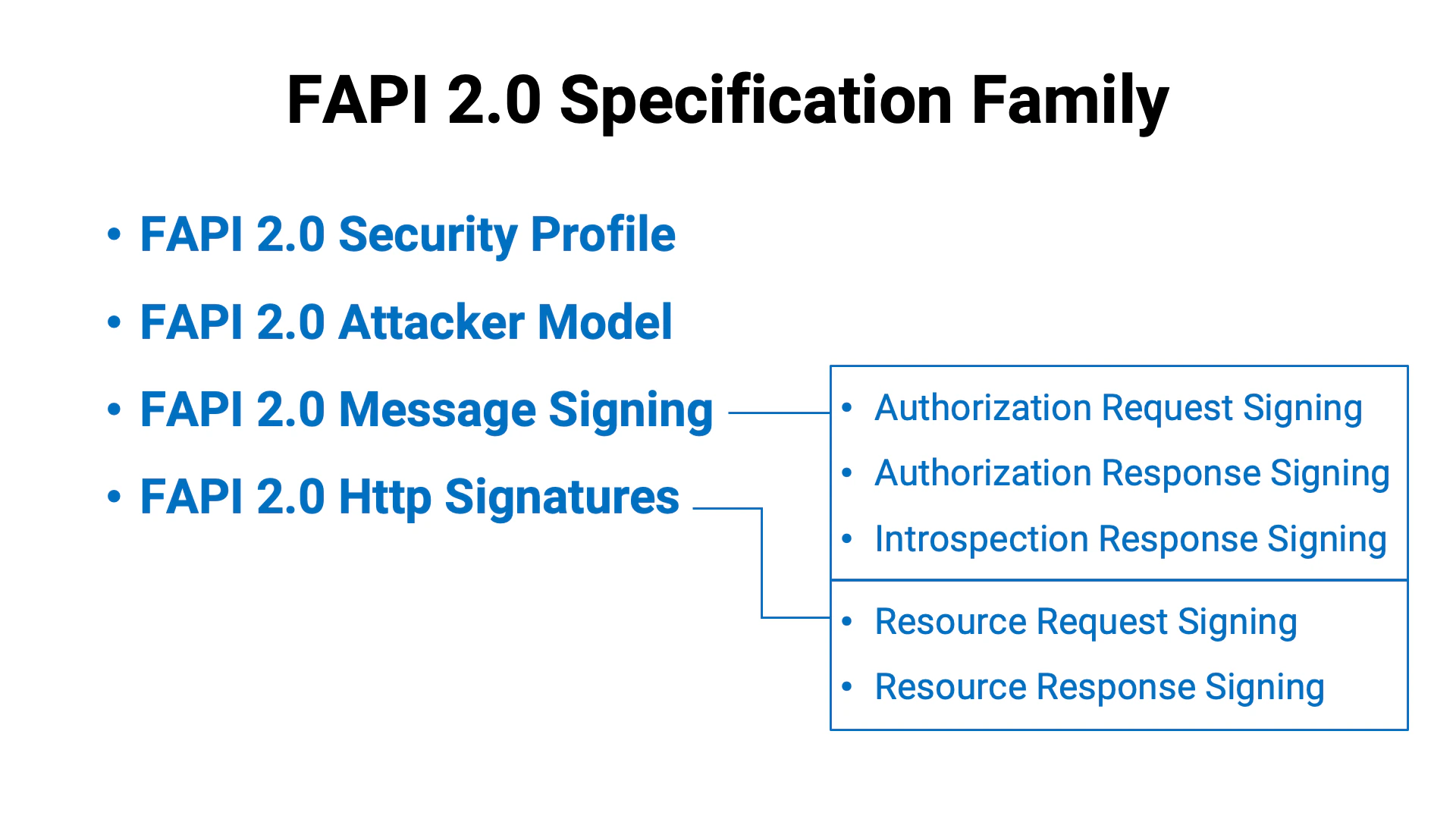
FAPI 2.0 Http Signatures
As RFC 9421 itself states, the specification is designed as a tool, and therefore additional requirements need to be defined according to the purposes of the application or profile when it is actually used. RFC 9421 Section 1.4 provides examples of such requirements. For instance, the following items are listed:- The set of components to be signed
- The set of signature metadata parameters
- The method of obtaining signing and verification keys
- The signature algorithm
| Request Signing | ||
|---|---|---|
| Components | "@method" | |
"@target-uri" | ||
"authorization" | ||
"dpop" | If DPoP is used. | |
"content-digest" | If the request has a message body. | |
| Metadata Parameters | created | |
tag | The value is fixed to "fapi-2-request". | |
| Response Signing | ||
|---|---|---|
| Components | "@method";req | |
"@target-uri";req | ||
"authorization";req | ||
"dpop";req | If DPoP is used. | |
"content-digest";req | If the request has a message body. | |
"@status" | ||
"content-digest" | If the response has a message body. | |
| Metadata Parameters | created | |
tag | The value is fixed to "fapi-2-response". | |
The
Content-Digest HTTP field is defined in
RFC 9530 Digest Fields,
Section 2.
The Content-Digest Field.Verification Key for Request
When using the FAPI 2.0 HTTP Signatures specification, the FAPI 2.0 Security Profile specification also applies, and therefore sender-constrained access tokens using either MTLS or DPoP are employed for resource requests. In both the MTLS and DPoP cases, the client application’s public key is conveyed to the resource server. With this technical property in mind, by introducing the convention that “the HTTP request is signed with the private key paired with the public key bound to the sender-constrained access token,” the verification key retrieval problem mentioned in the “Verification Method” can be solved. The advantage of this solution is that the verification key can be obtained solely through approved standard specifications (RFC 8705 and RFC 9449). This avoids reliance on non-standard, implementation-specific methods, thereby improving interoperability.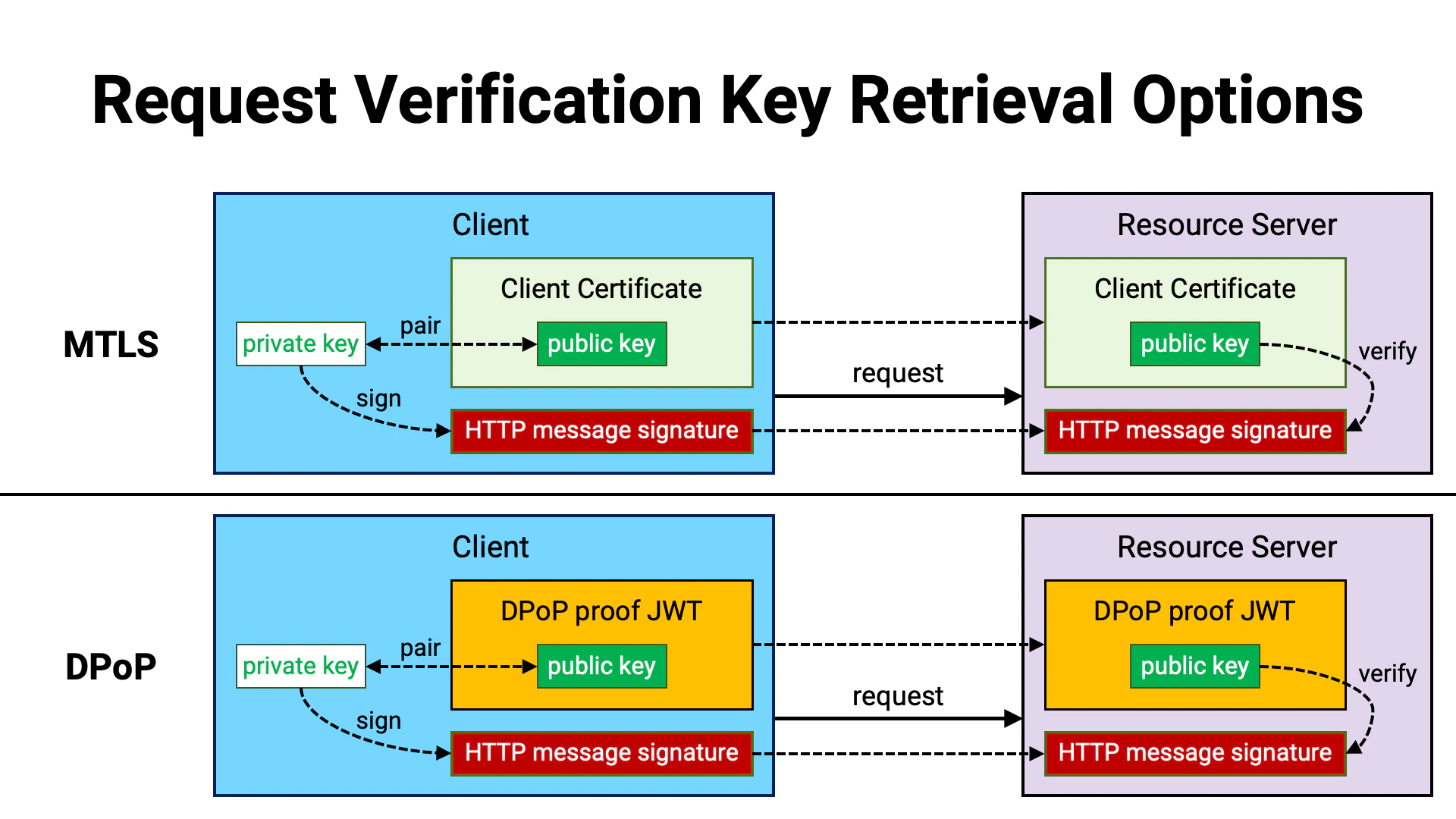
Please note that “the HTTP request is signed with the private key paired with
the public key bound to the sender-constrained access token” is not part of
the FAPI
2.0 HTTP Signatures specification, but merely one possible approach. The
specification explicitly states: “This specification doesn’t specify the
exact means by which a resource server can retrieve the key for the client.”
Verification Key for Response
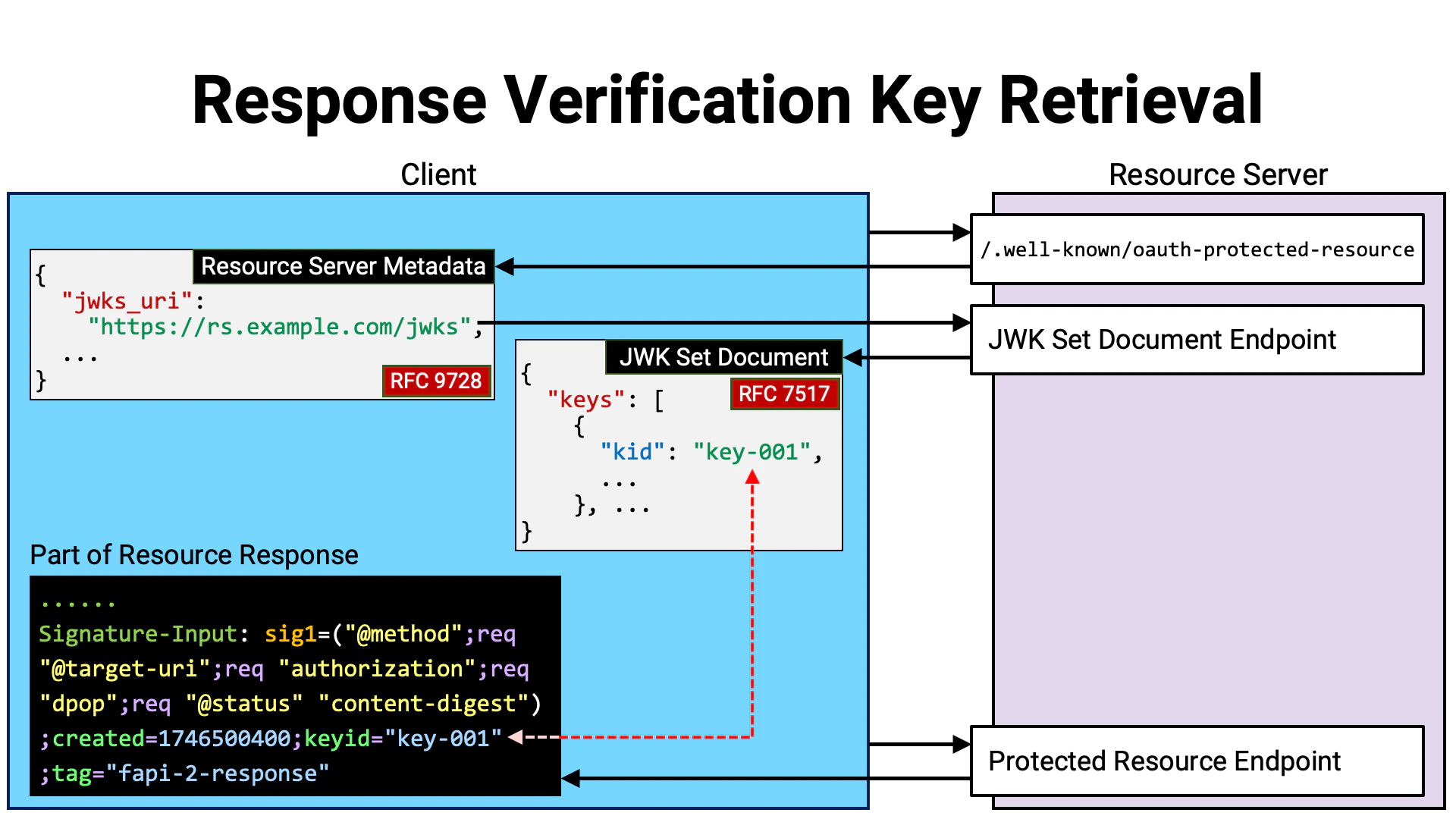
In order for a client application to verify the HTTP message signature of a resource response, it must obtain the verification key provided by the resource server. Compared to the client application providing the verification key, the provision of the verification key by the resource server can be realized in a straightforward manner. Just as authorization servers and OpenID providers do, the resource server can publish a JWK Set document (RFC 7517) and include within it the verification key used for verifying HTTP message signatures. The location of the JWK Set document can be indicated by thejwks_uri
property within the resource server metadata (RFC 9728) published
at /.well-known/oauth-protected-resource.
When providing verification keys via a JWK Set document, it is advisable to
assign the same key identifier to both the key (JWK) and the HTTP message
signature, so that the verification key can be identified among multiple keys.
The key can be associated with a key identifier using the kid property
(RFC 7517 Section 4.5), and the HTTP message signature can be
associated with it using the keyid parameter
(RFC 9421 Section 2.3).
RAR
The scope (RFC 6749 Section 3.3) of an access token represents the coarse-grained permissions associated with that access token. In order to express more fine-grained permissions, some authorization server implementations introduced a mechanism in which scope names are given structure, with parts of the scope name treated as variables. Such mechanisms are referred to as “parameterized scopes” or “dynamic scopes”. Of course, there is no interoperability across implementations. That said, packing information into scope names is, frankly, a bad practice. To improve this situation, RFC 9396 OAuth 2.0 Rich Authorization Requests (commonly known as RAR) was developed. The RAR specification defines theauthorization_details JSON array as a general mechanism for
representing permissions in a structured way.
Each element of the authorization_details JSON array is a
JSON object (hereafter referred to as a RAR object). The only mandatory
property that a RAR object must have is type. This type property indicates
the structure of the RAR object.
RFC 9396 itself does not define values for the type property.
The values to be used are determined independently by applications or profiles.
For example, the OpenID for Verifiable Credential Issuance (OID4VCI)
specification defines the value openid_credential. Below is
an example of an authorization_details array excerpted from
that specification.
type property, the
following properties. Whether or not to use them is optional:
locationsactionsdatatypesidentifierprivileges
authorization_details
array excerpted from RFC 9396, which makes use of top-level
properties such as geolocation and currency that are not defined in
RFC 9396.
authorization_details
parameter can be used anywhere the scope parameter is available (provided the
implementation supports it). For resource servers, the most important
occurrences of the authorization_details parameter are in
introspection responses and in the payload of JWT access tokens.
The following is an excerpt from
RFC 9396 Section 9.2. Token Introspection, showing an example
of an introspection response.
Cedar
Cedar is a language for writing authorization policies (Cedar Policy Language Reference Guide). Authorization policies written in Cedar (hereafter, Cedar policies) can be used to determine whether to allow access to a resource. One major advantage of Cedar is that it enables you to separate authorization logic from business logic. Cedar policies can be externalized and managed independently from business logic. In fact, there are commercial services available for managing Cedar policies (see Integrations). Another major advantage of Cedar is that it allows authorization logic to be expressed with fine granularity. For example, you can write an authorization rule such as “If someone is Jane’s friend, they are allowed to view and comment on photos in Jane’s trip album.” Below is an example of a Cedar policy that represents this authorization logic, excerpted from the Example scenario in the Cedar Policy Language Reference Guide.when and unless clauses to specify the
conditions under which a policy applies. Within these conditions, you can use
comparison operators, logical operators, arithmetic operators, and more, giving
Cedar a high level of expressiveness.
Cedar in RAR Object
By associating scopes with an access token (RFC 6749 Section 3.3), it is possible to represent the coarse-grained permissions of that access token. Similarly, if we could associate Cedar policies with an access token, wouldn’t it be possible to represent the fine-grained permissions of that token? One promising approach to realizing this idea is to represent Cedar policies as RAR objects. When determining the details of how to represent them, the following considerations arise:-
The original syntax of Cedar policies is unique. Should we embed the policy
in its original syntax within the RAR object, or should we convert it to
JSON format (JSON Policy Format) before embedding?
While the JSON format is highly compatible with RAR, it tends to be verbose
(particularly in expressing
when/unlessconditions), and most members of the Cedar community are likely to prefer the original syntax. - Should both the original Cedar syntax and the JSON format be supported, or should we limit support to one of them?
-
If both formats are supported, how should the format in use be indicated?
Should the information be embedded in the value of the
typeproperty, or should a separate property (e.g.,format) be introduced? -
Should a policy set be represented as a single RAR object, or should each
RAR object represent only a single policy? In the JSON representation of a
policy set shown in
“Representing a policy set with JSON”, a single
JSON object contains
staticPolicies,templates, andtemplateLinks. Should we follow this approach? And in the first place, is support fortemplatesnecessary in the RAR context? -
Might there be cases where something other than Cedar policies (e.g., Cedar
schemas) would need to be represented? If so, how should the value of
typebe determined in anticipation of that possibility?
| Specification Example of “Cedar in RAR Object” | |||
|---|---|---|---|
| Properties | type | “REQUIRED | The value is fixed to "cedar-policy". |
format | OPTIONAL | "cedar" (default) or "json". | |
policy_id | OPTIONAL | Policy ID. JSON string. | |
policy | REQUIRED | Cedar Policy. If the value of the format property is
"cedar", this contains a single JSON string representing
a Cedar policy written in the original Cedar syntax.
If the value of the format property is "json",
this contains a JSON object representing a single Cedar policy written
in the JSON Policy Format. | |
| Entities | principal | If a subject is associated with the access token (i.e., if the
introspection response or the JWT access token payload contains
a sub claim), then the principal entity is
User; otherwise, it is Client.For a User entity, the value of the access token’s
sub claim is treated as its unique identifier. For
a Client entity, the value of the access token’s
client_id is treated as its unique identifier.The elements of the access token’s groups,
roles, and entitlements claims
(RFC 9068 Section 2.2.3) are mapped to Group,
Role, and Entitlement entities,
respectively, and are set as parent entities of the
principal. If they follow
RFC 7643 Section 2.4, each element is a JSON object that
includes a value property (e.g.,
"groups":[{"value":"group1"}]).
The value of this value property is treated as the
unique identifier of the entity. If they do not follow
RFC 7643 Section 2.4, they are assumed to be JSON strings
(e.g., "groups":["group1"]),
and the string value itself is treated as the unique identifier
of the entity. | |
action | action entities are defined by the resource server. | ||
resource | resource entities are defined by the resource server. | ||
| Context | time | The current time expressed as the number of milliseconds elapsed since the Unix epoch. | |
access_token | Information about the access token. It has the sub-properties
iss, sub, and client_id. | ||
ip_address | Client’s IP address. | ||
authorization_details
array written based on this specification. The first RAR object describes
a Cedar policy using the original Cedar syntax, while the second RAR object
describes a Cedar policy using the JSON Policy Format.
Please note that this proposed specification has not been agreed upon within
the industry. However, at Authlete we have confirmed that this specification
is implementable and works as intended.In our upcoming product, Authlete Arena, for the
Shared Signals Framework, we will support “Cedar in RAR Object” in
addition to advanced security specifications such as MTLS, DPoP, and FAPI
2.0 Http Signatures.
Step Up Authentication
Some of the APIs provided by a resource server may impose stricter security requirements than others. For example, it is common for a funds transfer API to require higher security than a balance inquiry API. Among such security requirements, one possible requirement is that the user must undergo stronger authentication than usual when obtaining the access token. If the user authentication performed when the presented access token was obtained does not meet the required criteria, the API would likely want to notify the client application of this fact and prompt it to re-obtain the access token. In such cases, the RFC 9470 OAuth 2.0 Step Up Authentication Challenge Protocol can be used. The API can notify that the user authentication at the time of token issuance did not meet the requirements by using the error codeinsufficient_user_authentication. The error response
can also include information about the requirements by using parameters such
as acr_values and max_age.
Below is an example error response excerpted from RFC 9470.