
This page is for Authlete 3.0. For 2.x, see OpenID Federation 1.0 (2.x).
Introduction
This document explains OpenID Federation 1.0.| Revision History | |
|---|---|
| Date | Changes |
| 2023-01-01 | |
| 2024-08-03 | |
Overview
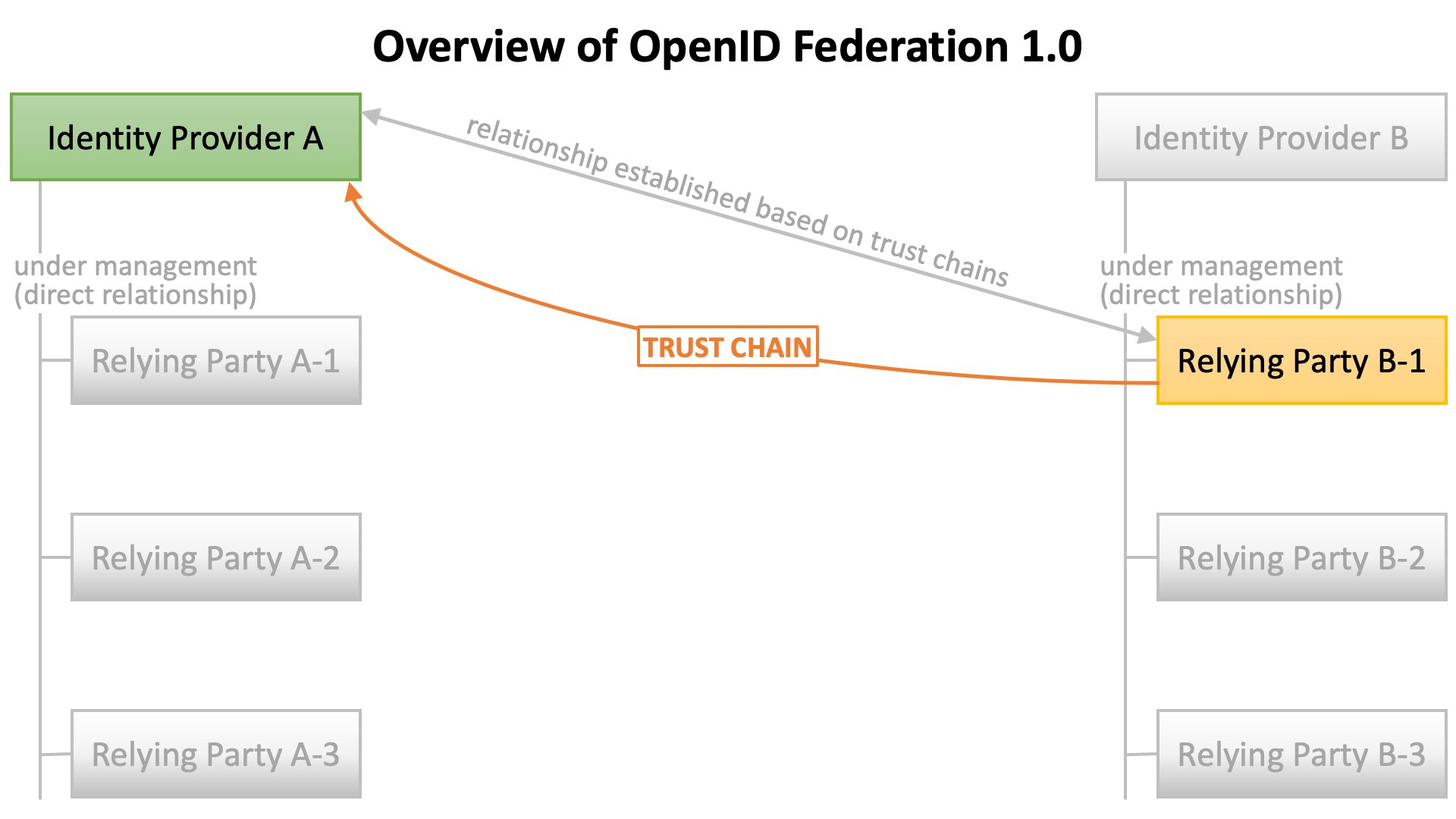
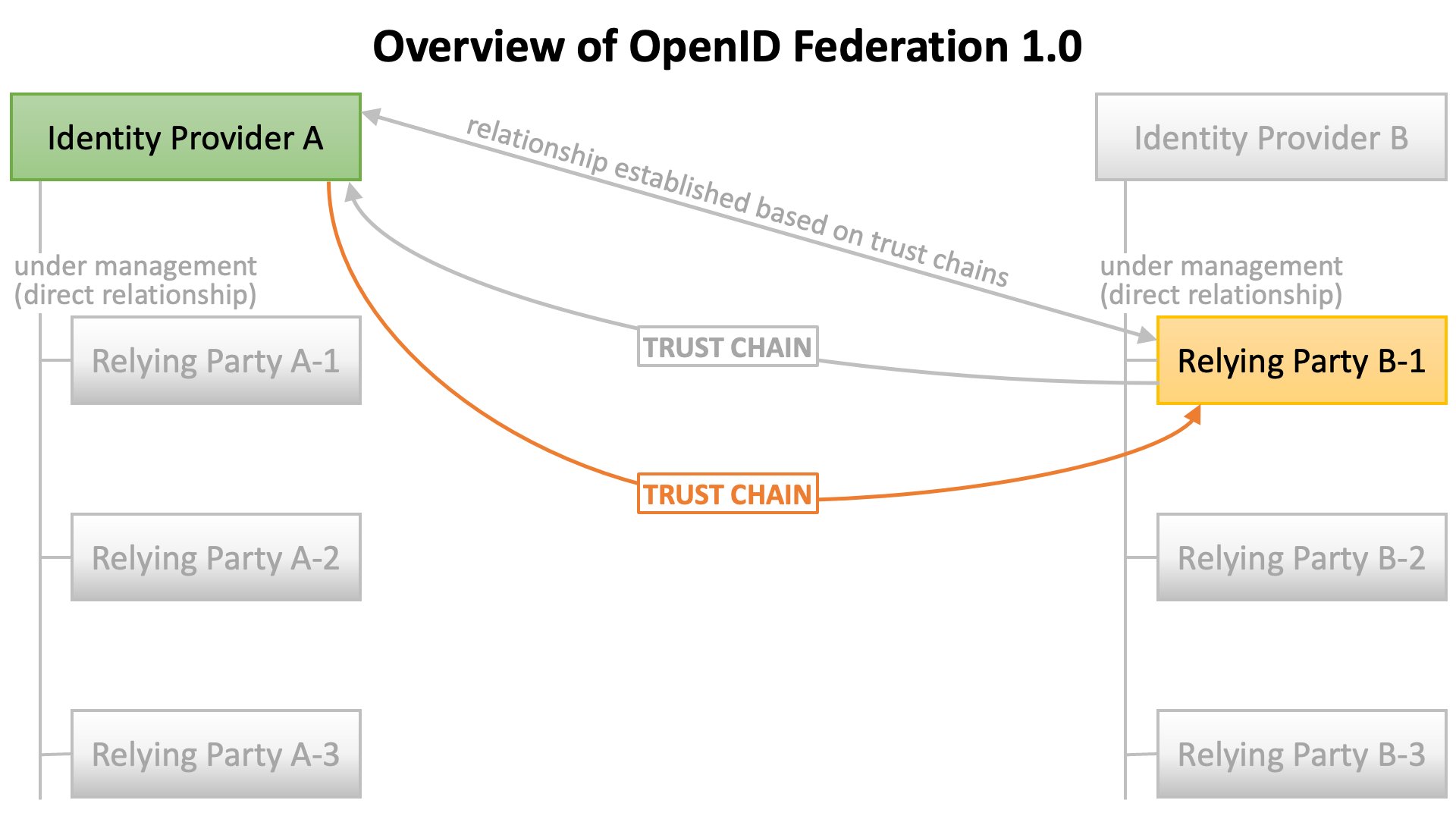
OpenID Federation 1.0 defines a mechanism where an identity provider / authorization server and a relying party (client) that have no direct relationship trust each other based on trust chains and the identity provider accepts OAuth/OIDC requests from the relying party without needing prior registration of the relying party.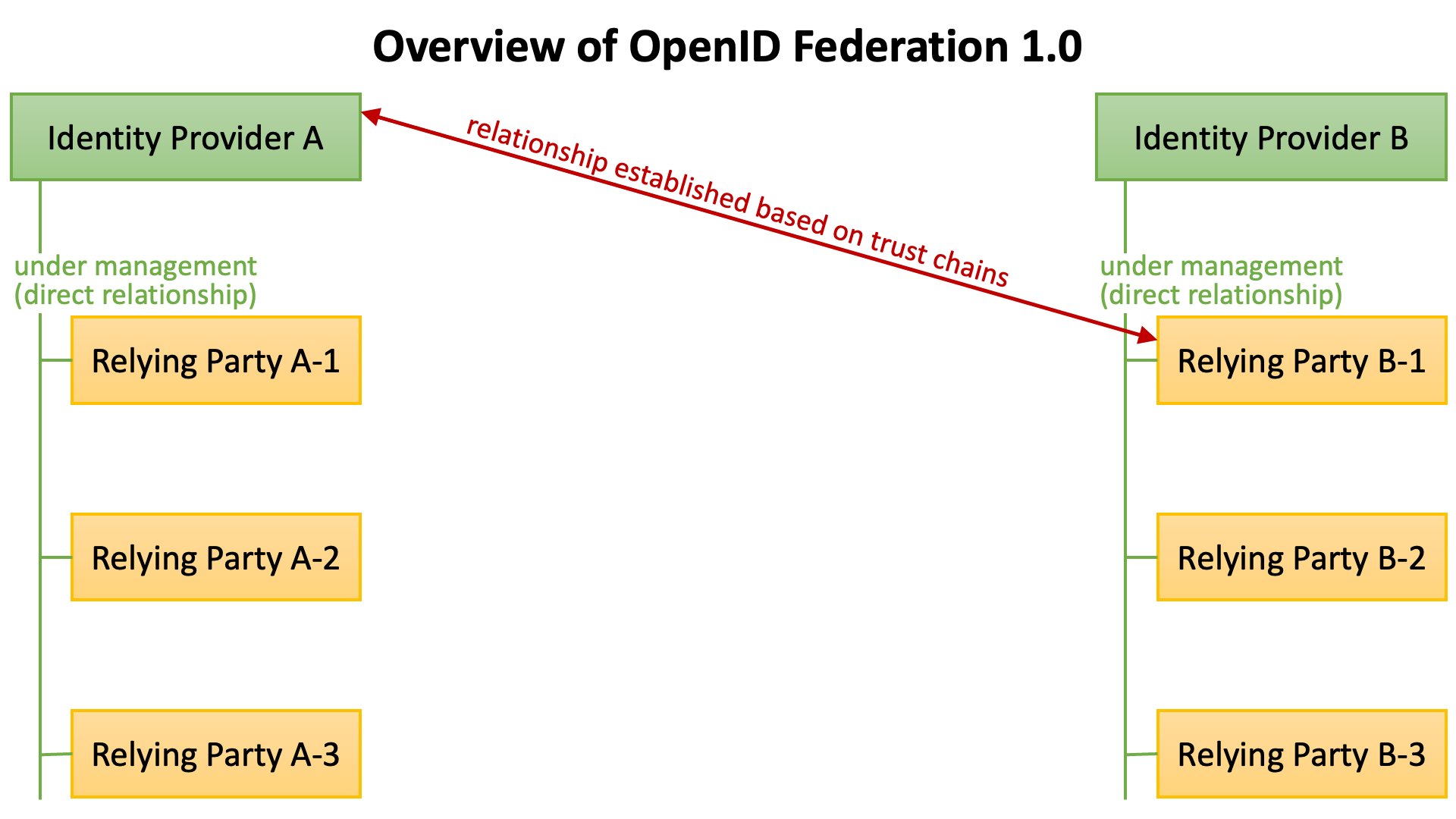

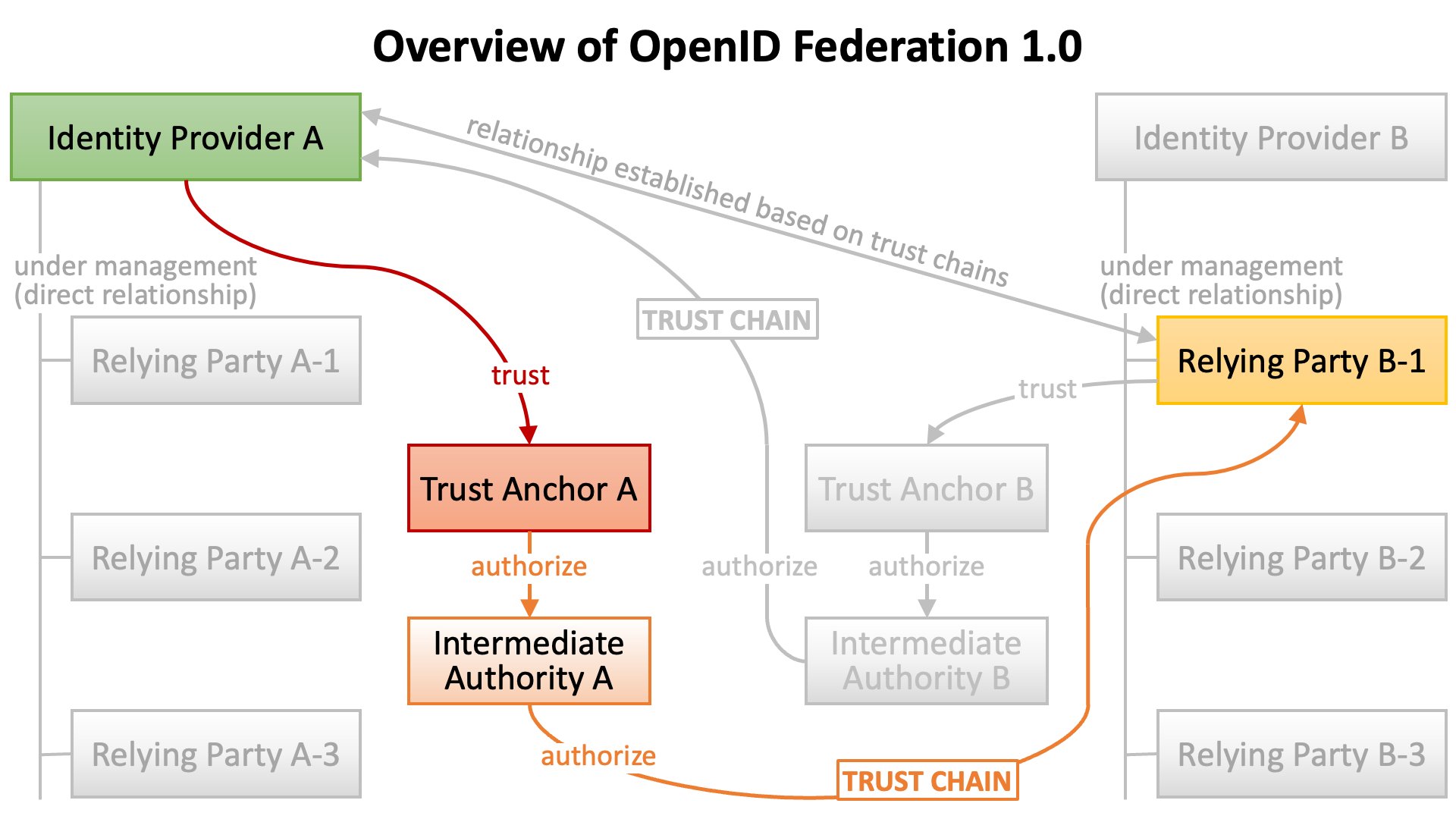
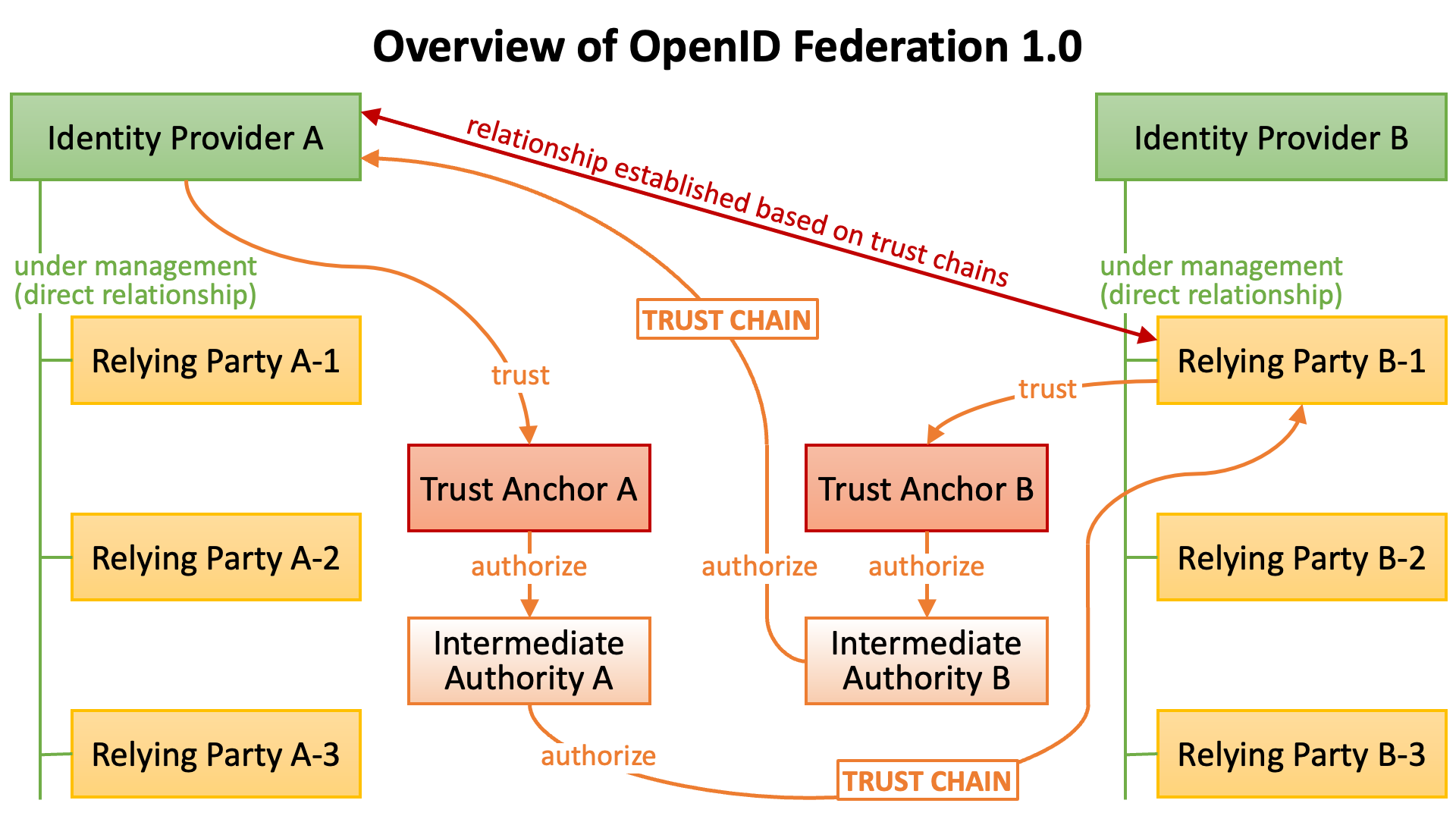
Trust Chain
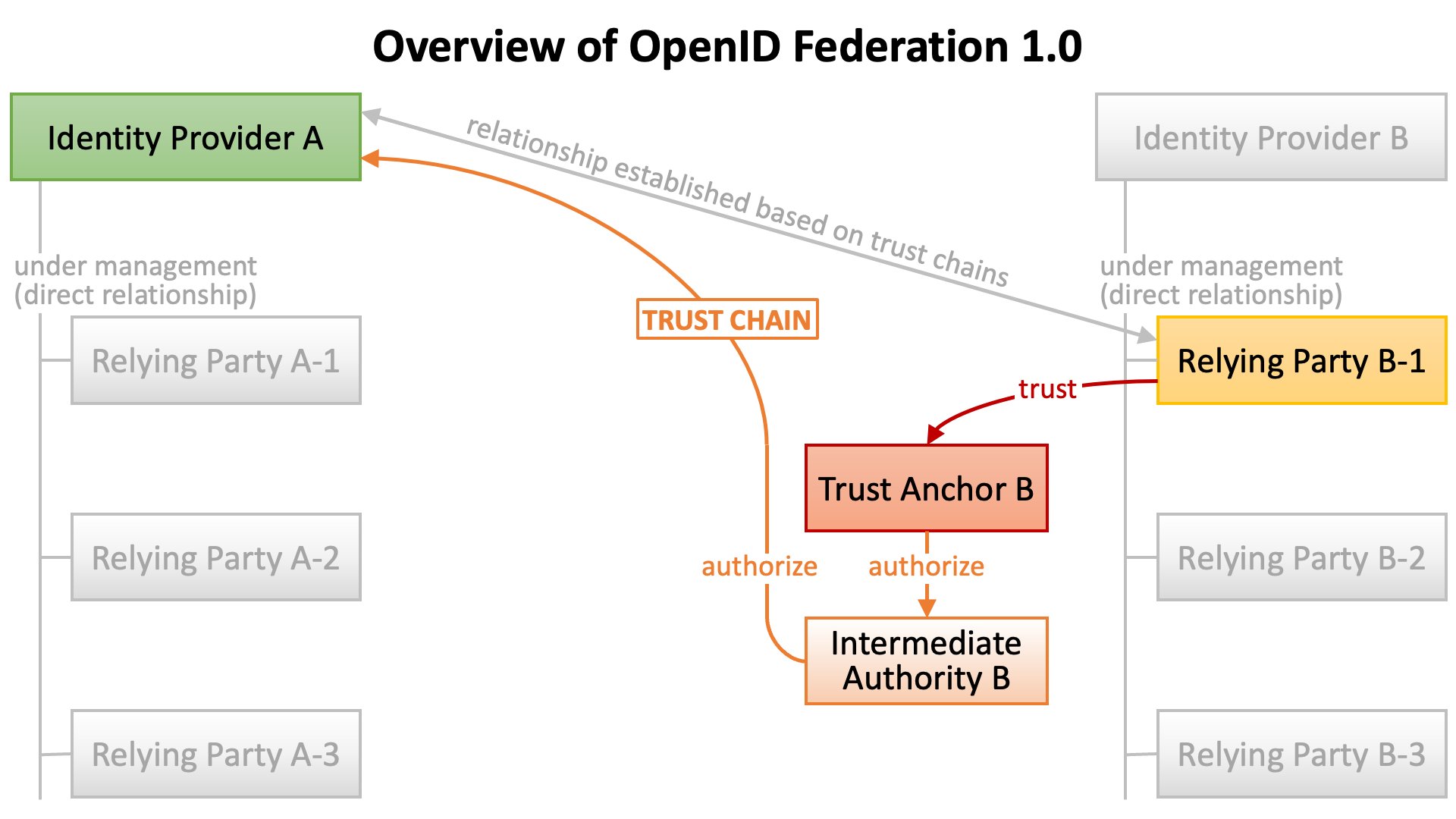
Technically speaking, a trust chain is a sequence of JWTs (RFC 7519 JSON Web Token) that are issued by a leaf entity, zero or more intermediate authorities, and a trust anchor.JWT Issued by Leaf Entity
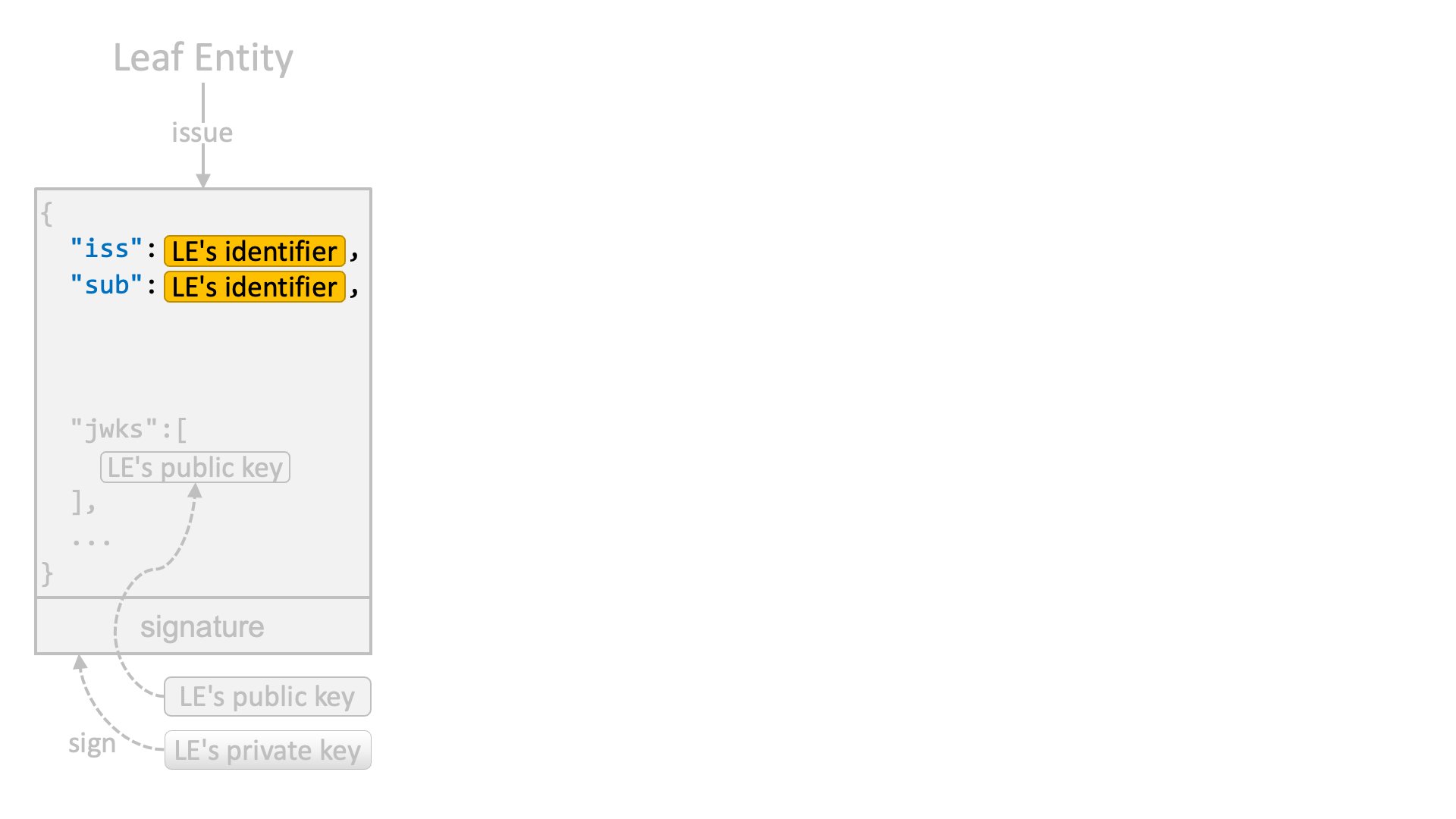
A leaf entity issues a JWT that is signed by the leaf entity’s private key.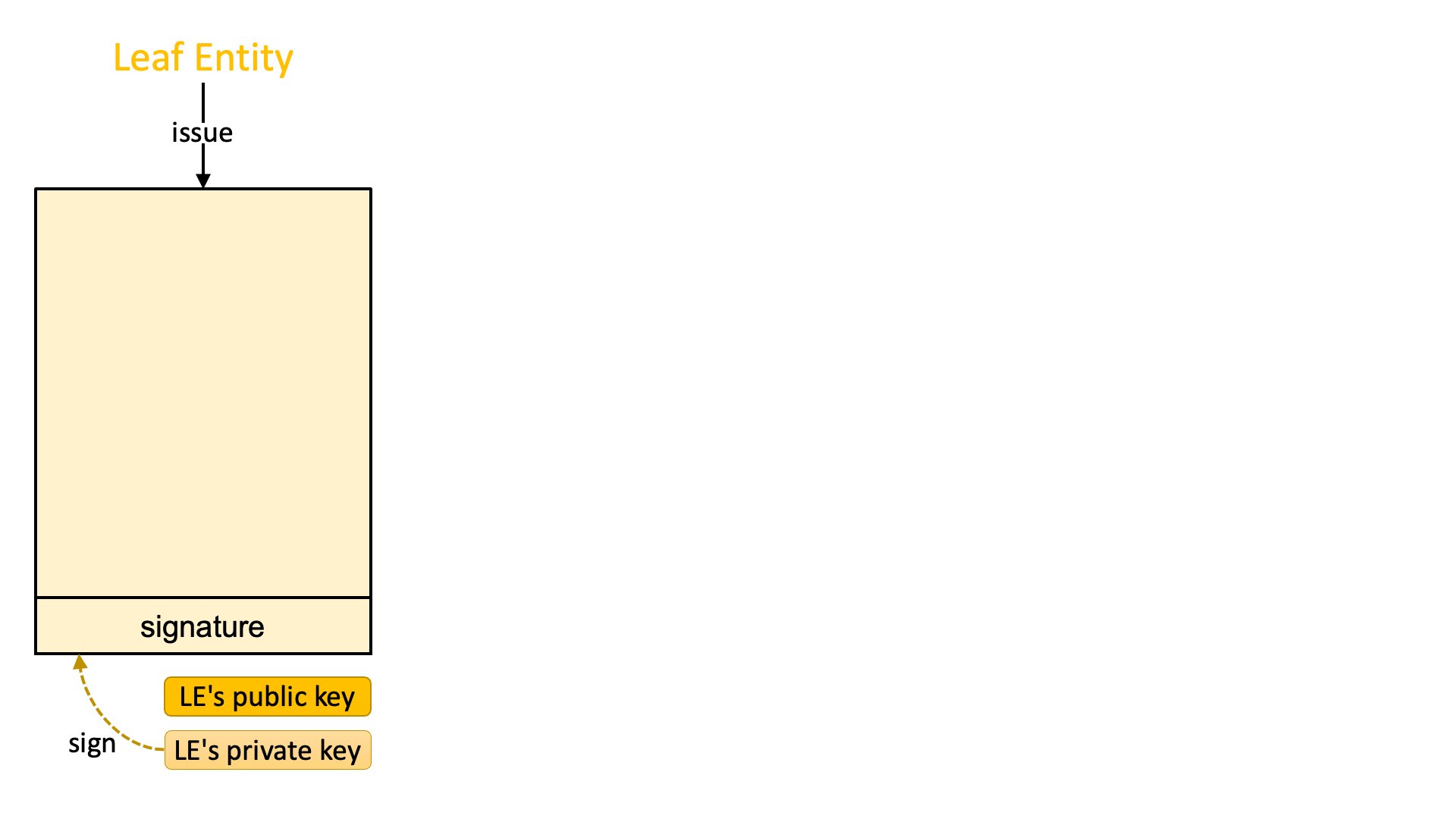
jwks claim is used to include the public key.
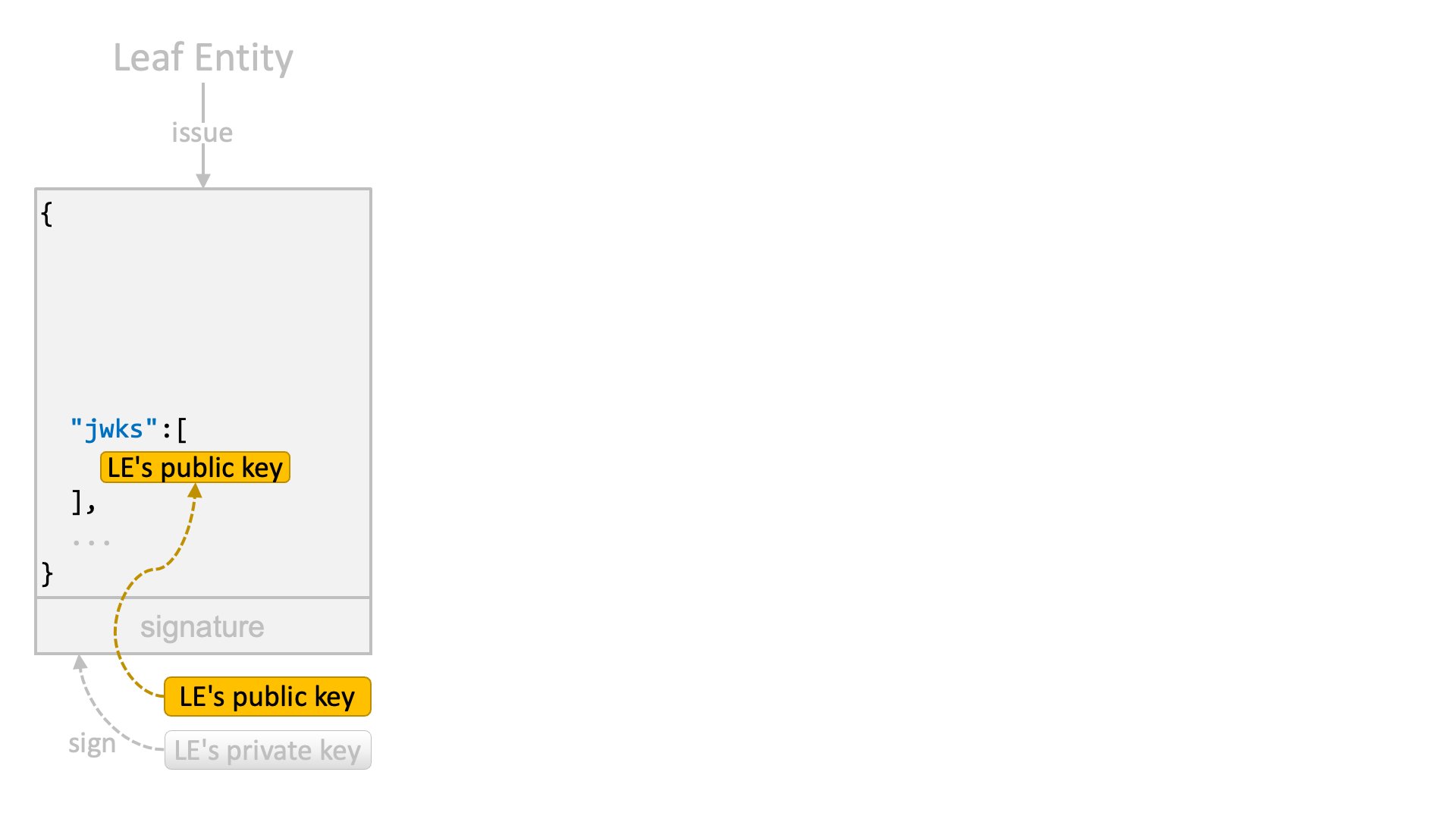
iss claim (Issuer; RFC 7519 Section 4.1.1) and the sub claim (Subject; RFC 7519 Section 4.1.2) in the payload part of the JWT hold the leaf entity’s identifier.
JWT Issued by Intermediate Authority
An intermediate authority (or a trust anchor if no intermediate authority exists in a trust chain) that authorizes the leaf entity issues a JWT that is signed by the intermediate authority’s private key.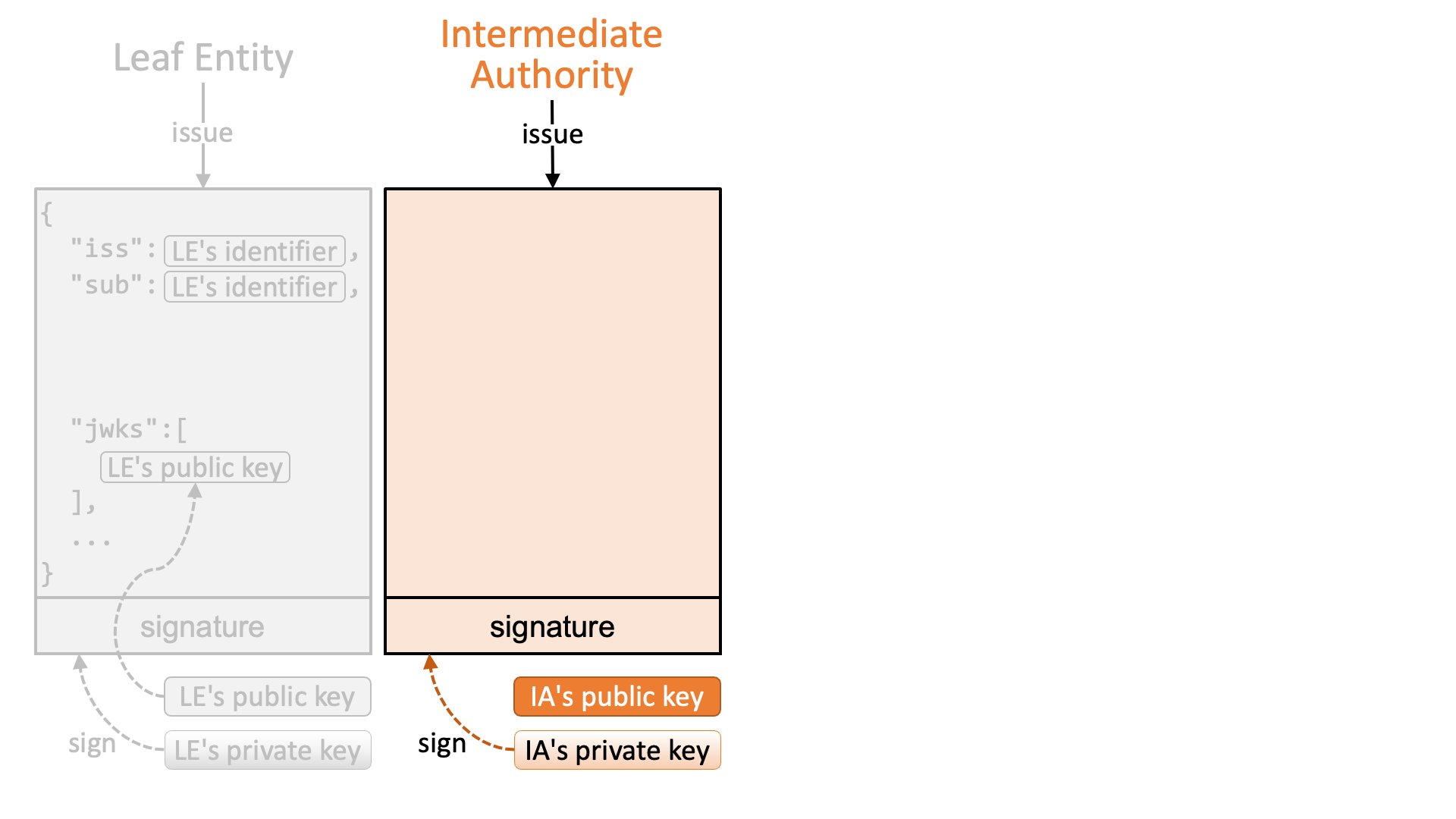
sub claim holds the leaf entity’s identifier while the iss claim holds the intermediate authority’s identifier.
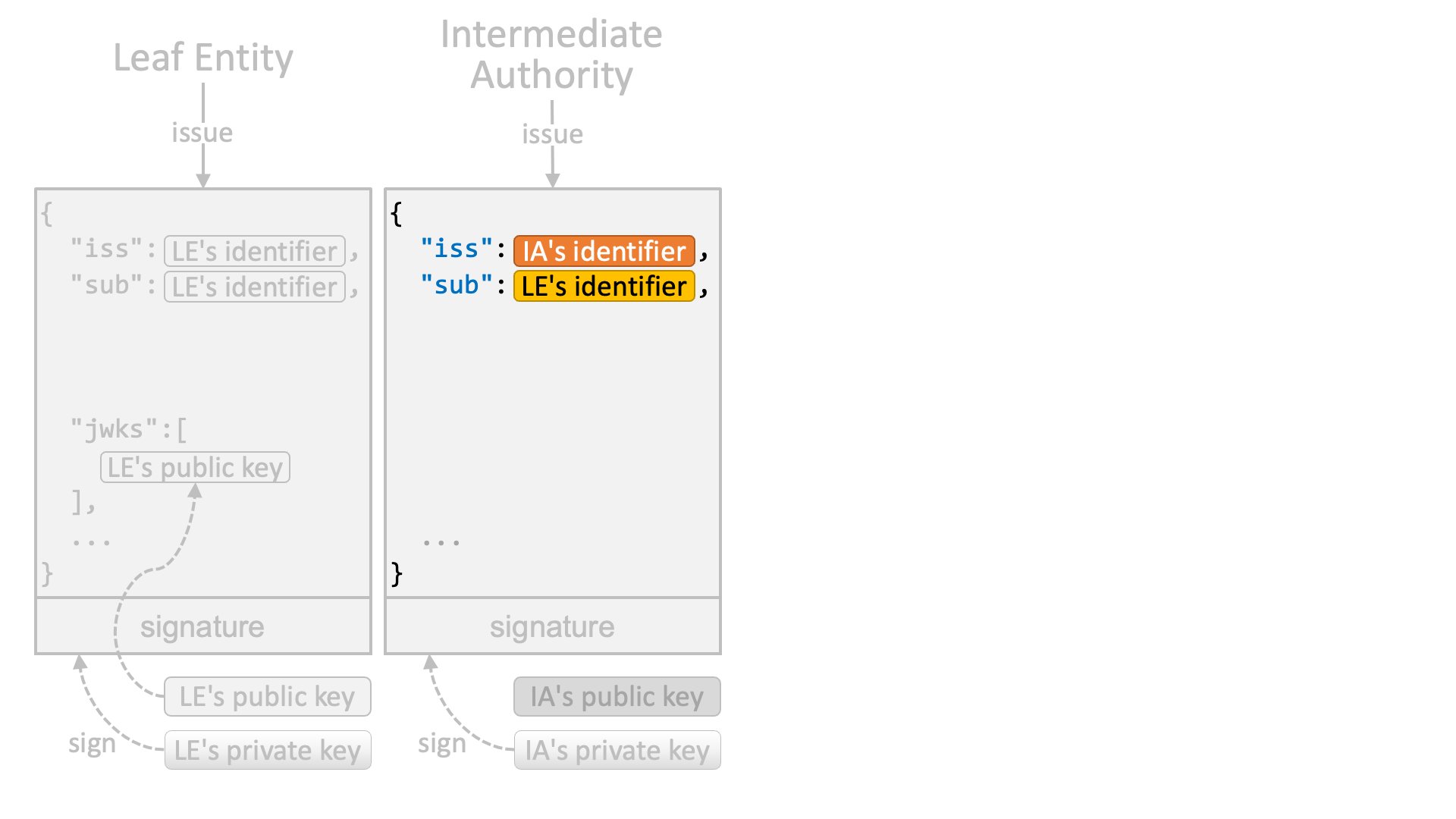
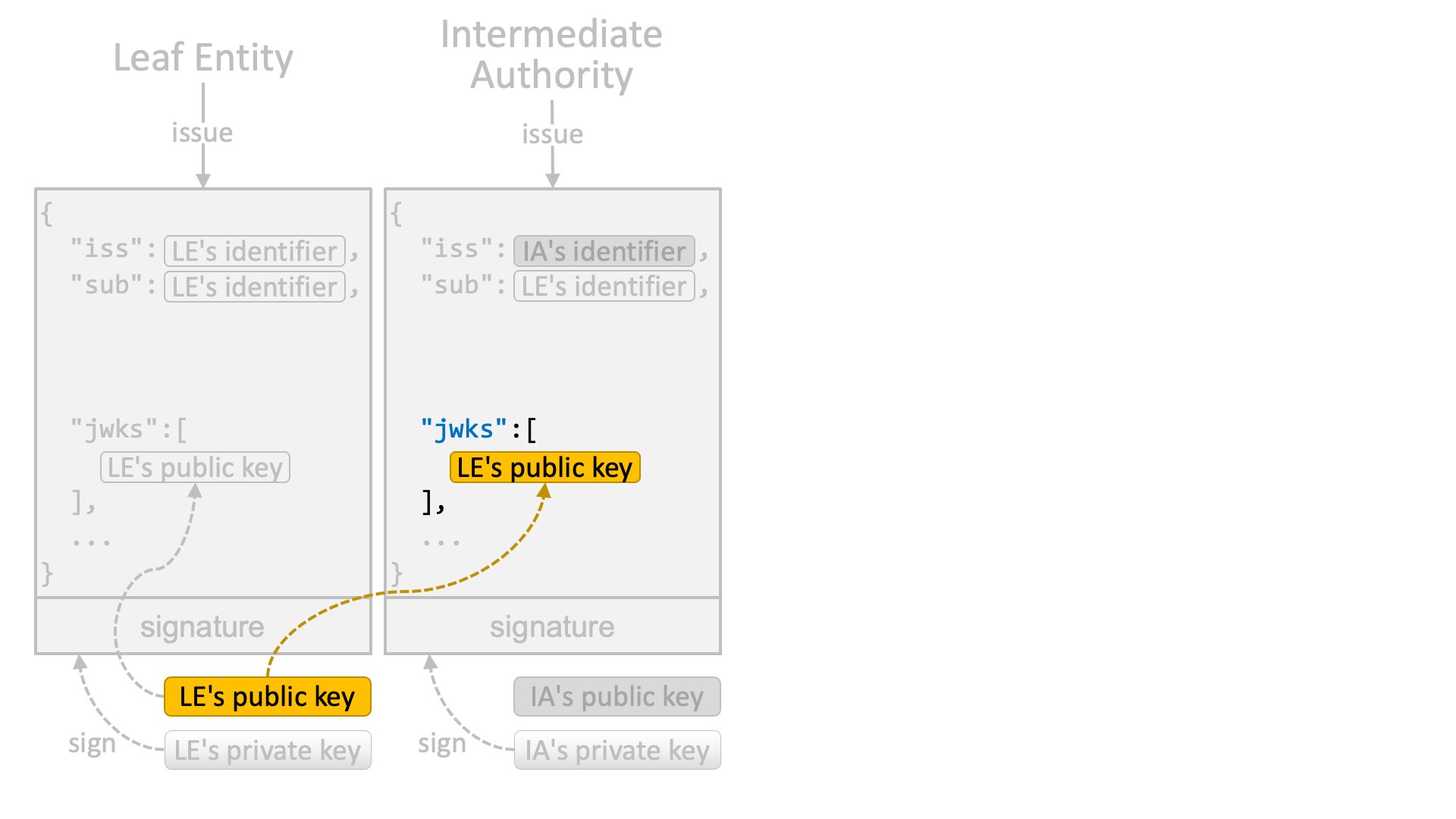
jwks claim holds the public key of the leaf entity.
JWT Issued by Trust Anchor
A trust chain is terminated by a JWT signed by a trust anchor’s private key.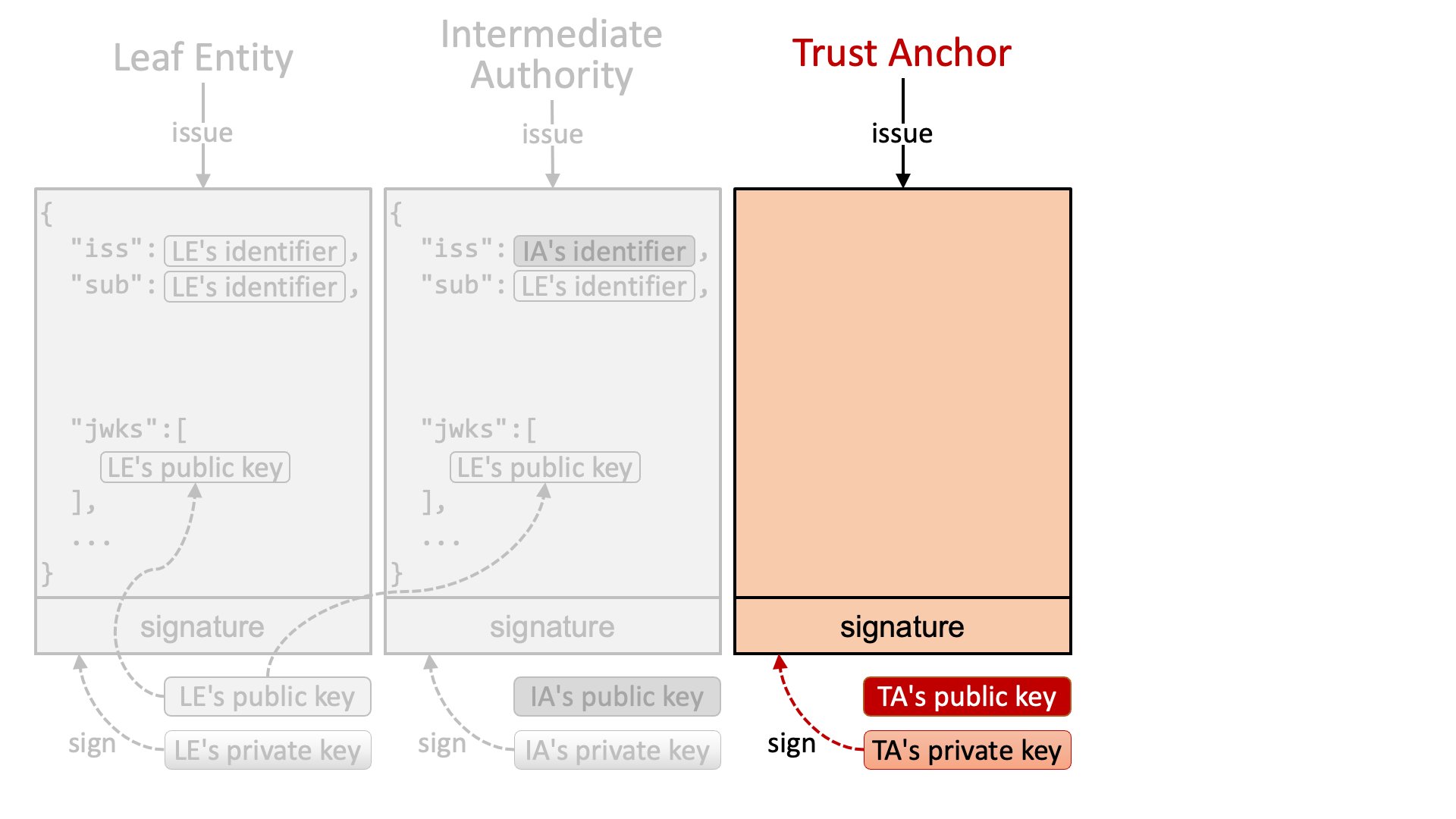
sub claim is the last intermediate authority’s identifier and the value of the iss claim is the trust anchor’s identifier. If no intermediate authorities are involved, the trust anchor issues a JWT that directly authorizes the leaf entity. In that case, the sub claim holds the leaf entity’s identifier.
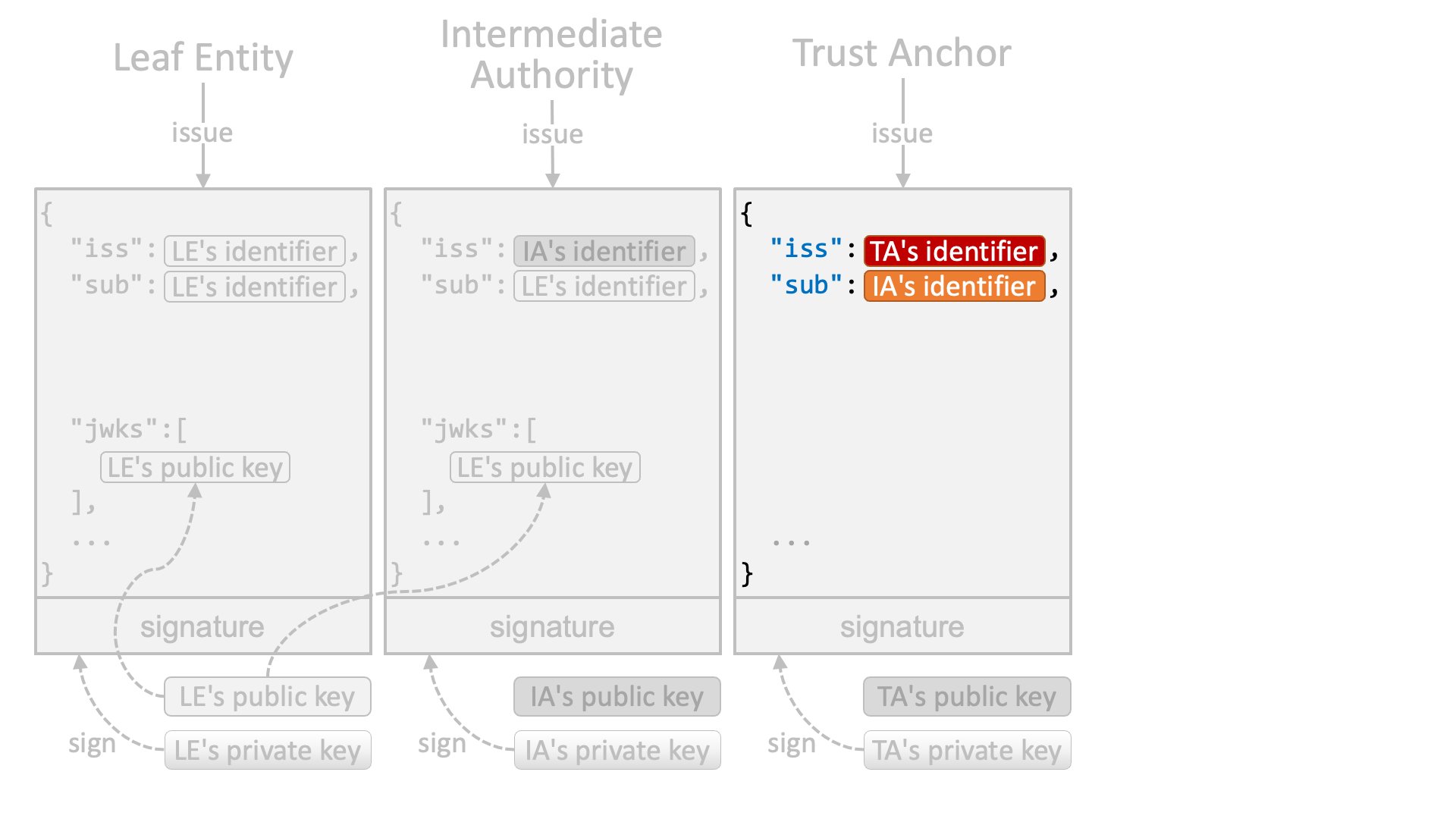
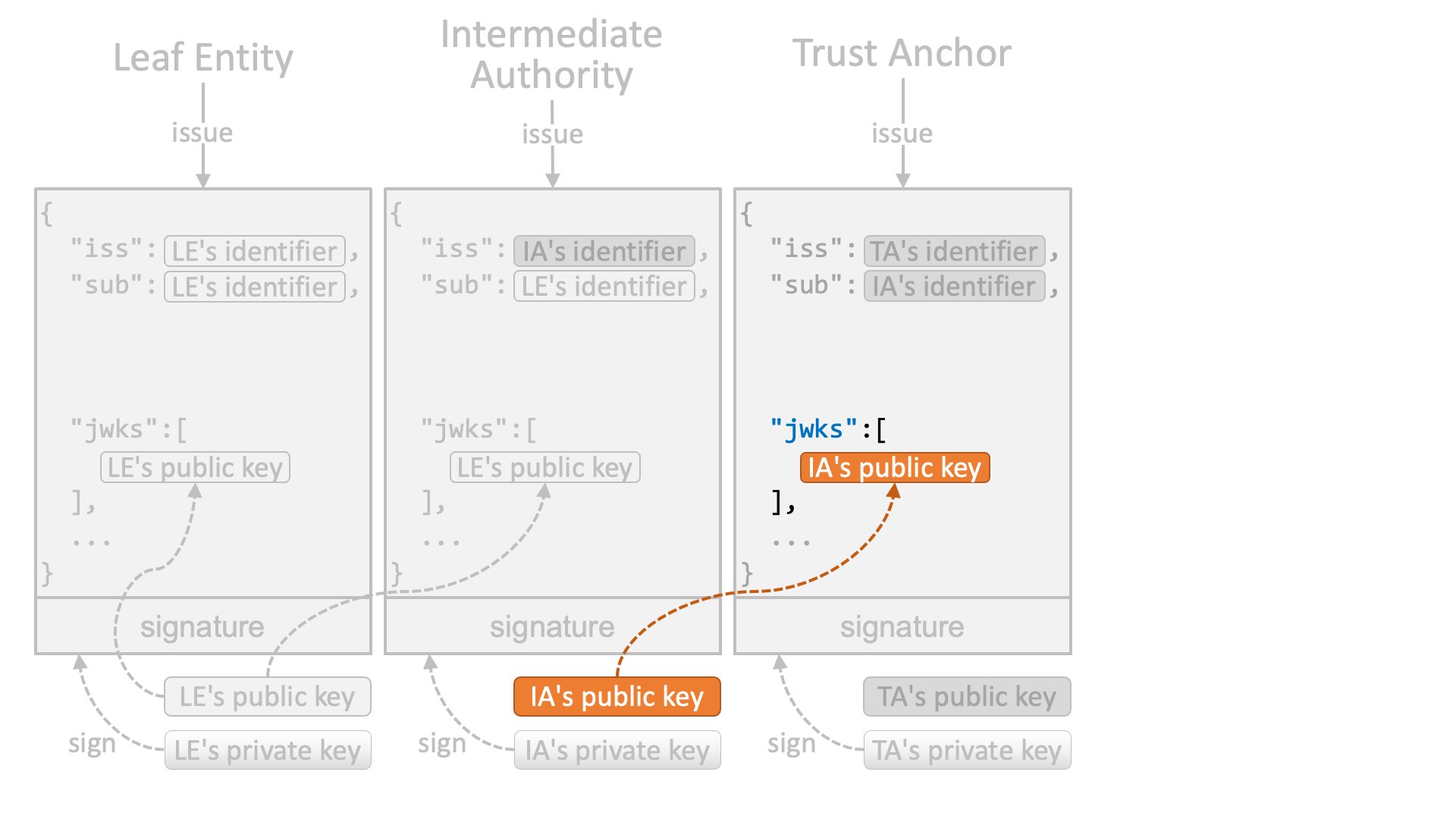
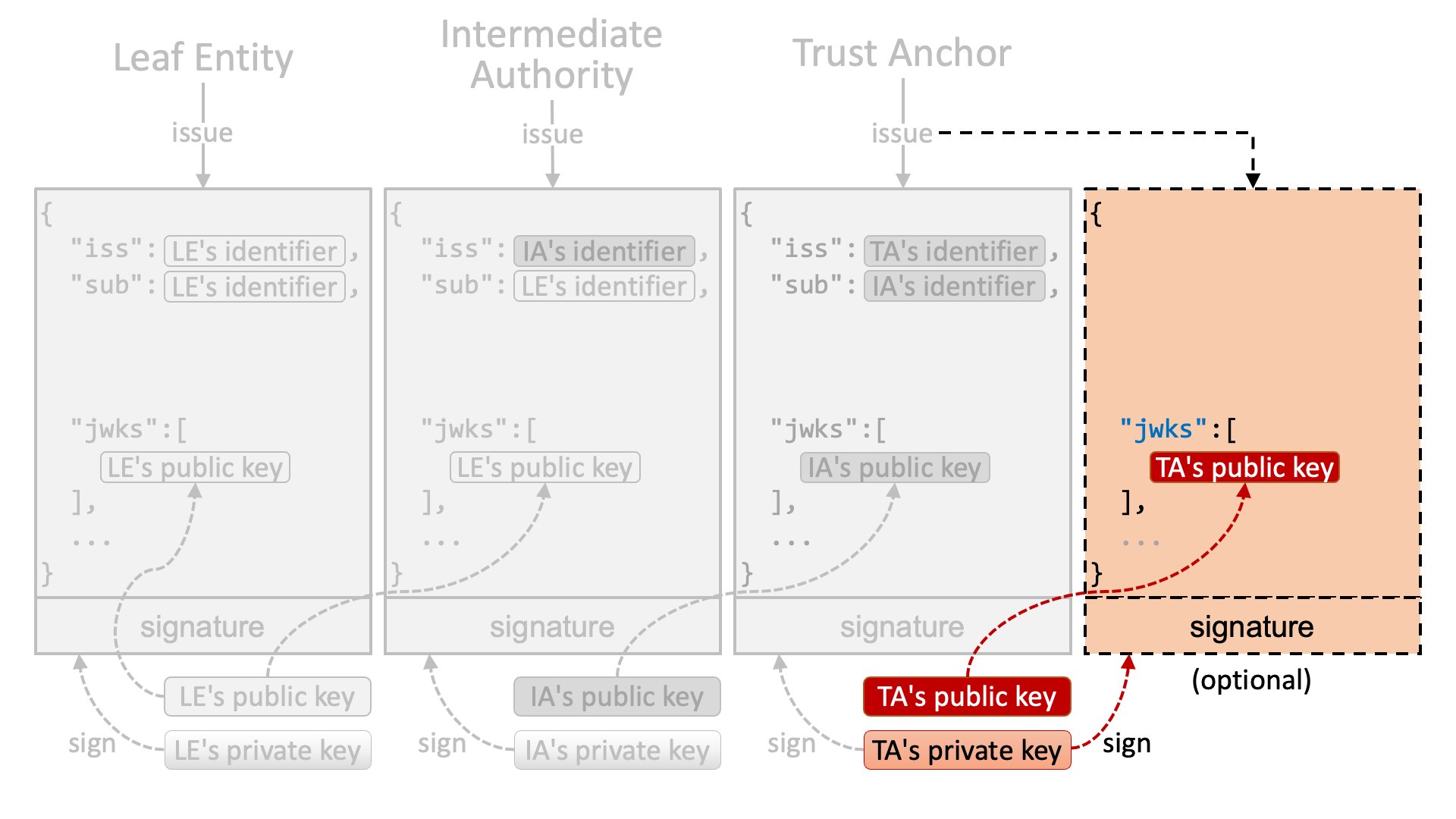
iss claim and the sub claim hold the trust anchor’s identifier.
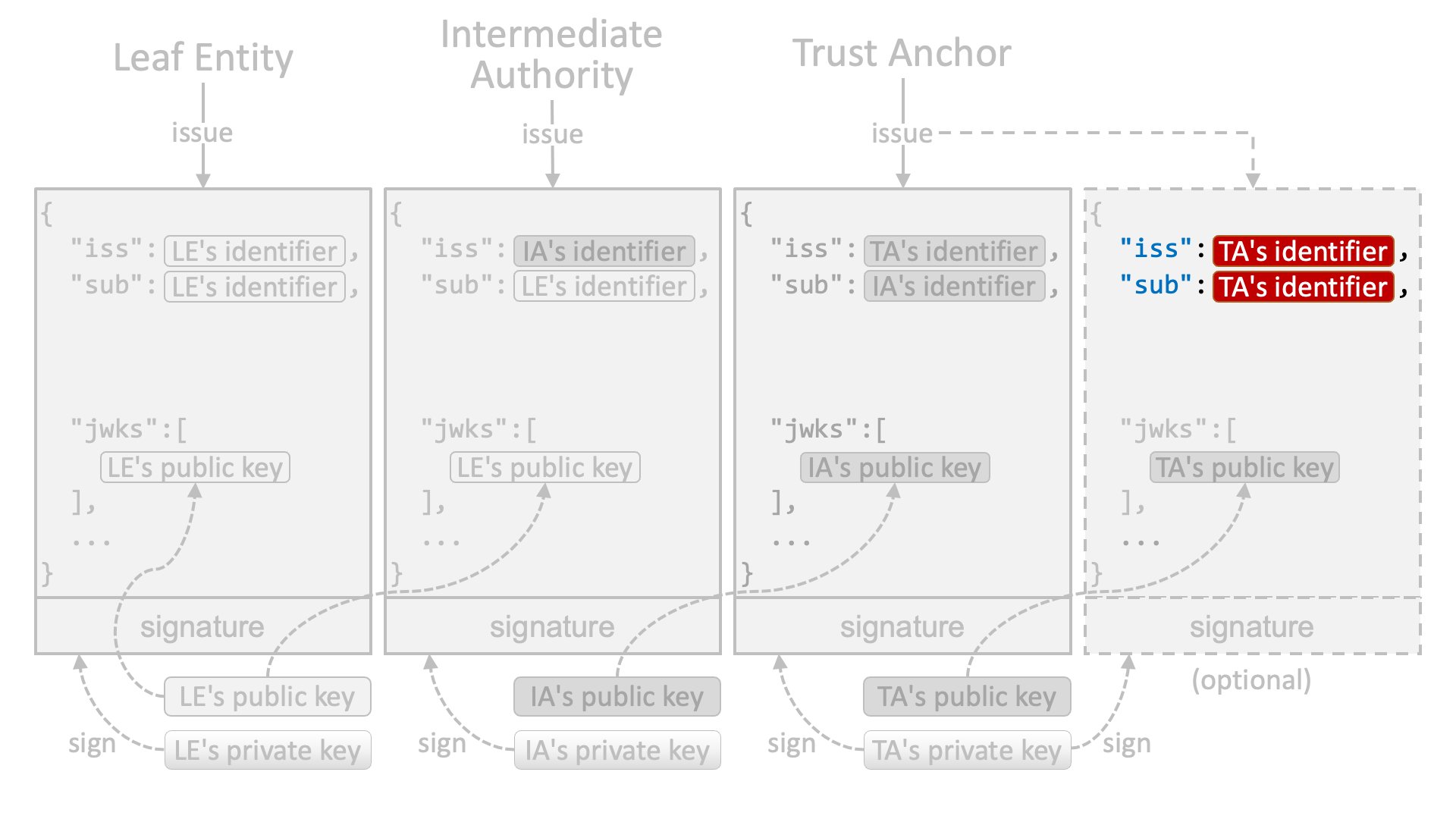
Trust Chain Summary
The following diagram depicts the entire trust chain.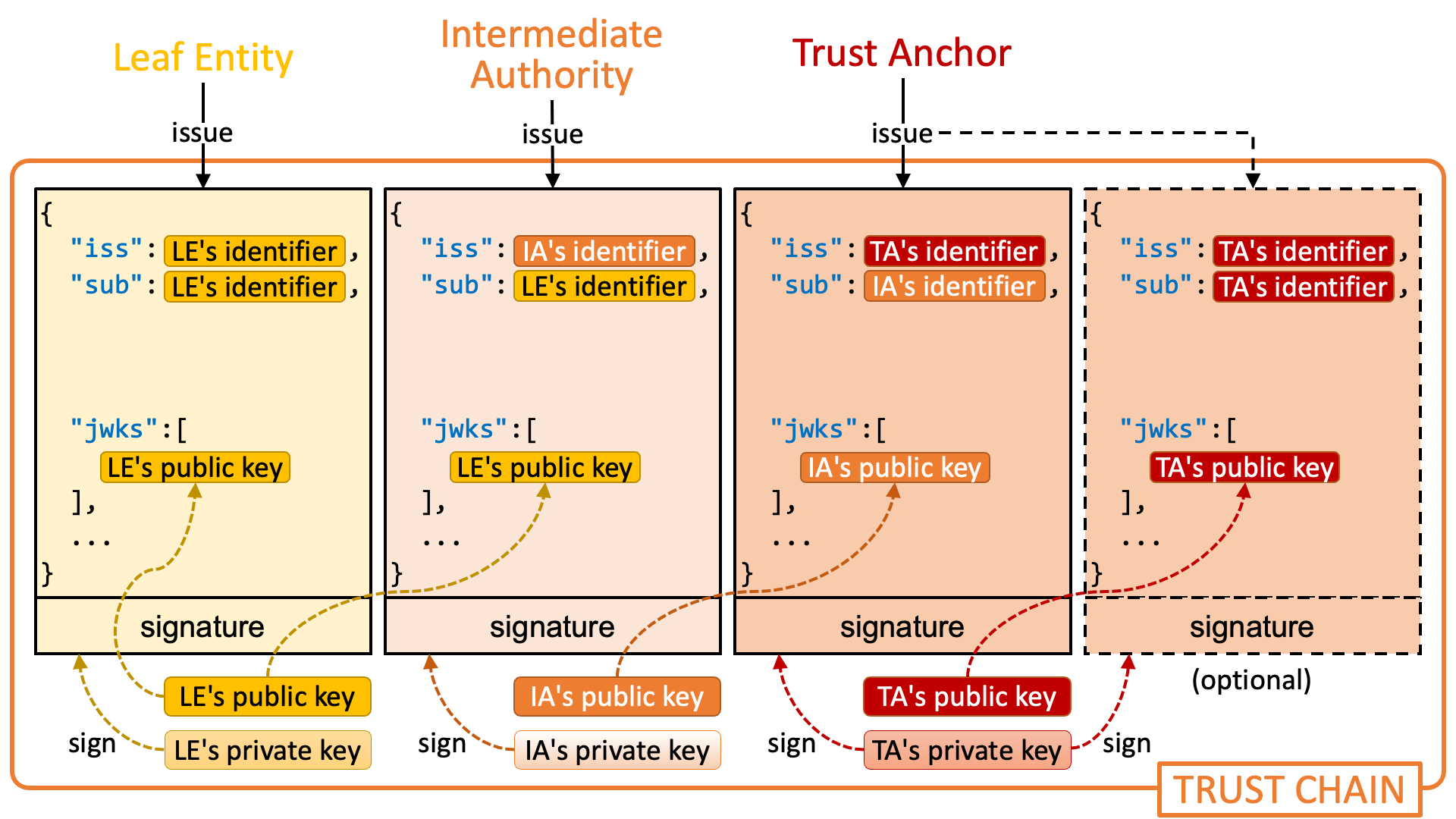
Trust Chain Resolution
Entity Configuration
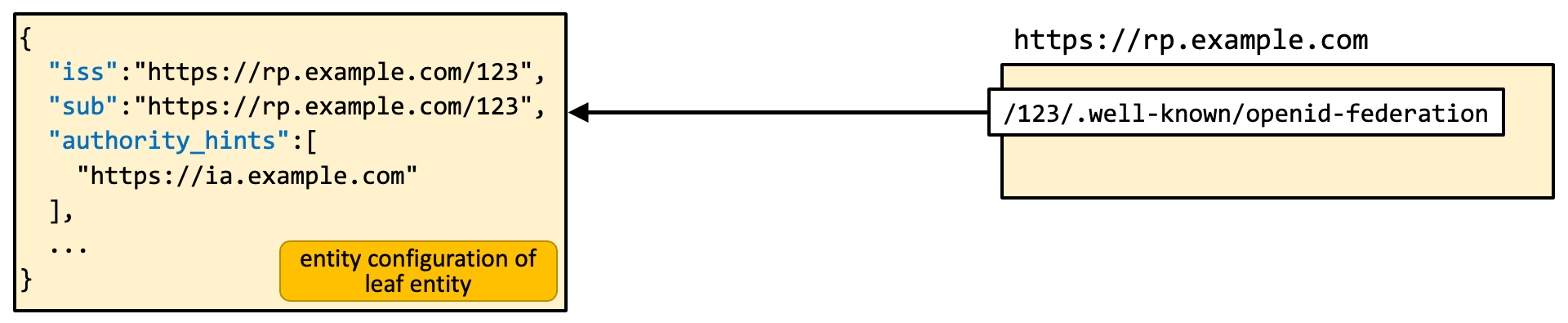
The resolution process of a trust chain starts from getting the self-signed JWT of a leaf entity. The location of the self-signed JWT is defined in the OpenID Federation specification. It is a URL constructed by concatenating the leaf entity’s identifier and the fixed string"/.well-known/openid-federation".
http:// or https://. Your guess is correct.
Participants of a federation, i.e., identity providers, relying parties, intermediate authorities and trust anchors, are called “federation entity”. Each federation entity has a globally unique identifier. The identifier is called “entity ID”. And, entity IDs must be URLs whose scheme part is either http or https. It is expected that Web servers are running on hosts identified by the URLs so that federation entities can issue JWTs that are necessary to build trust chains.
For instance, when the entity ID of a relying party is https://rp.example.com/123, the self-signed JWT of the relying party is expected to be published at the following URL.
/.well-known/openid-federation are called “entity configuration”.
Authority Hints
The payload part of an entity configuration contains theauthority_hints claim. It is a JSON array listing entity IDs of intermediate authorities and/or trust anchors that can issue a JWT indicating that the authority authorizes the federation entity of the entity configuration.
For example, when a relying party whose entity ID is https://rp.example.com/123 has a direct intermediate authority whose entity ID is https://ia.example.com, the authority_hints claim in the entity configuration of the relying party contains https://ia.example.com.
https://ta.example.com as a direct authority, the authority_hints claim in the entity configuration of the intermediate authority contains https://ta.example.com.
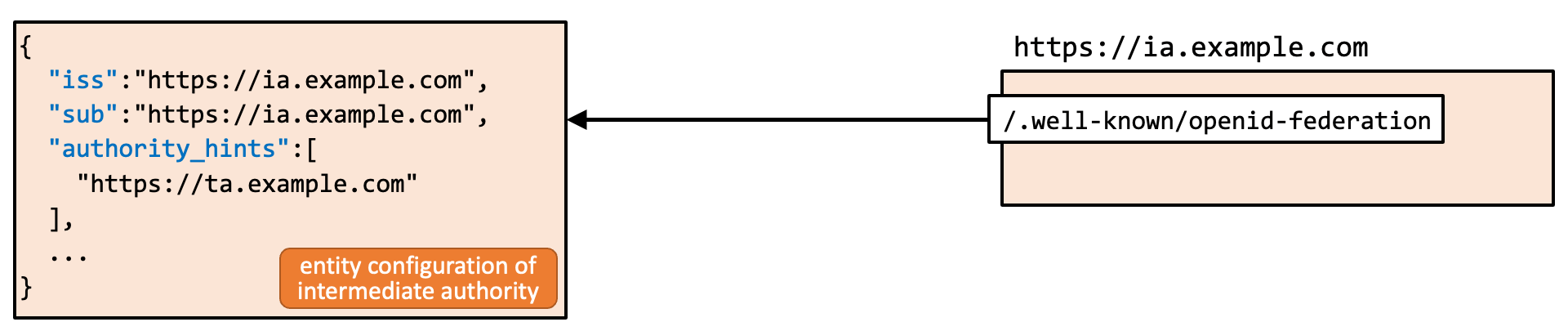
authority_hints claim.

Federation Fetch Endpoint
The next step after getting the entity configuration of a leaf entity is to get a JWT from the direct authority of the leaf entity that indicates that the authority authorizes the leaf entity. Authorities are supposed to provide an endpoint that issues JWTs for the purpose. The endpoint is called “federation fetch endpoint”. The table below is a summary of the specification of the endpoint.| Request | |||
|---|---|---|---|
| HTTP Method | GET | ||
| Parameters | iss | Optional | The entity ID of the issuer. |
sub | Optional | The entity ID of the subject. | |
| Response | |||
| HTTP Status Code | 200 | ||
| Content-Type | application/entity-statement+jwt | ||
https://ia.example.com provides its federation fetch endpoint at https://ia.example.com/fetch, a JWT that indicates that the intermediate authority authorizes a federation entity https://rp.example.com/123 can be obtained by making the following HTTP request.
federation_fetch_endpoint claim holds the URL of the endpoint, but the claim is put at a bit deep place. It is placed inside the federation_entity JSON object which is inside the metadata JSON object.
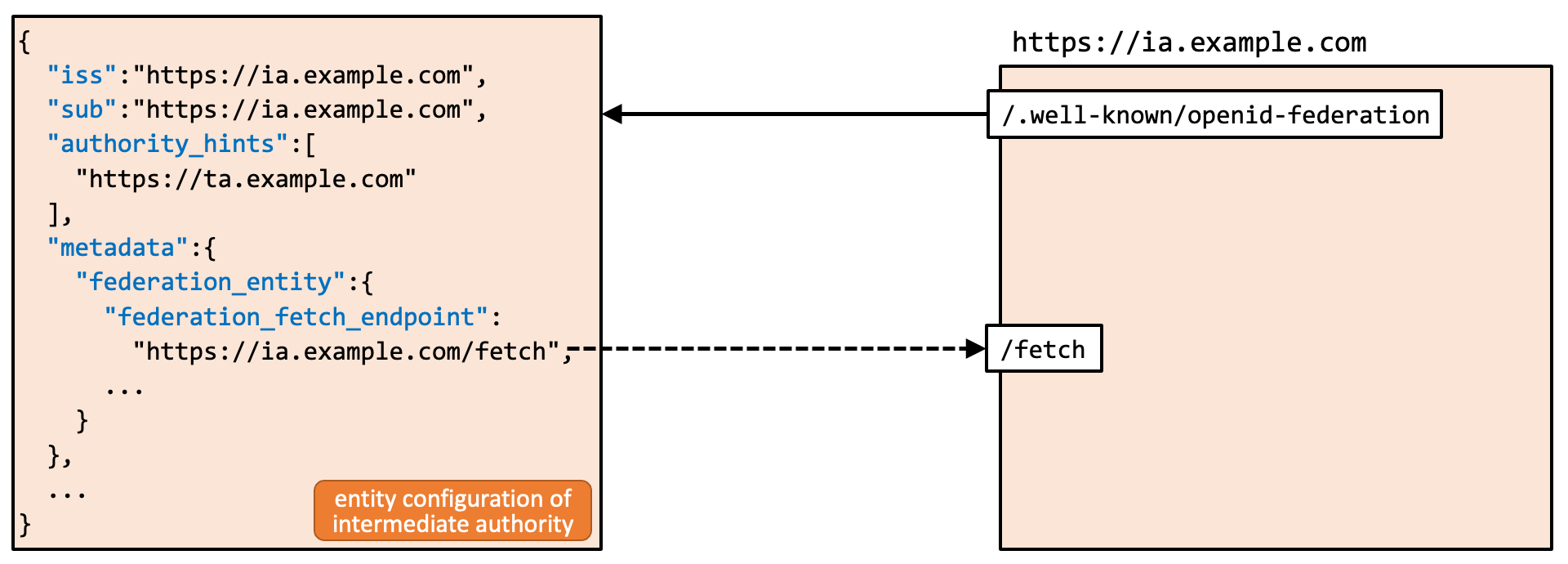
authority_hints claim need to be tried.
Trust Chain Resolution Flow
Let’s review the flow of trust chain resolution. (1) The first step is to get the entity configuration of a leaf entity.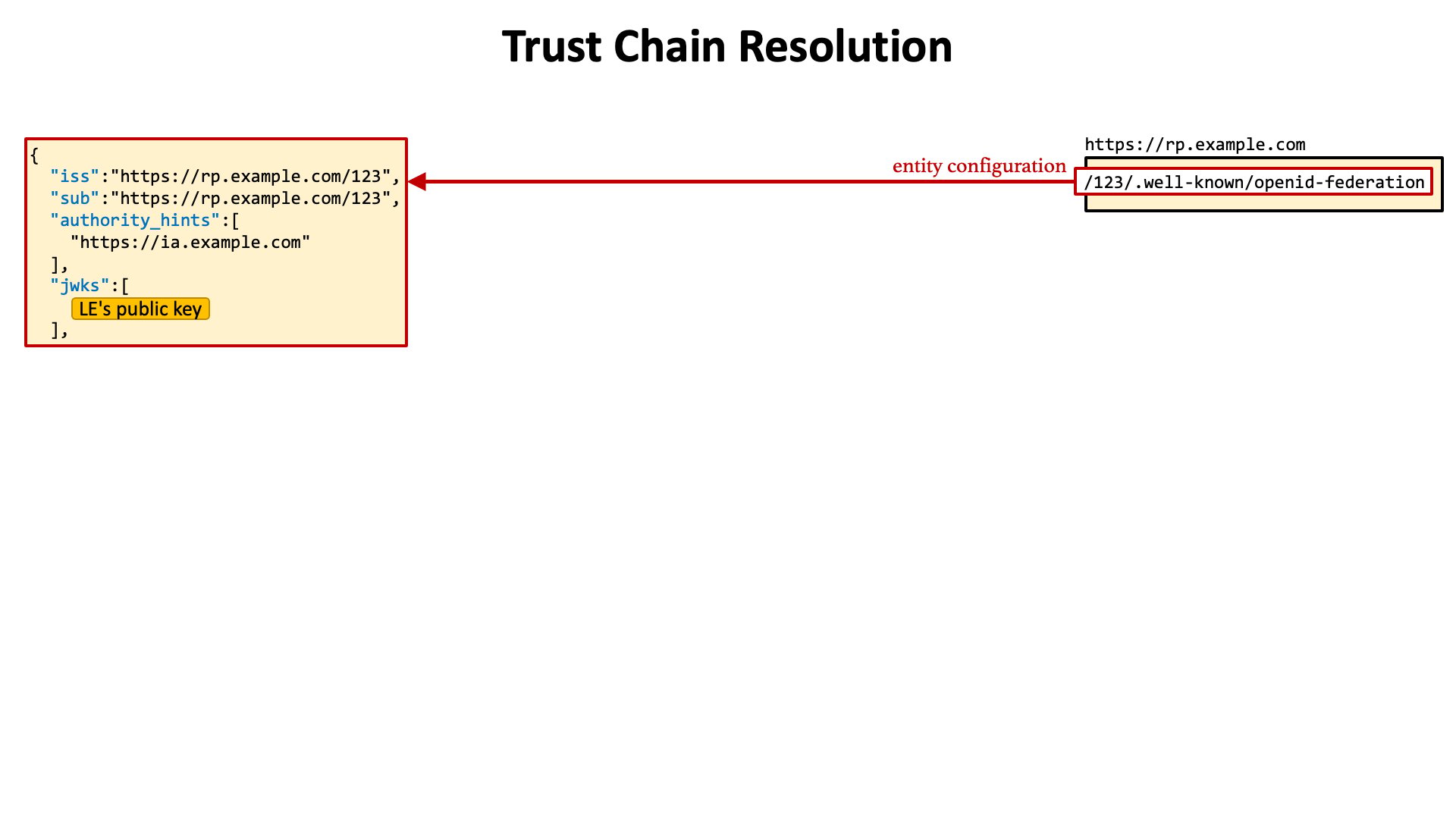
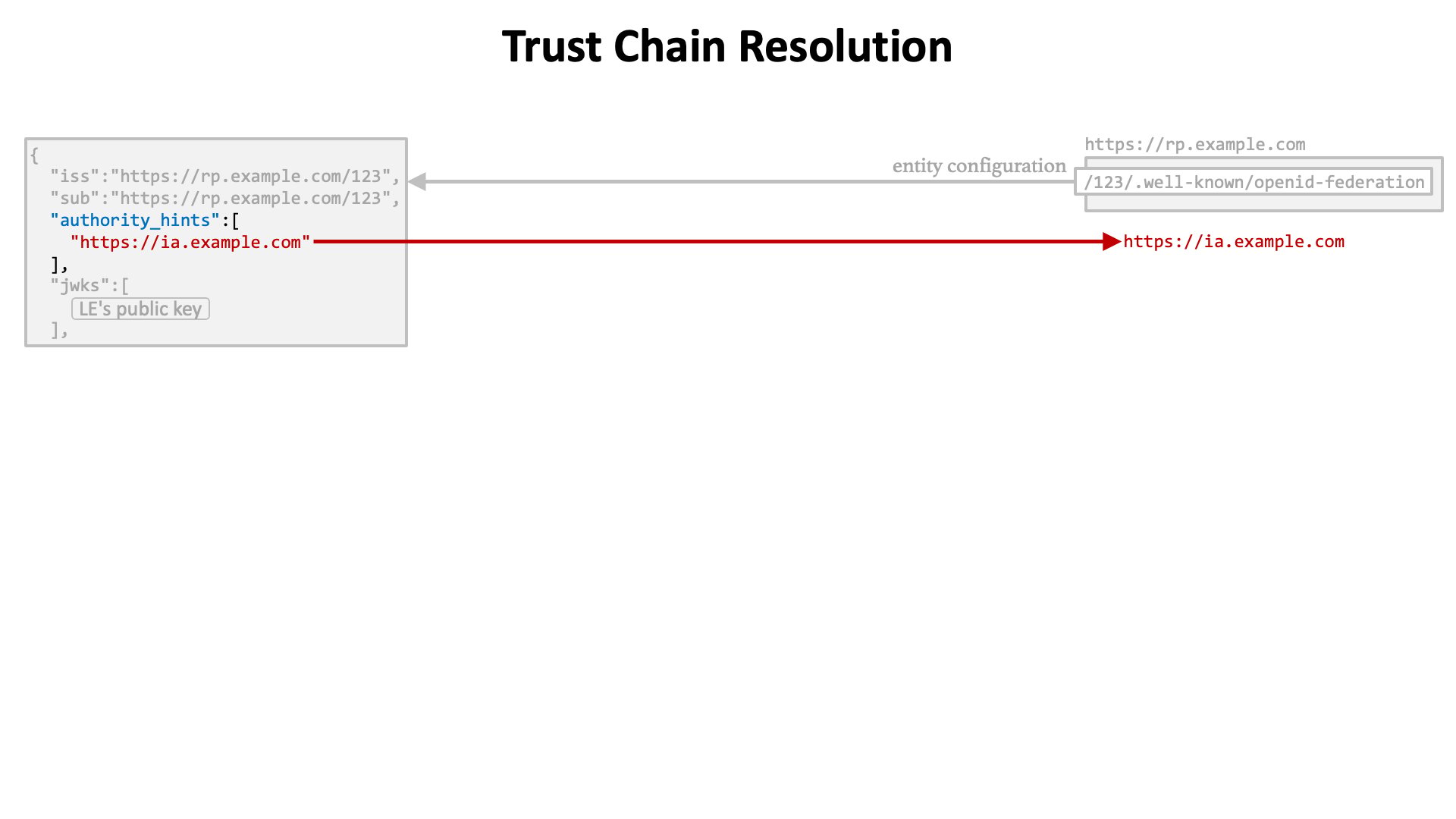
authority_hints claim. It is a JSON array listing entity IDs of intermediate authorities or trust anchors. Web servers of authorities can be identified by the entity IDs. In this example, an intermediate authority https://ia.example.com is included in the authority_hints claim.
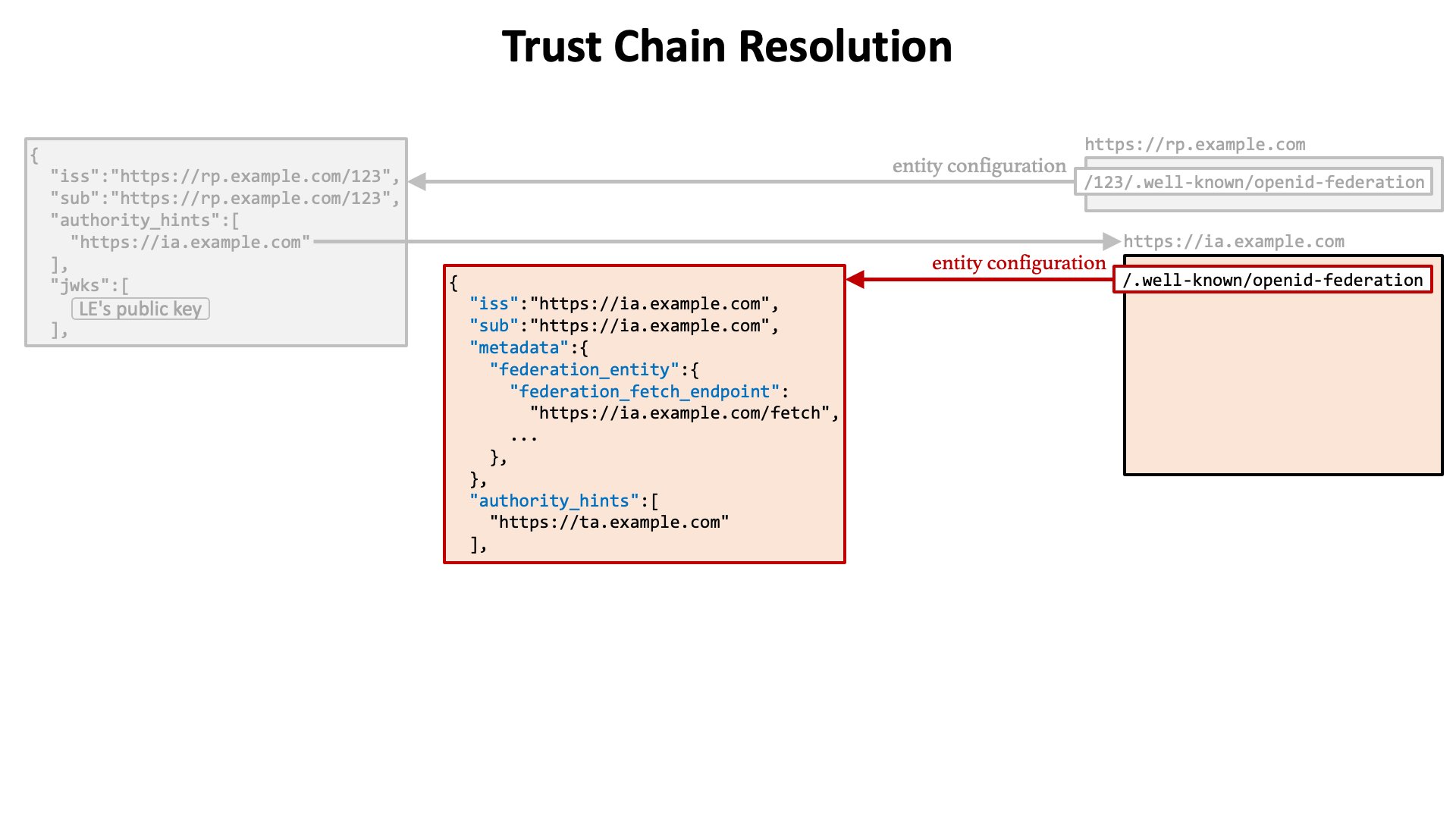
sub request parameter is sent to the federation fetch endpoint. In this example, the entity ID of the leaf entity (https://rp.example.com/123) is specified as the value of the sub request parameter.
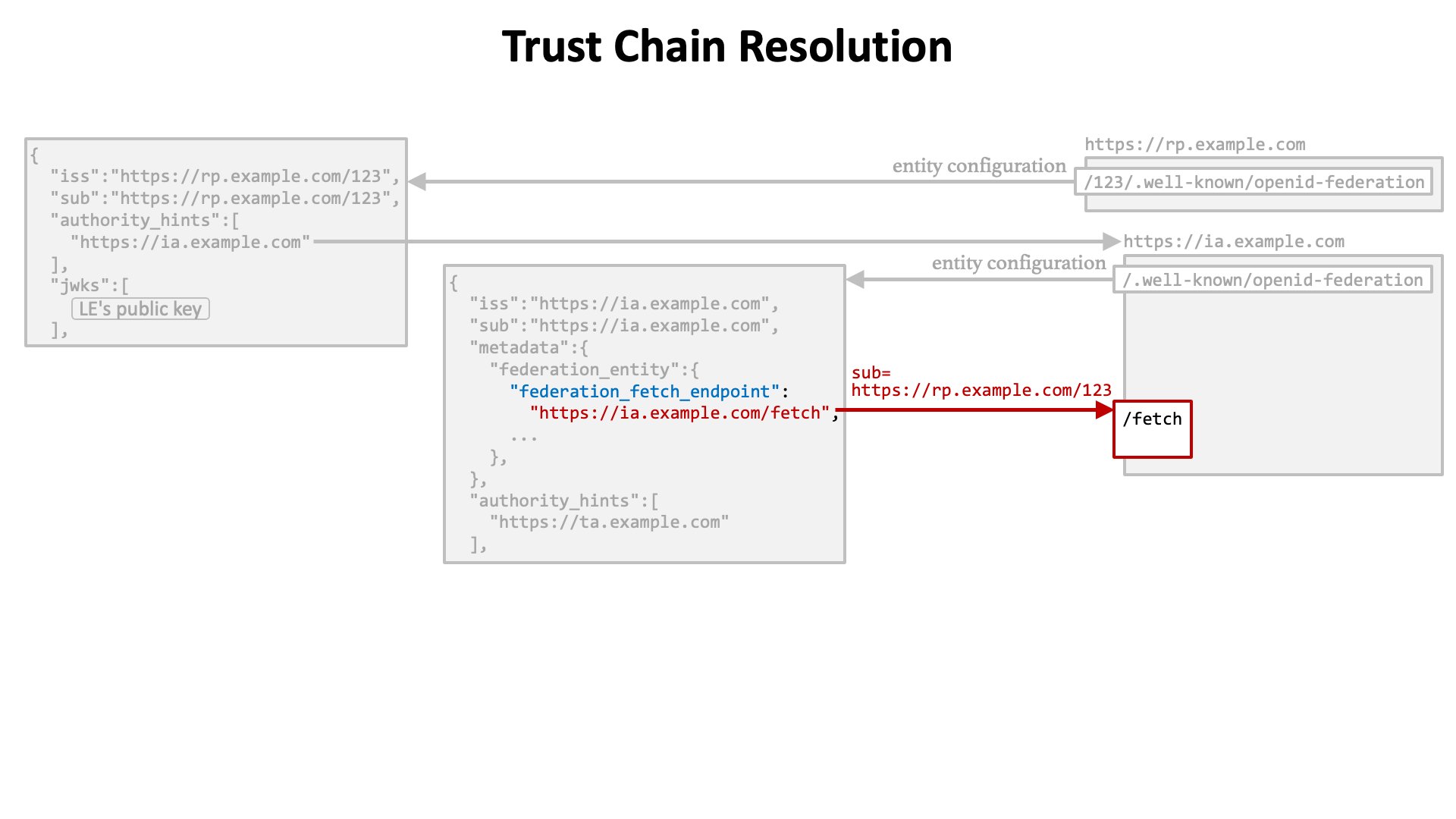
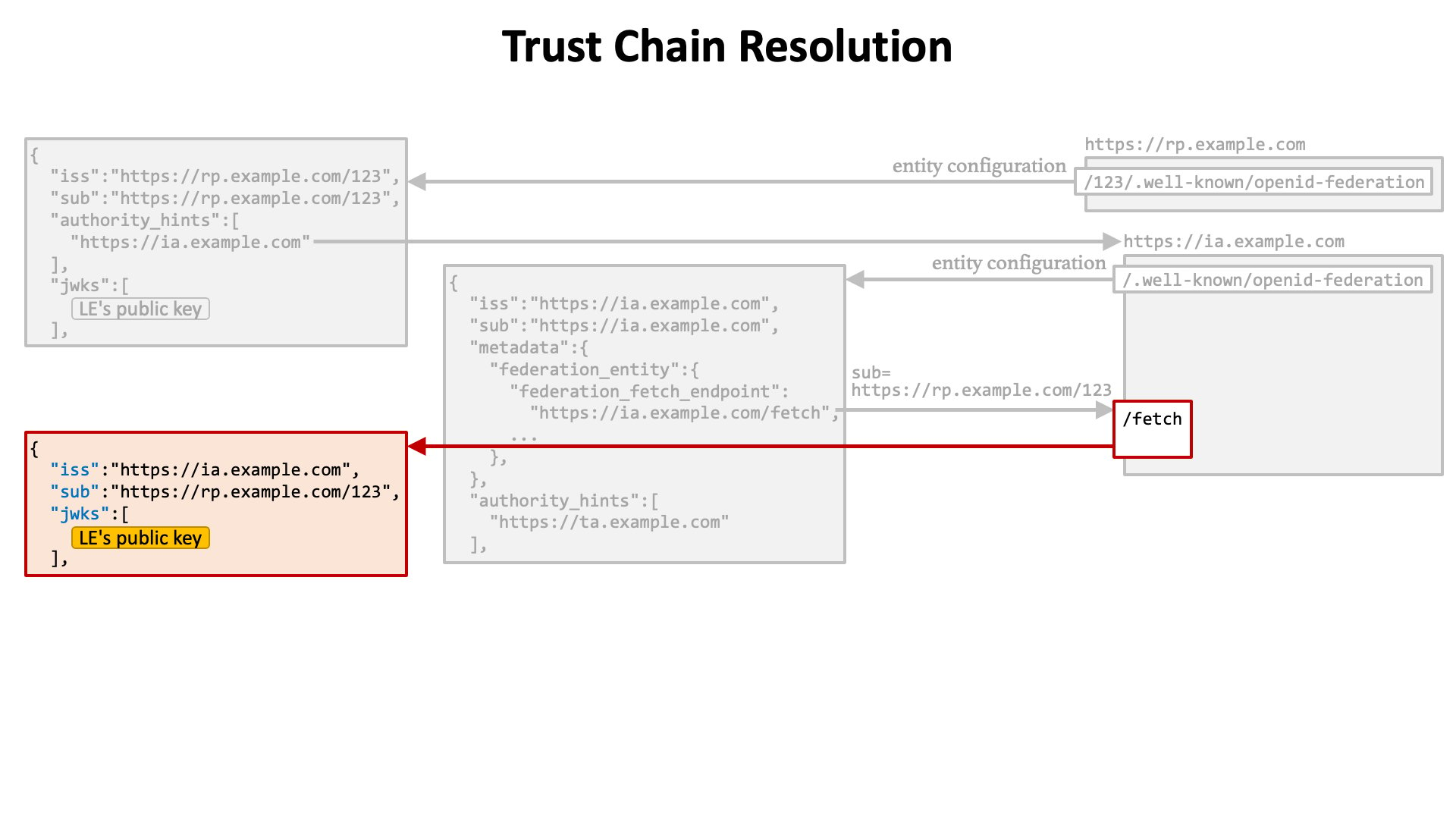
authority_hints claim in the entity configuration of the intermediate authority. In this example, a trust anchor https://ta.example.com is included in the authority_hints claim.
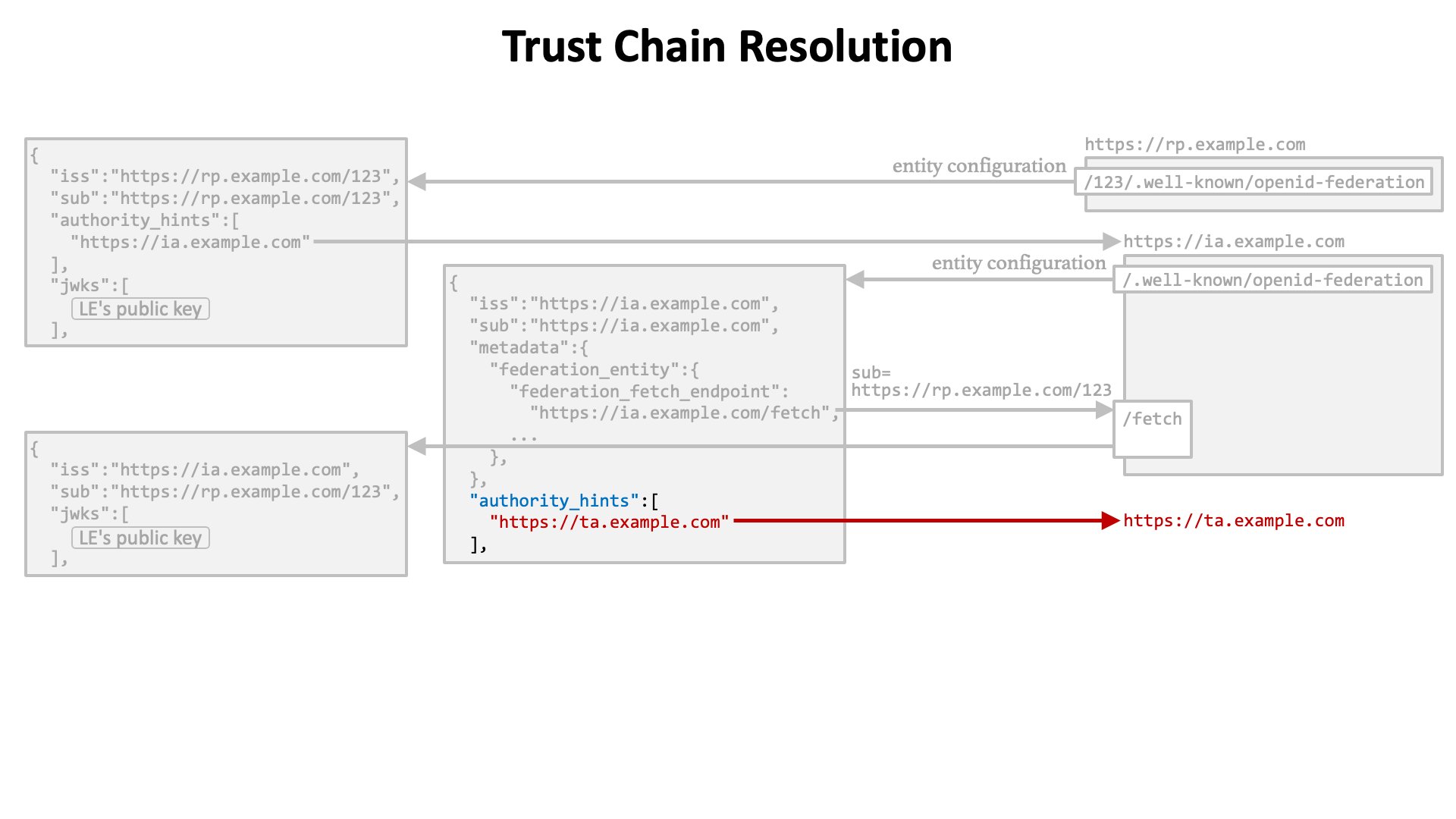
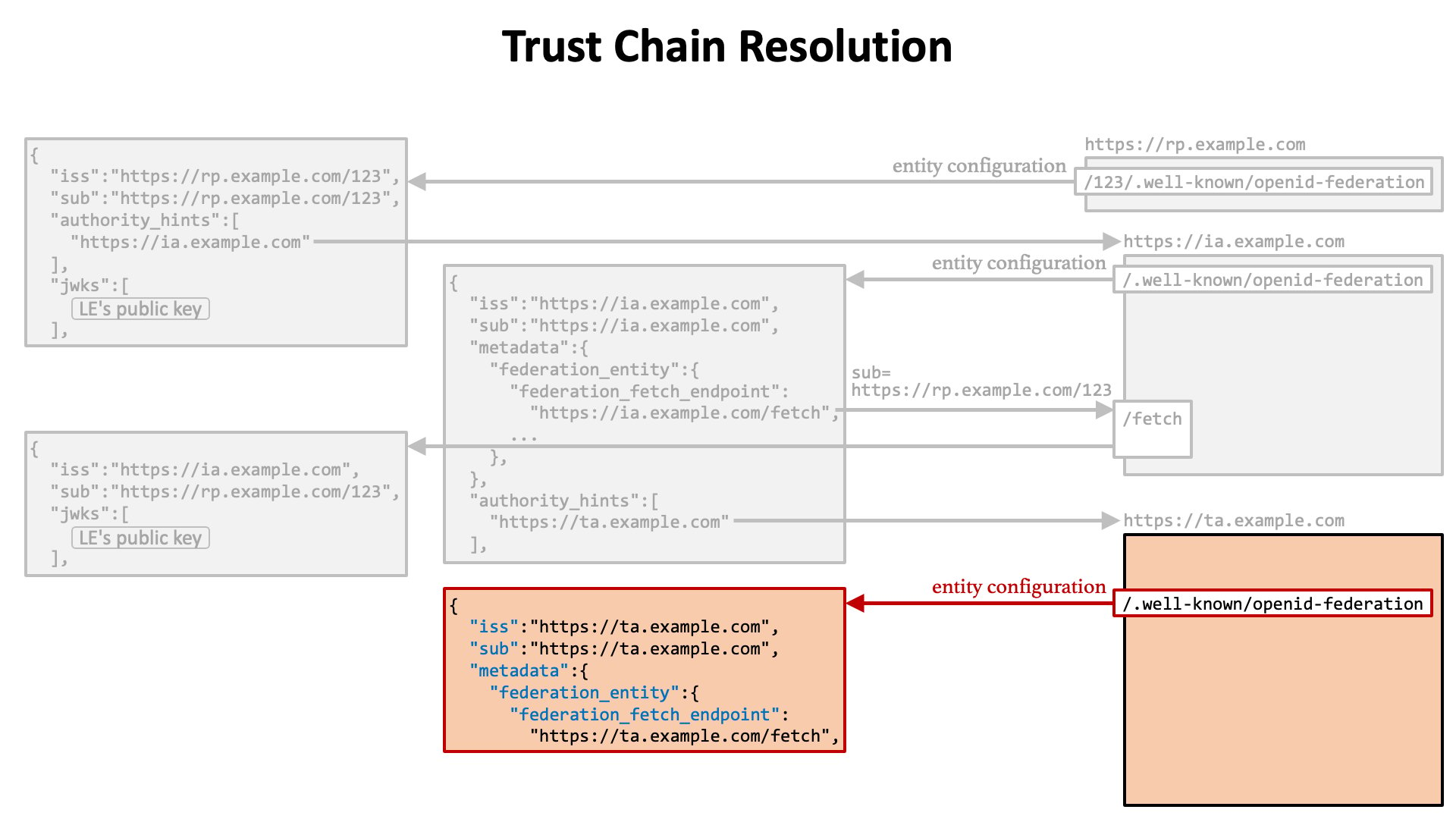
sub request parameter is sent to the federation fetch endpoint. In this example, the entity ID of the intermediate authority (https://ia.example.com) is specified as the value of the sub request parameter.
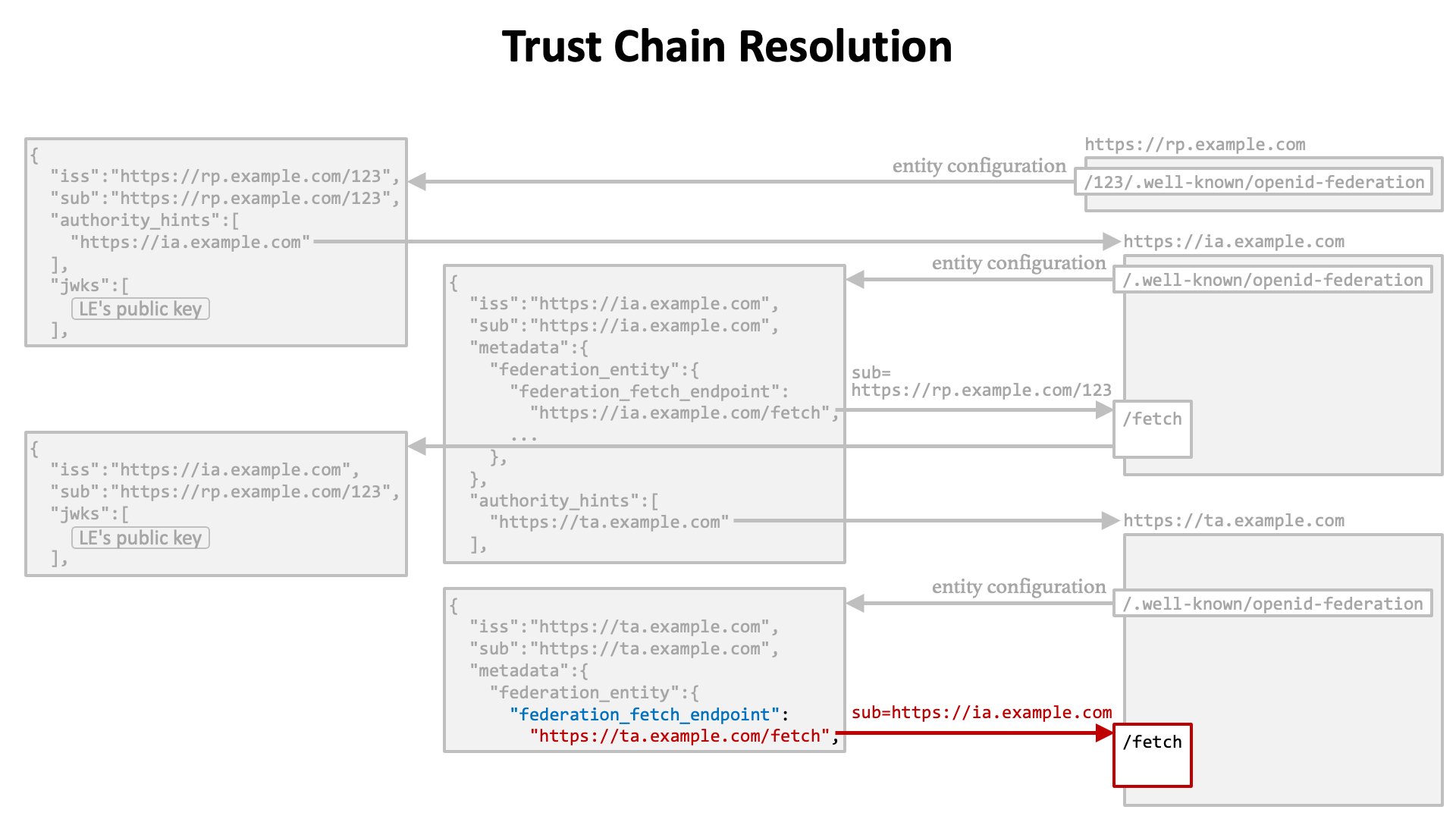
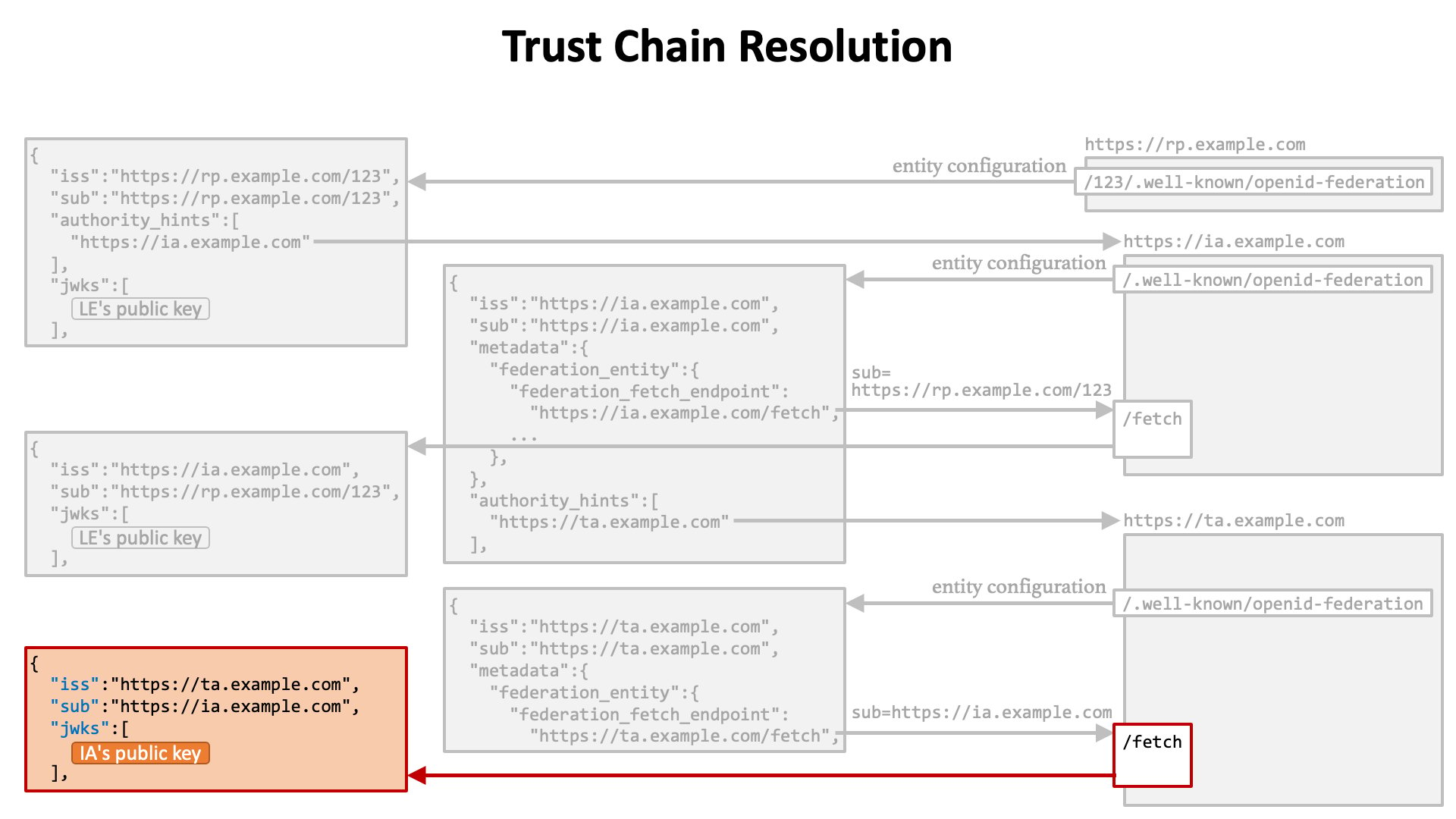
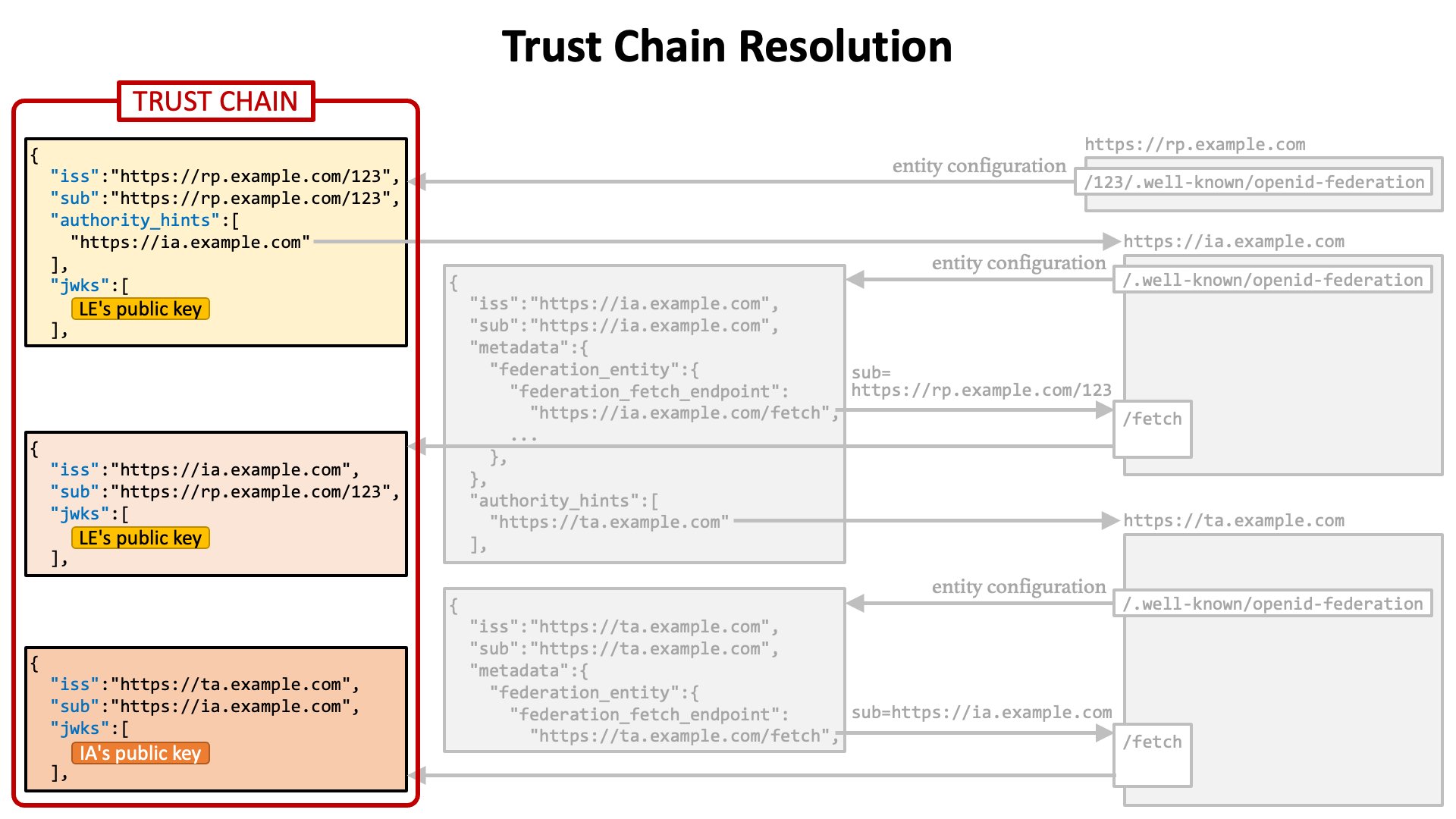
Trust Chain Resolution Summary
The following diagram depicts the entire flow of trust chain resolution.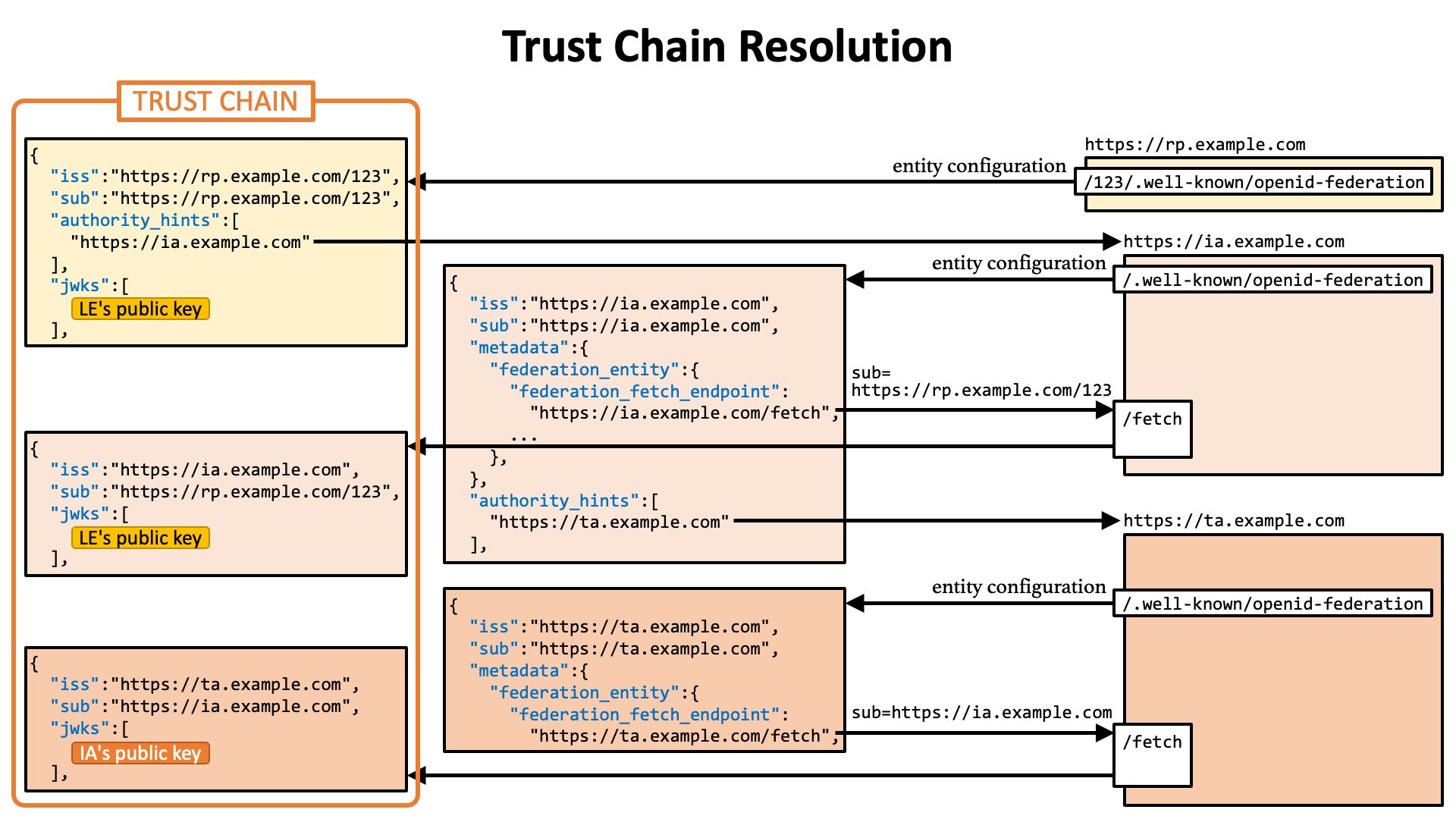
Metadata
An entity configuration contains metadata of the federation entity.Identity Provider Metadata
Metadata of an identity provider are put in theopenid_provider JSON object which is in the metadata JSON object.
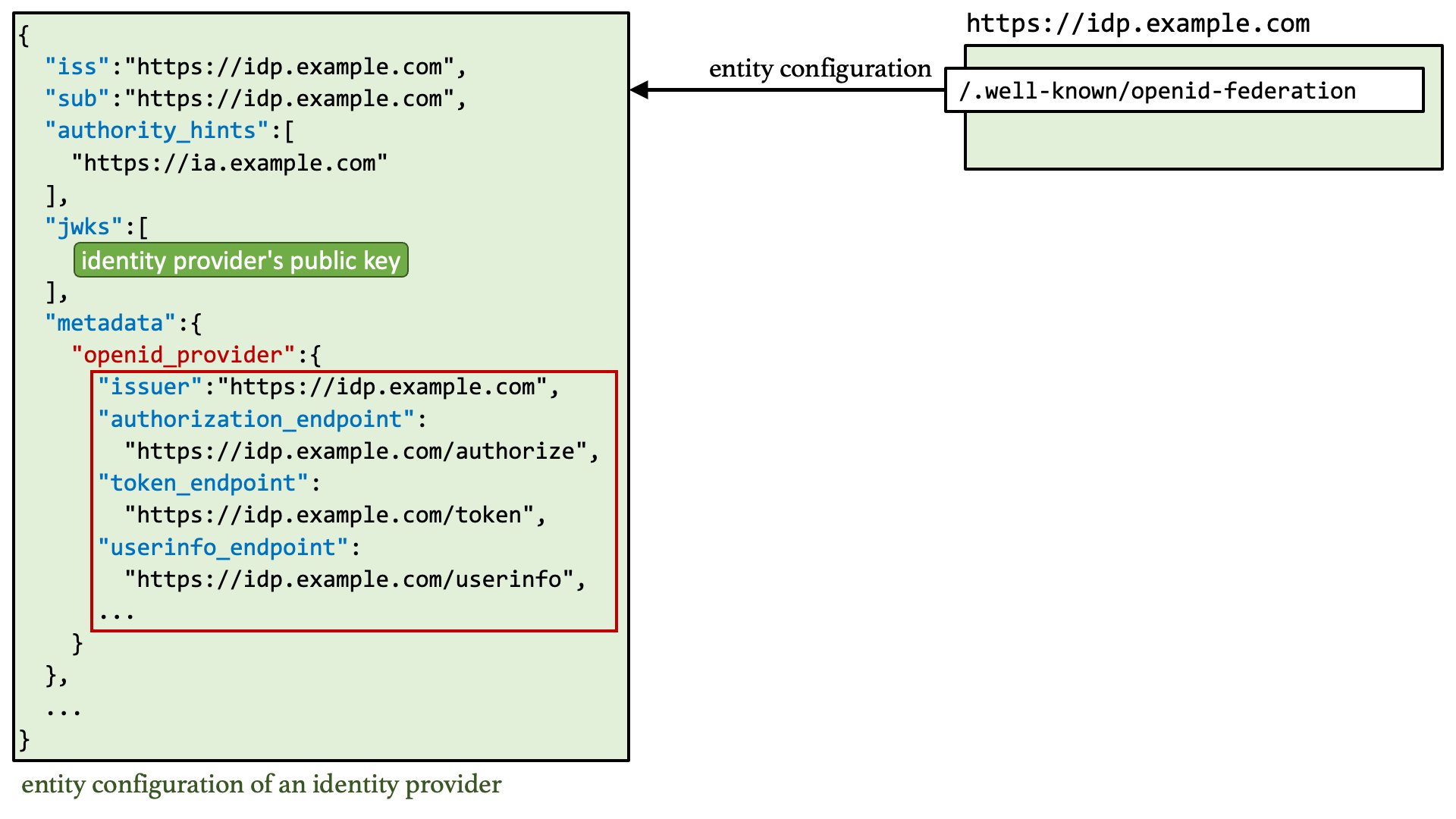
openid_provider JSON object.
In addition, the OpenID Federation specification defines the following server metadata.
client_registration_types_supportedorganization_namefederation_registration_endpointrequest_authentication_methods_supported(removed in OpenID Federation 1.0 final)request_authentication_signing_alg_values_supported(removed in OpenID Federation 1.0 final)signed_jwks_urijwks
Relying Party Metadata
Metadata of a relying party are put in theopenid_relying_party JSON object which is in the metadata JSON object.
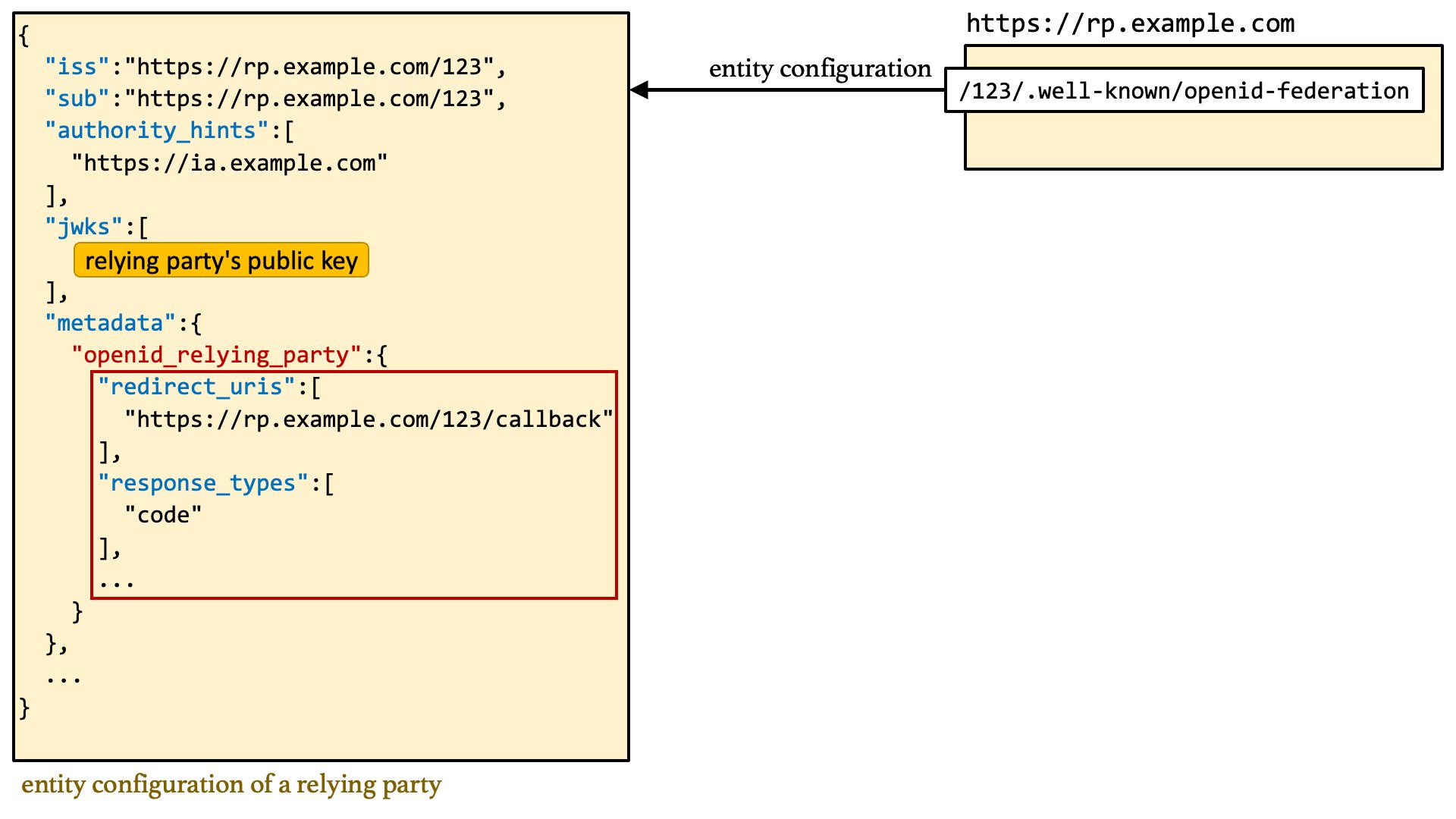
openid_relying_party JSON object.
In addition, the OpenID Federation specification defines the following client metadata.
client_registration_typesorganization_namesigned_jwks_uri
Authority Metadata
Metadata of authorities (intermediate authorities and trust anchors) are put in thefederation_entity JSON object which is in the metadata JSON object.
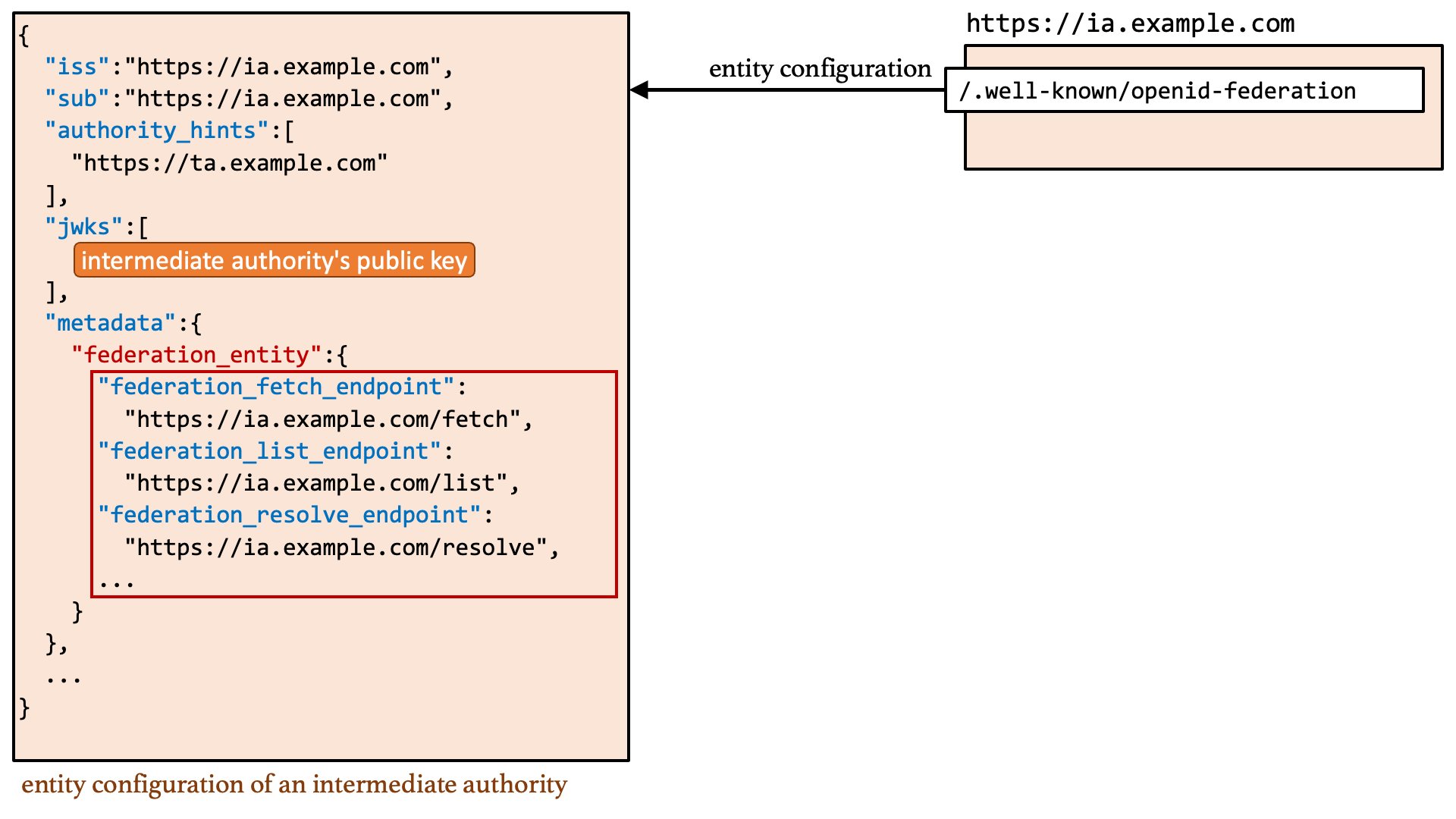
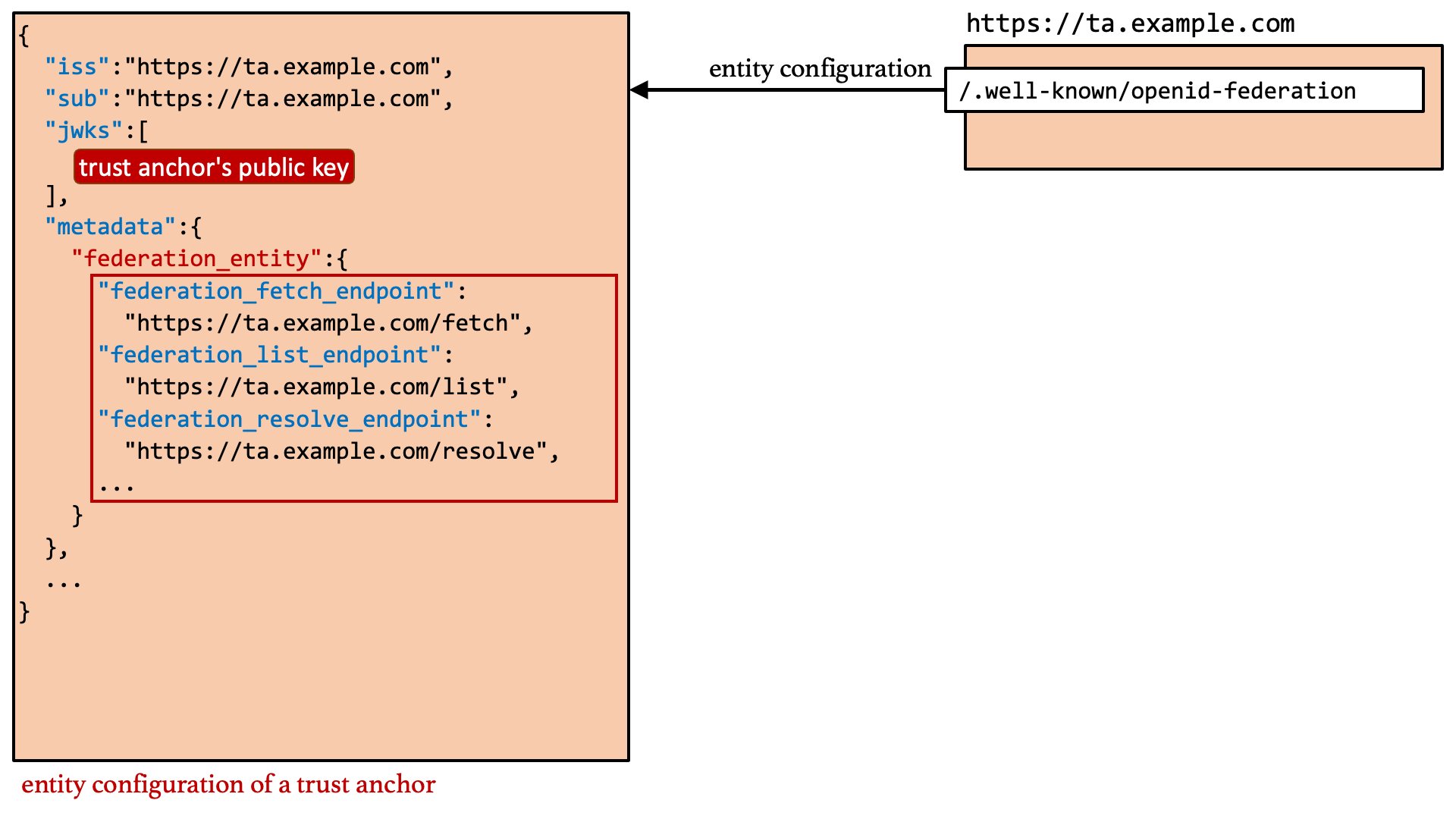
federation_fetch_endpointfederation_list_endpointfederation_resolve_endpointfederation_trust_mark_status_endpointorganization_namecontactslogo_uripolicy_urihomepage_uri
Metadata Policy
The entity configuration of the leaf entity in a trust chain includes metadata of the leaf entity. Themetadata claim is used to hold the metadata.
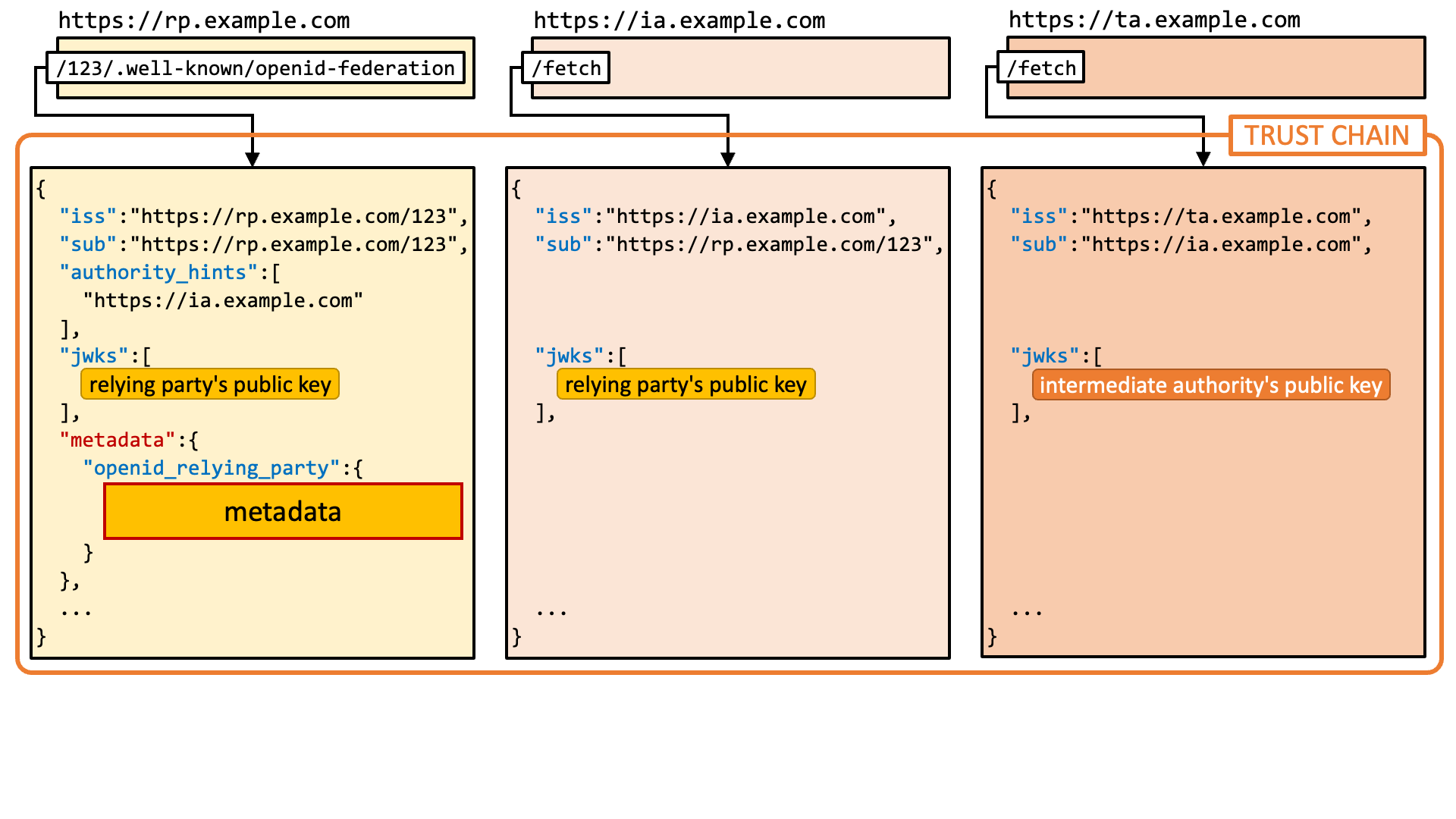
metadata_policy claim is used to hold the metadata policy.
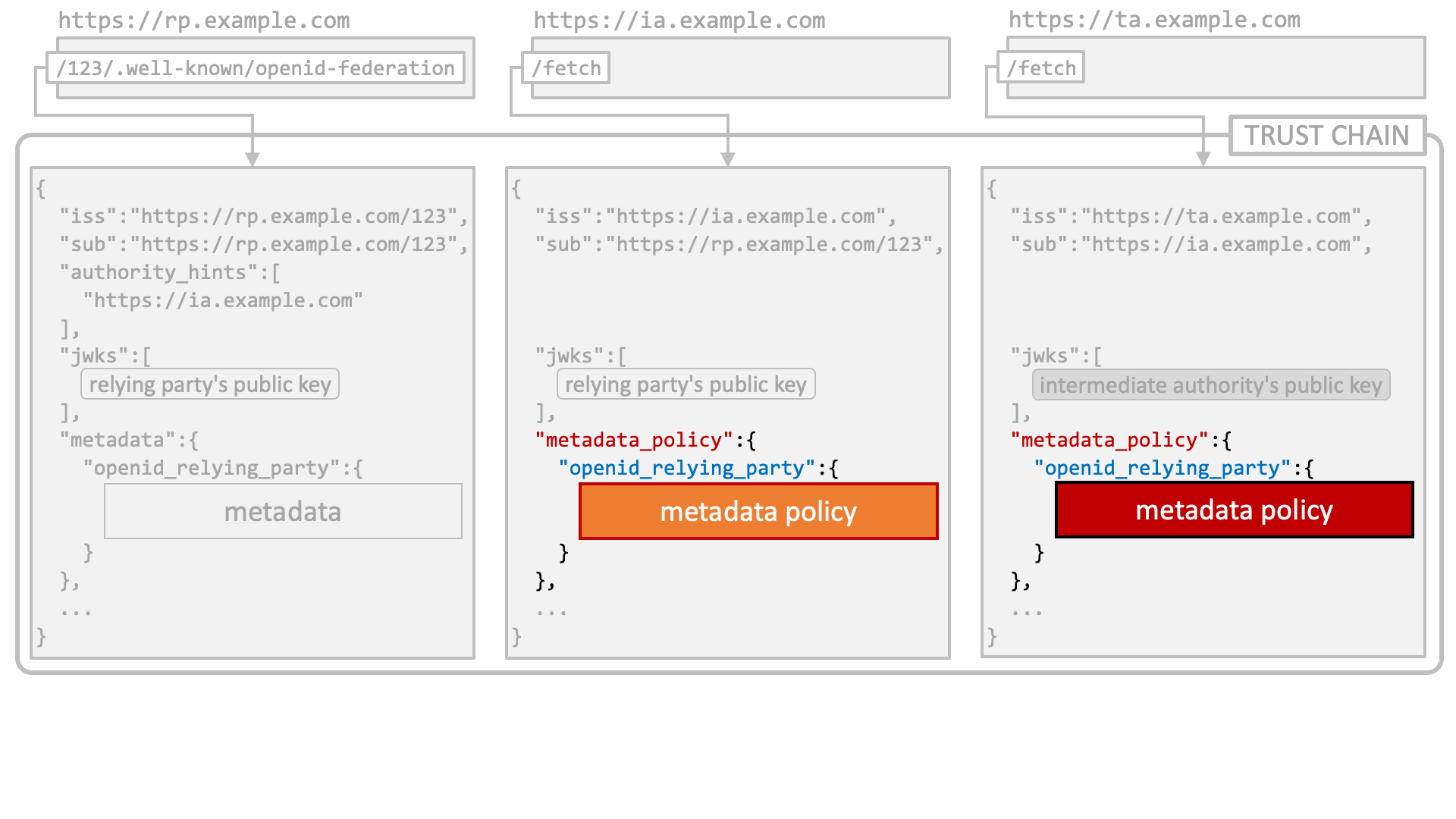
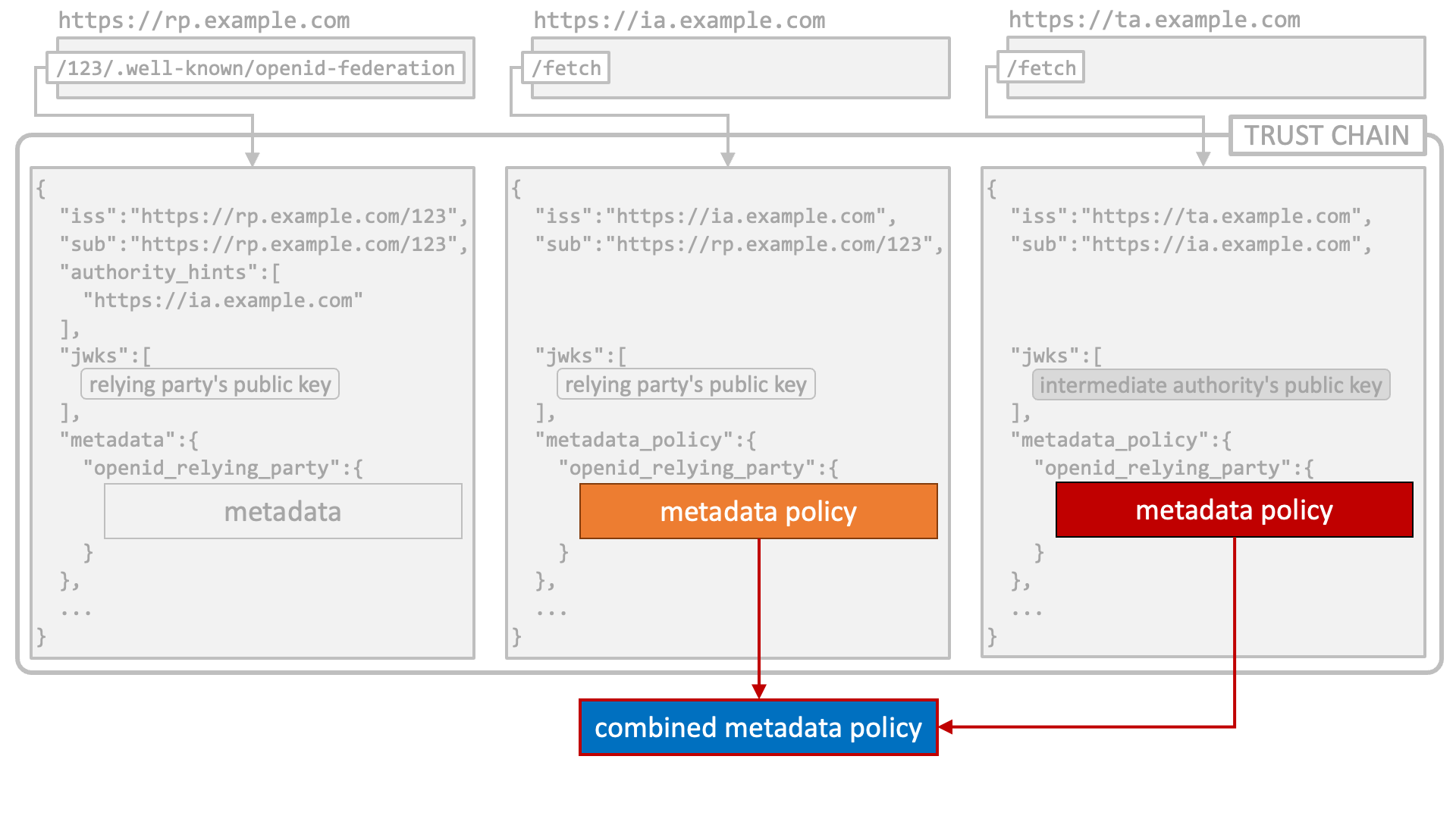
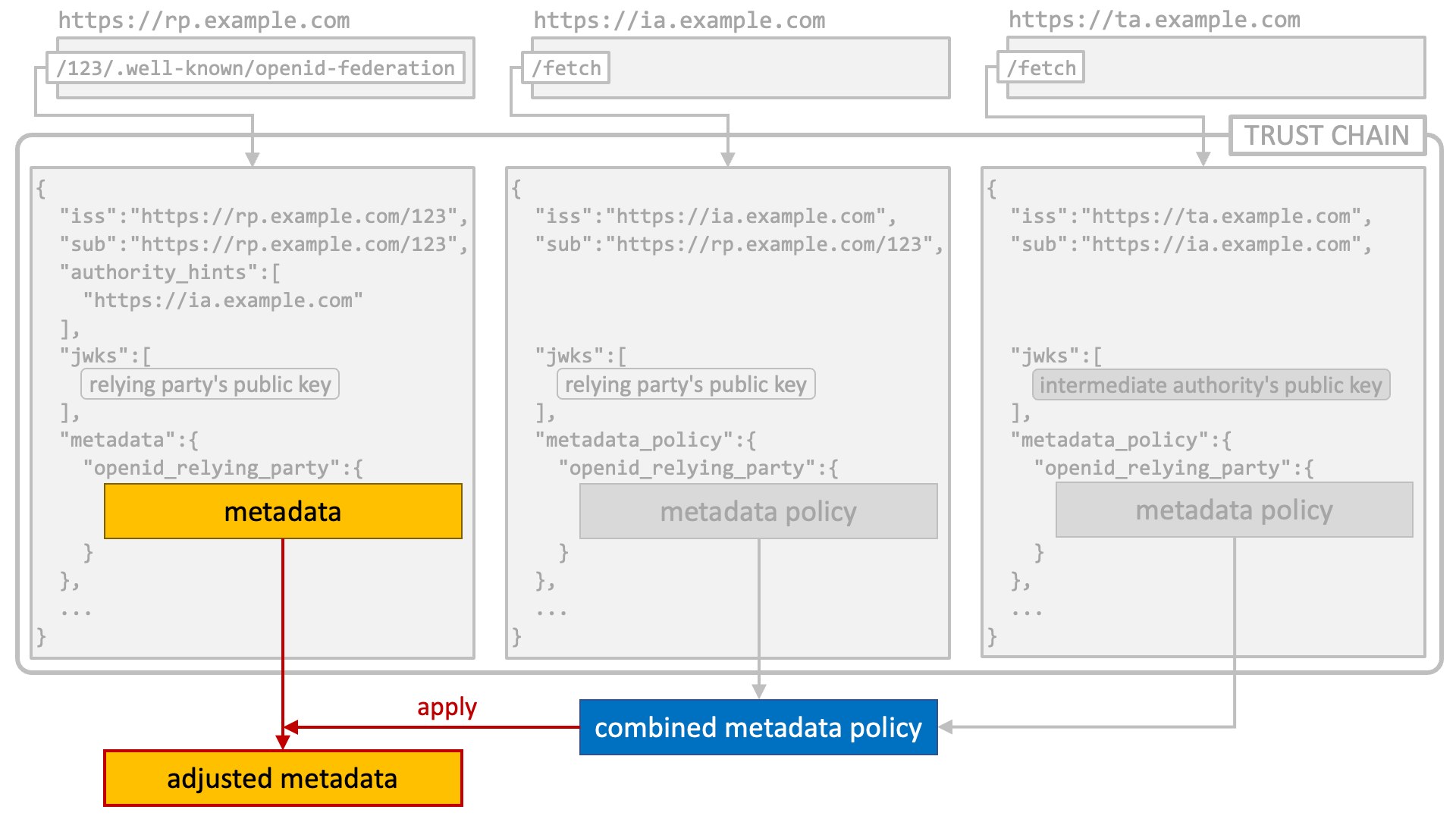
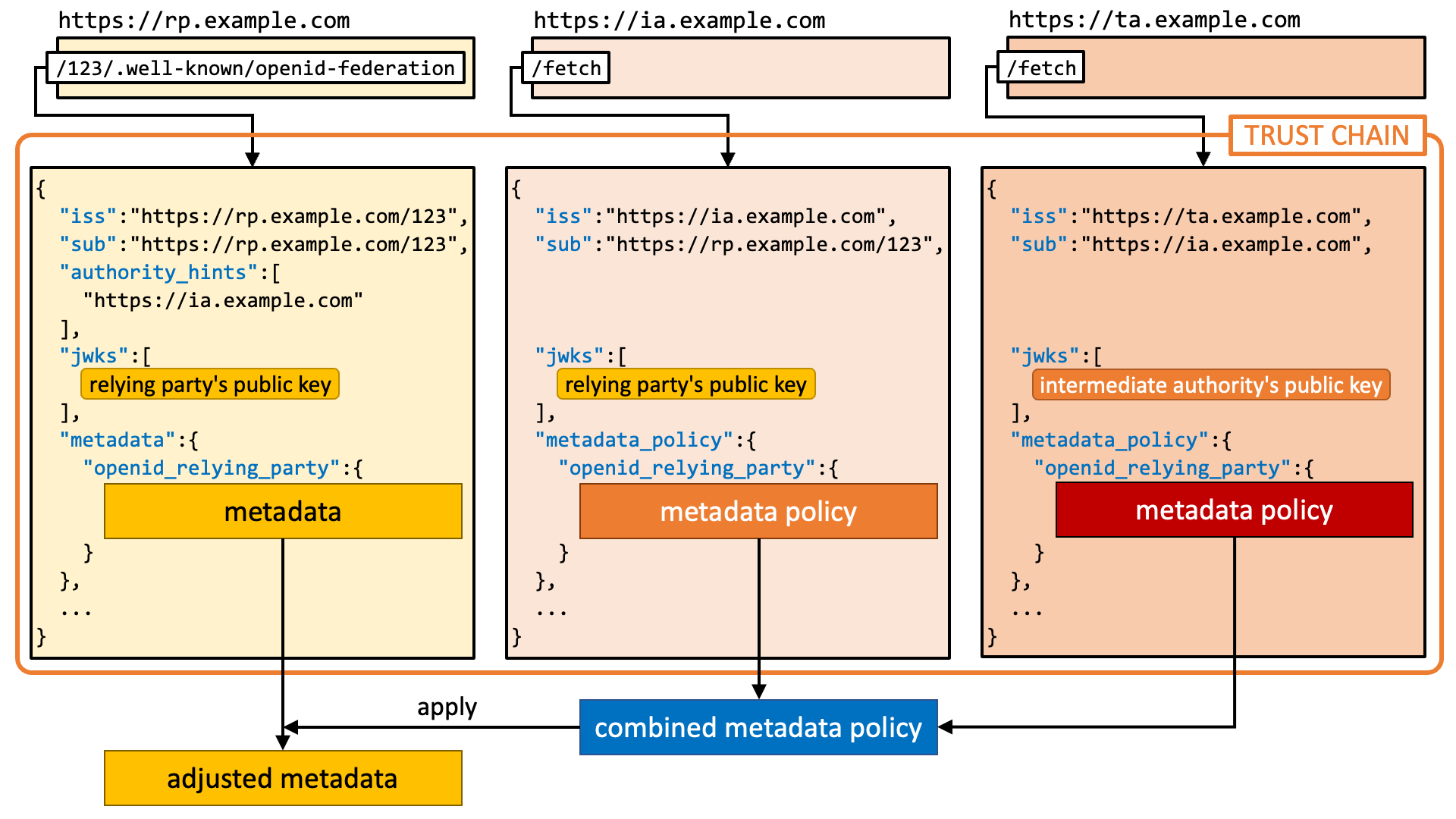
Client Registration
In a typical implementation of identity provider, identifiers of relying parties (clients) are under the management of the identity provider. The identifiers are unique only in the realm of the identity provider. On the other hand, in the OpenID Federation world, every federation entity has a globally unique identifier. An interesting characteristic of OpenID Federation is that the globally unique identifiers, i.e., entity IDs, can be used as a client ID in OAuth/OIDC requests. For example, an authorization request like below can be made. The point to pay attention to in the example is that the value of theclient_id request parameter is the entity ID of the relying party.
Automatic Client Registration
When the client ID in an OAuth/OIDC request is unknown but looks like an entity ID, an identity provider that supports OpenID Federation tries to find a trust chain that starts from the entity ID and ends with one of trust anchors that the identity provider trusts. If such a trust chain is found, the identity provider automatically registers a new client with the entity ID and metadata and continues to process the OAuth/OIDC request. The discovery document (OpenID Connect Discovery 1.0) of an identity provider that supports automatic client registration includesautomatic in the client_registration_types_supported server metadata. Note that the OpenID Federation specification defines the client_registration_types_supported server metadata as mandatory.

client_registration_types client metadata of the client being automatically registered must include automatic. Note that the OpenID Federation specification defines the client_registration_types client metadata as mandatory.
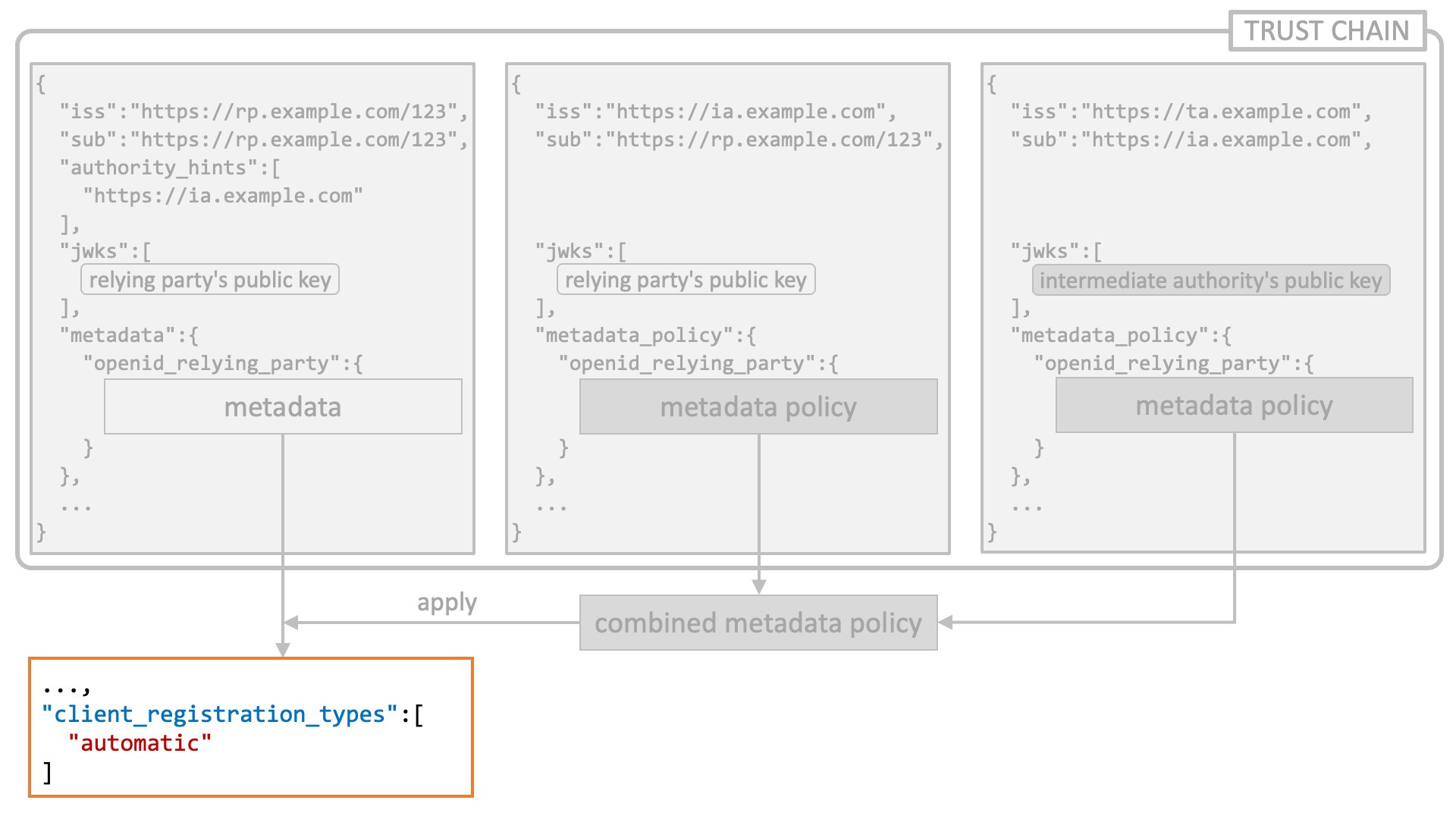
Request Authentication
When an OAuth/OIDC request triggers automatic client registration, the request needs to be authenticated in some way or other. The OpenID Federation specification requires the requester to prove that it has a private key that is paired with a public key in the request. The specification lists the following as available request authentication methods.request_object- Request object signed with an asymmetric algorithm.private_key_jwt- Client authentication using client assertion.tls_client_auth- Client authentication using X.509 certificate.self_signed_tls_client_auth- Client authentication using X.509 certificate.
References:Request Object — Implementer’s note about JAR (JWT-Secured Authorization Request)
Client Authentication — OAuth 2.0 Client Authentication
X.509 Certificate — Illustrated X.509 Certificate
request request parameter nor the request_uri request parameter.
The following table shows availability of request authentication methods per endpoint.
| Endpoint | Request Authentication Methods | |||
|---|---|---|---|---|
request_object | private_key_jwt | tls_client_auth | self_signed_tls_client_auth | |
| Authorization | ✓ | N/A | N/A | N/A |
| Token | N/A | ✓ | ✓ | ✓ |
| PAR | ✓ | ✓ | ✓ | ✓ |
| Backchannel Authentication | ✓ | ✓ | ✓ | ✓ |
| Device Authorization | N/A | ✓ | ✓ | ✓ |
References:Authorization Endpoint — The OAuth 2.0 Authorization Framework
Token Endpoint — The OAuth 2.0 Authorization Framework
PAR Endpoint — RFC 9126 OAuth 2.0 Pushed Authorization Requests
Backchannel Authentication Endpoint — OpenID Connect Client-Initiated Backchannel Authentication Flow - Core 1.0
Device Authorization Endpoint — RFC 8628 OAuth 2.0 Device Authorization Grant
request_authentication_methods_supported server metadata that indicates which request authentication methods are supported at which endpoints.
The value of the server metadata is a JSON object. Property names that appear in the JSON object are endpoint names such as authorization_endpoint. A property value is a JSON array listing request authentication methods available at the corresponding endpoint.
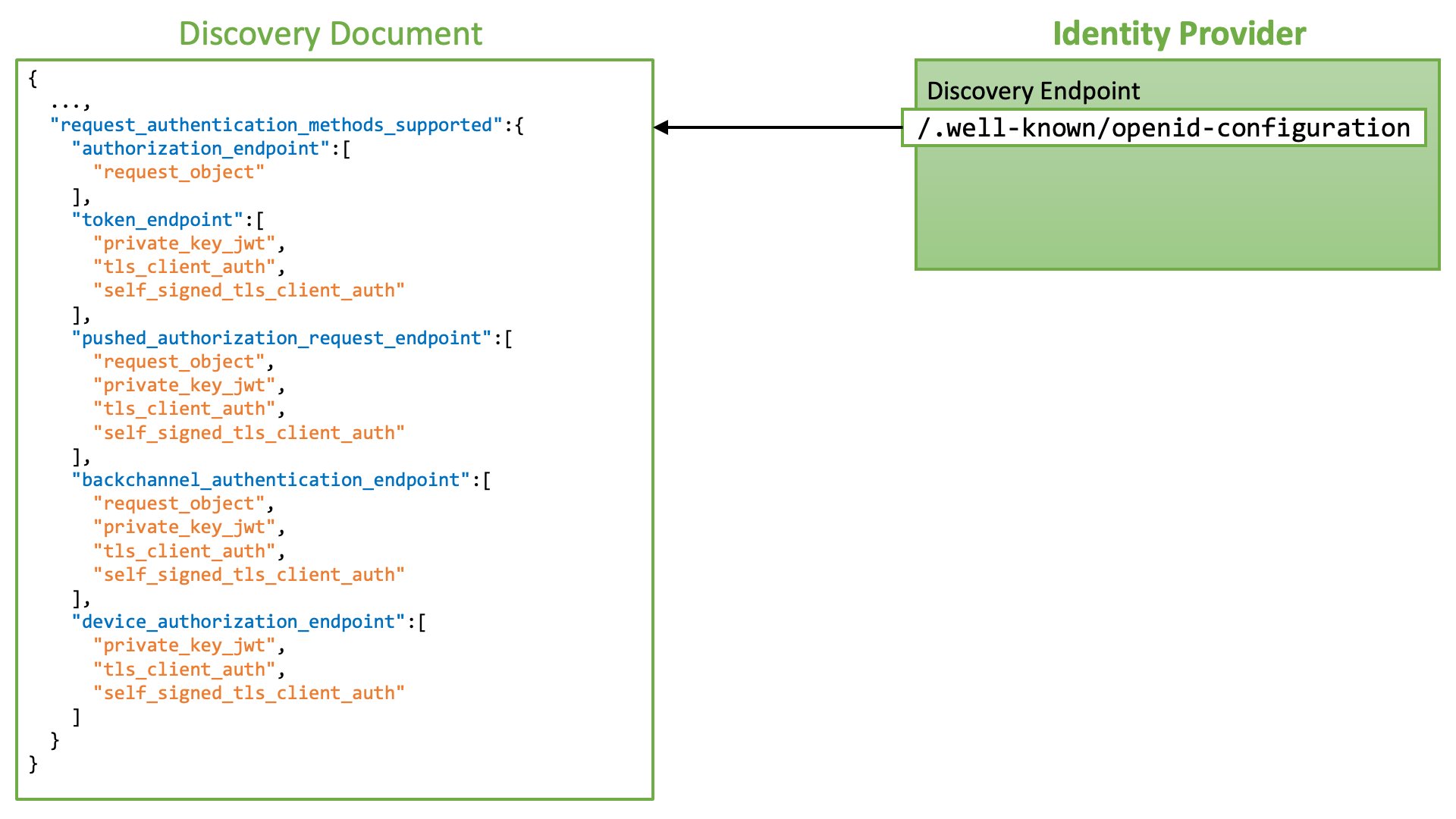
request_authentication_methods_supported and request_authentication_signing_alg_values_supported were dropped when OpenID Federation 1.0 was finalized. Authlete 3.0.32 and later no longer publish them in the discovery document. Request authentication itself is still required.Explicit Client Registration
In addition to automatic client registration, the OpenID Federation specification defines a way to register a client explicitly. The mechanism is called “explicit client registration”. It is similar to dynamic client registration defined in OpenID Connect Dynamic Client Registration 1.0 and RFC 7591 OAuth 2.0 Dynamic Client Registration Protocol. An identity provider that supports explicit client registration has the federation registration endpoint that accepts explicit client registration requests. Input data to the federation registration endpoint is either of the following.- Entity configuration. Its Content-Type is
application/entity-statement+jwt. - Trust chain, a JSON array listing entity statements. Its Content-Type is
application/trust-chain+json.
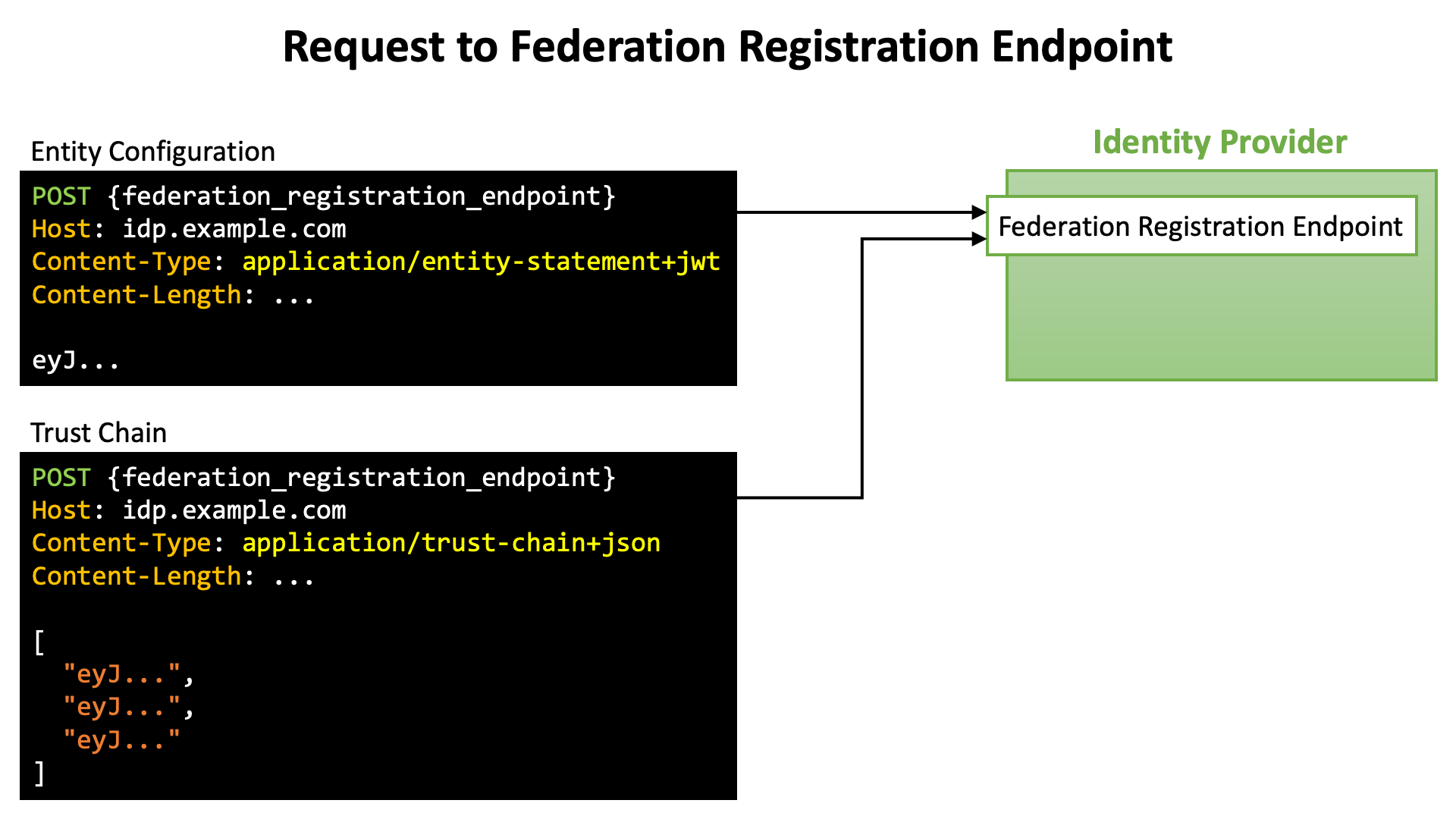
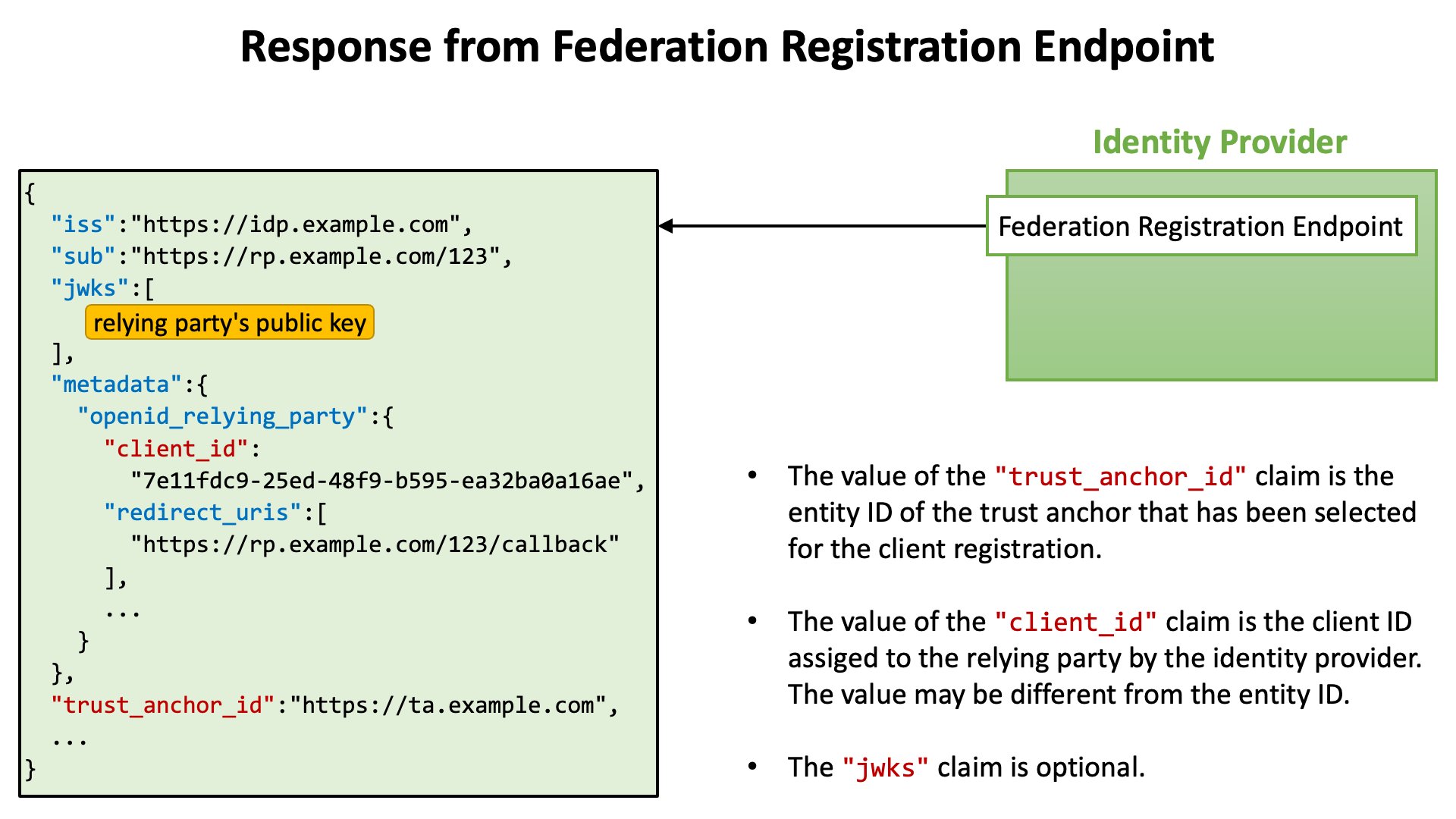
trust_anchor claim. The value of the claim denotes the entity ID of the trust anchor that has been selected for the client registration.
Authlete versions earlier than 3.0.32 emit this claim under its pre-final name,
trust_anchor_id.client_id client metadata in the response is the client ID assigned to the relying party by the identity provider. The value may be different from the entity ID.
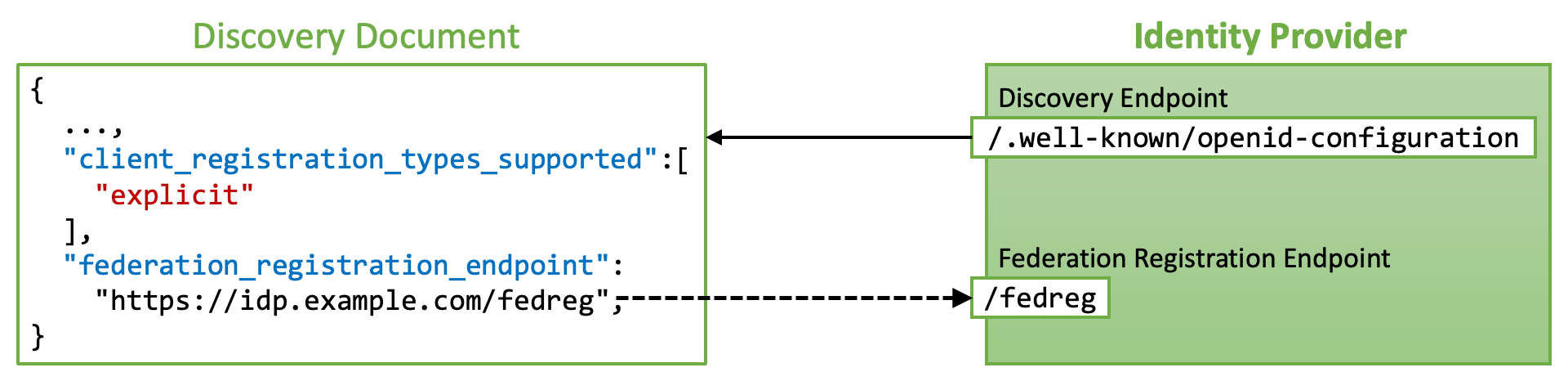
explicit in the client_registration_types_supported server metadata and advertises the URL of the federation registration endpoint by the federation_registration_endpoint server metadata.
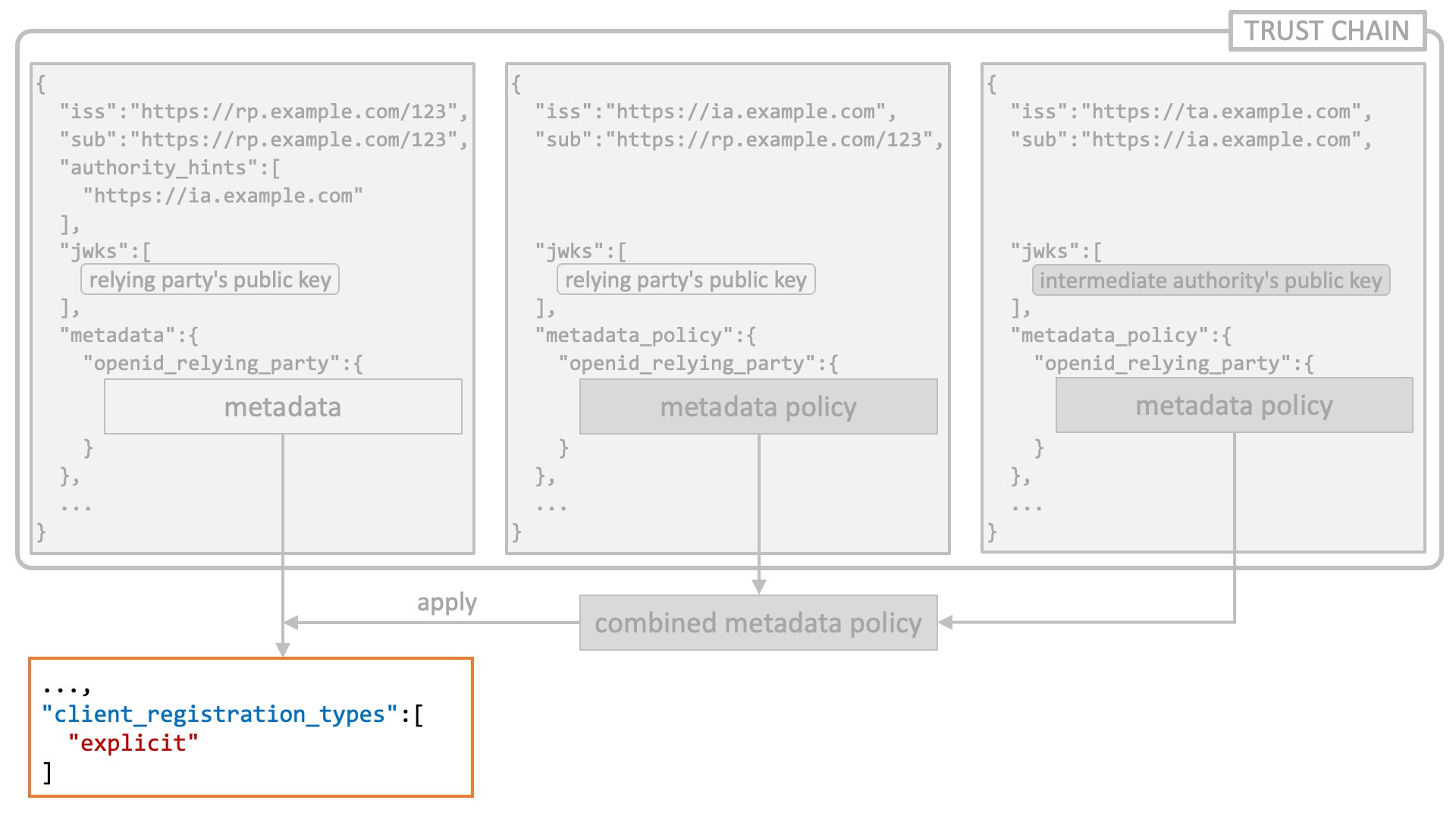
client_registration_types client metadata of the client being explicitly registered must include explicit.
Automatic Client Update
All entity statements in a trust chain include theexp claim (Expiration Time; RFC 7519 Section 4.1.4) as the OpenID Federation specification requires so. The minimum value among the exp claims is regarded as the expiration time of the trust chain.
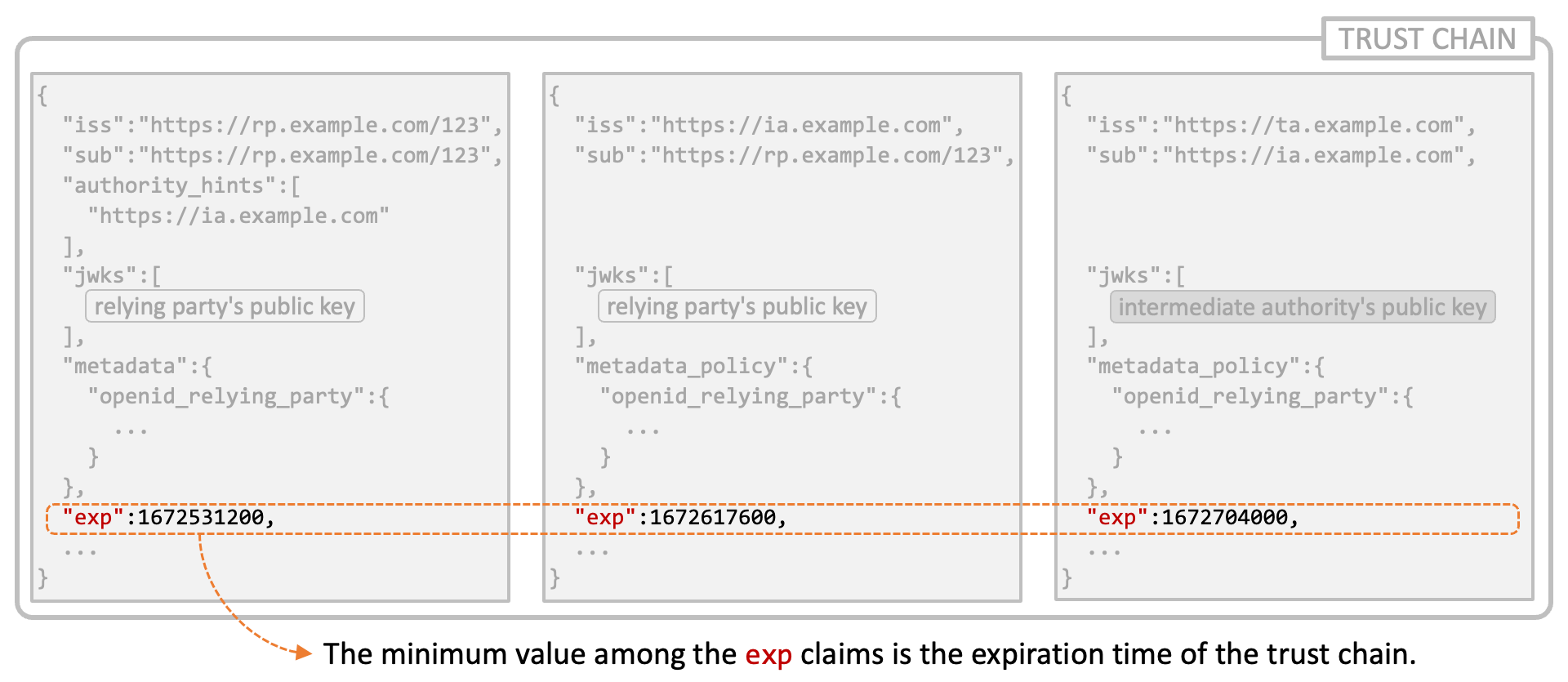
Authlete performs the automatic update only for clients whose
client_registration_types client metadata includes automatic.The trust_chain Request Parameter
An OAuth/OIDC request may contain the trust_chain request parameter. The identity provider may use the trust chain specified by the request parameter to update metadata of the client or register the client if it has not been registered yet.
Authlete does not reference the
trust_chain request parameter for registration.
Authlete references the request parameter only for update.Authlete Implementation
Version
OpenID Federation 1.0 is supported in Authlete 2.3 and later versions. As the specification is actively evolving, new features may be introduced, and breaking changes may occur in the future. Authlete will continue to align with these updates as they are released.Feature Availability
To enable the feature of OpenID Federation 1.0, the following conditions must be satisfied. Otherwise, the Authlete Server would behave as if it didn’t know the specification at all.-
Authlete Server must be deployed with
feature.oidc_federation.enabled=true. -
The
federationEnabledflag ofServicemust betrue. (cf. Service.setFederationEnabled(boolean))
- At least one authority (intermediate authority or trust anchor) must be registered. Otherwise, the service cannot generate its entity configuration. (cf. Service.setAuthorityHints(URI[]))
- At least one pair of trust anchor and its JWK Set must be registered. Otherwise, the service cannot trust any trust chain. (cf. Service.setTrustAnchors(TrustAnchor[]))
- At least one private key dedicated to OpenID Federation must be registered. Otherwise, the service cannot sign entity statements. (cf. Service.setFederationJwks(String))
- At least either of automatic client registration or explicit client registration must be supported. Otherwise, the service cannot register federation clients. (cf. Service.setSupportedClientRegistrationTypes(ClientRegistrationType[]))
The relying party’s metadata must also fit within what the service supports. If a relying party declares a value the service does not support — for example a
token_endpoint_auth_method that is missing from the service’s supported client authentication methods — client registration fails with A320308, naming the metadata in question (A320309 when the offending value is an element of an array metadata).Configuring Federation
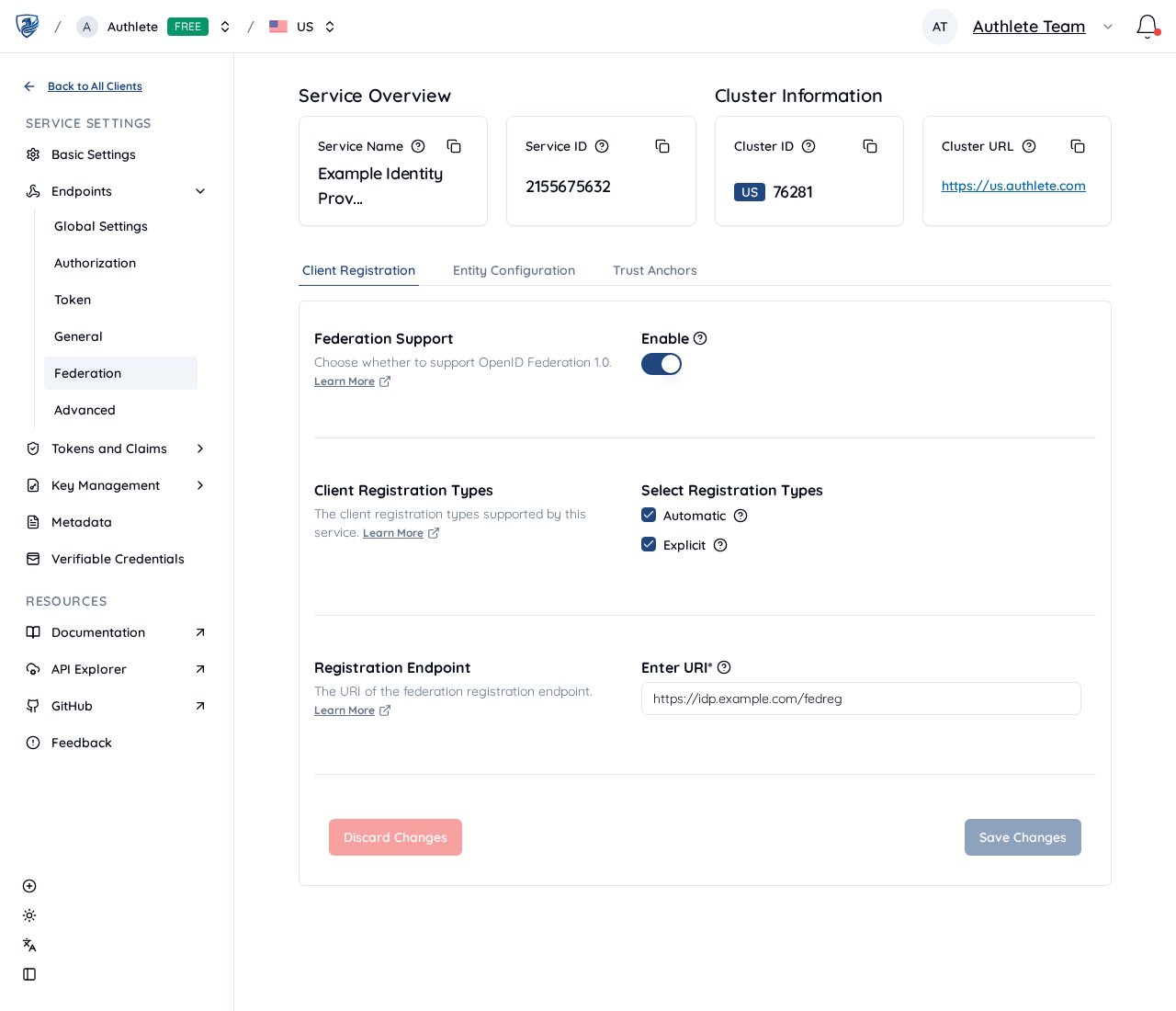
To make OpenID Federation 1.0 work, configure the following four places in the Authlete Management Console. For each of them, log in to the Authlete Management Console, click the organization name, and select the target service first.Client Registration
Enable the federation feature itself and choose which client registration types the service accepts.- Navigate to Service Settings > Endpoints > Federation and open the Client Registration tab.
- In the Federation Support section, turn on Enable to activate OpenID Federation 1.0 support.
- Under Client Registration Types, select one or both registration methods:
- Automatic: Enables automatic client registration.
- Explicit: Enables explicit client registration.
- In the Registration Endpoint section, provide the URI of the federation registration endpoint (e.g.,
https://idp.example.com/fedreg). This field is mandatory when Explicit is selected. - Click Save Changes to apply the configuration.
Federation JWK Set
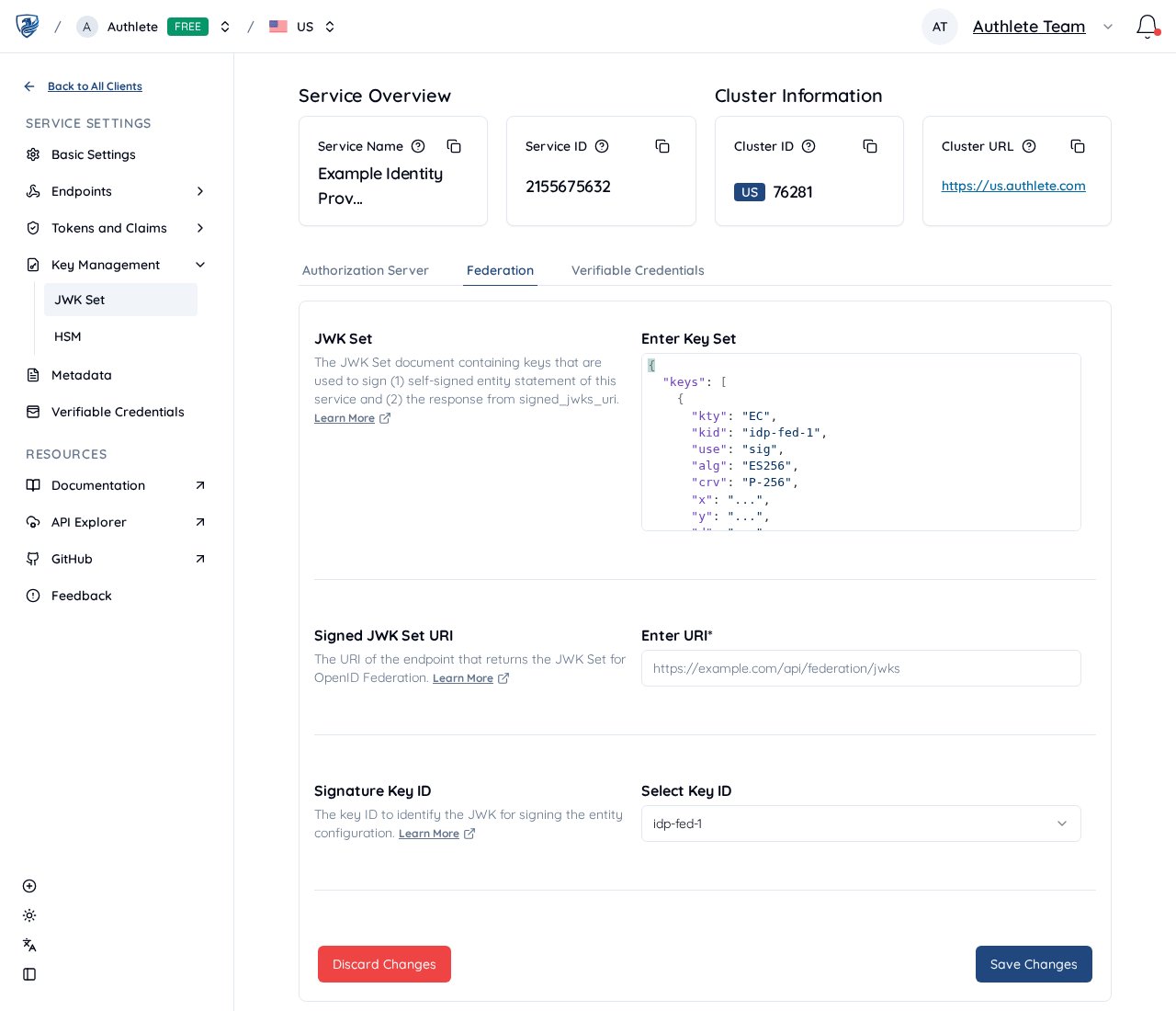
Register the key used to sign entity statements. Without it, the entity configuration endpoint cannot generate an entity statement.- Navigate to Service Settings > Key Management > JWK Set and open the Federation tab.
- In the JWK Set section, enter the JWK Set containing the private key used for signing.
- If you publish a signed JWK Set, enter the URI of that endpoint in the Signed JWK Set URI section.
- In the Signature Key ID section, select the
kidof the key used to sign the entity configuration. - Click Save Changes to apply the configuration.
Entity Configuration
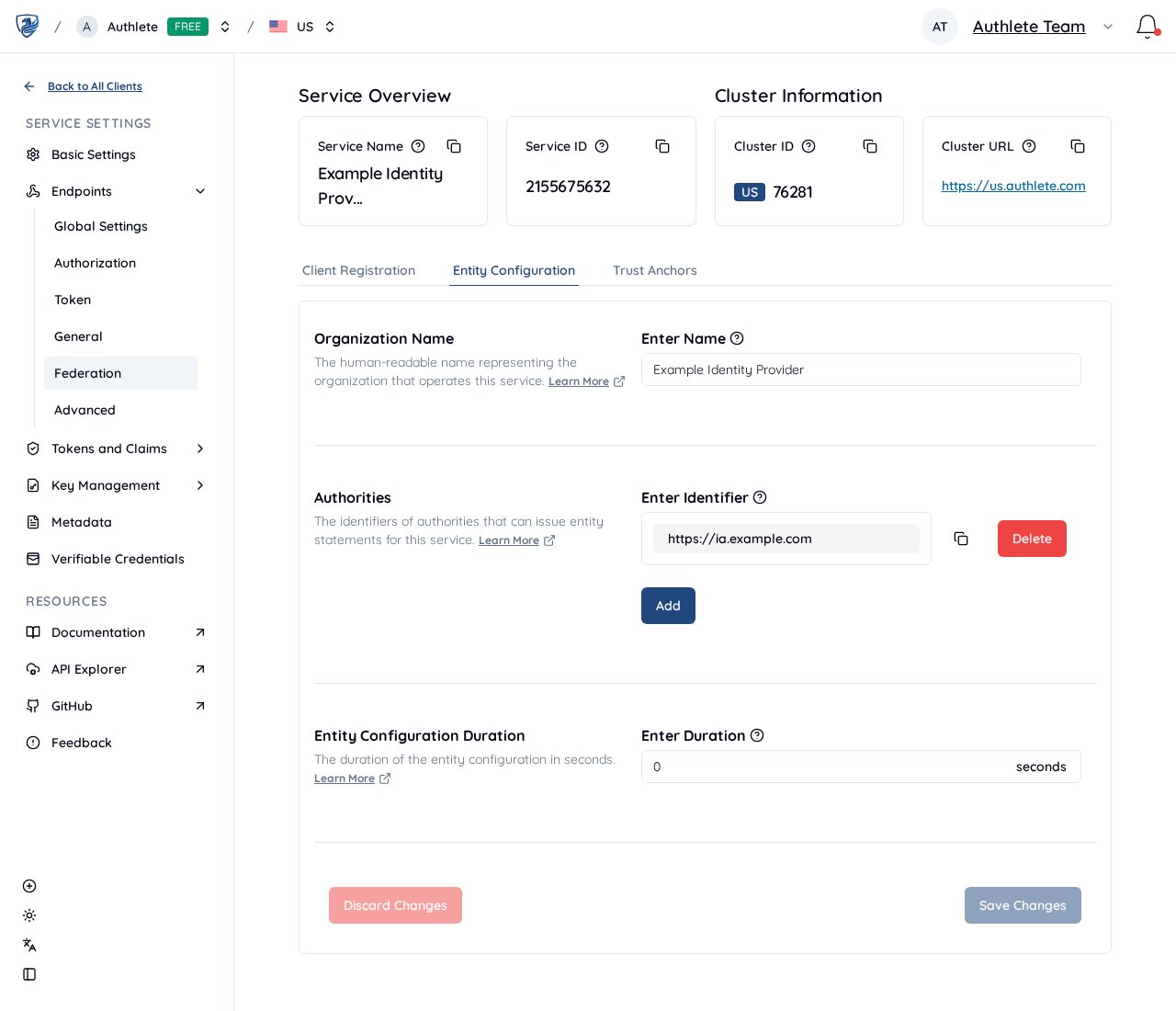
Configure the information carried in the self-signed entity statement. If Authorities is empty, the entity configuration endpoint cannot generate a valid entity statement.- Navigate to Service Settings > Endpoints > Federation and open the Entity Configuration tab.
- In the Organization Name section, enter the name of the organization that operates the service. The value is published as
organization_name. - In the Authorities section, click Add and enter the entity ID of a superior authority (an intermediate authority or a trust anchor). The value corresponds to
authority_hints. - In the Entity Configuration Duration section, enter the duration of the entity configuration in seconds. When
0is specified, the default value determined by your Authlete server is used. - Click Save Changes to apply the configuration.
Trust Anchors
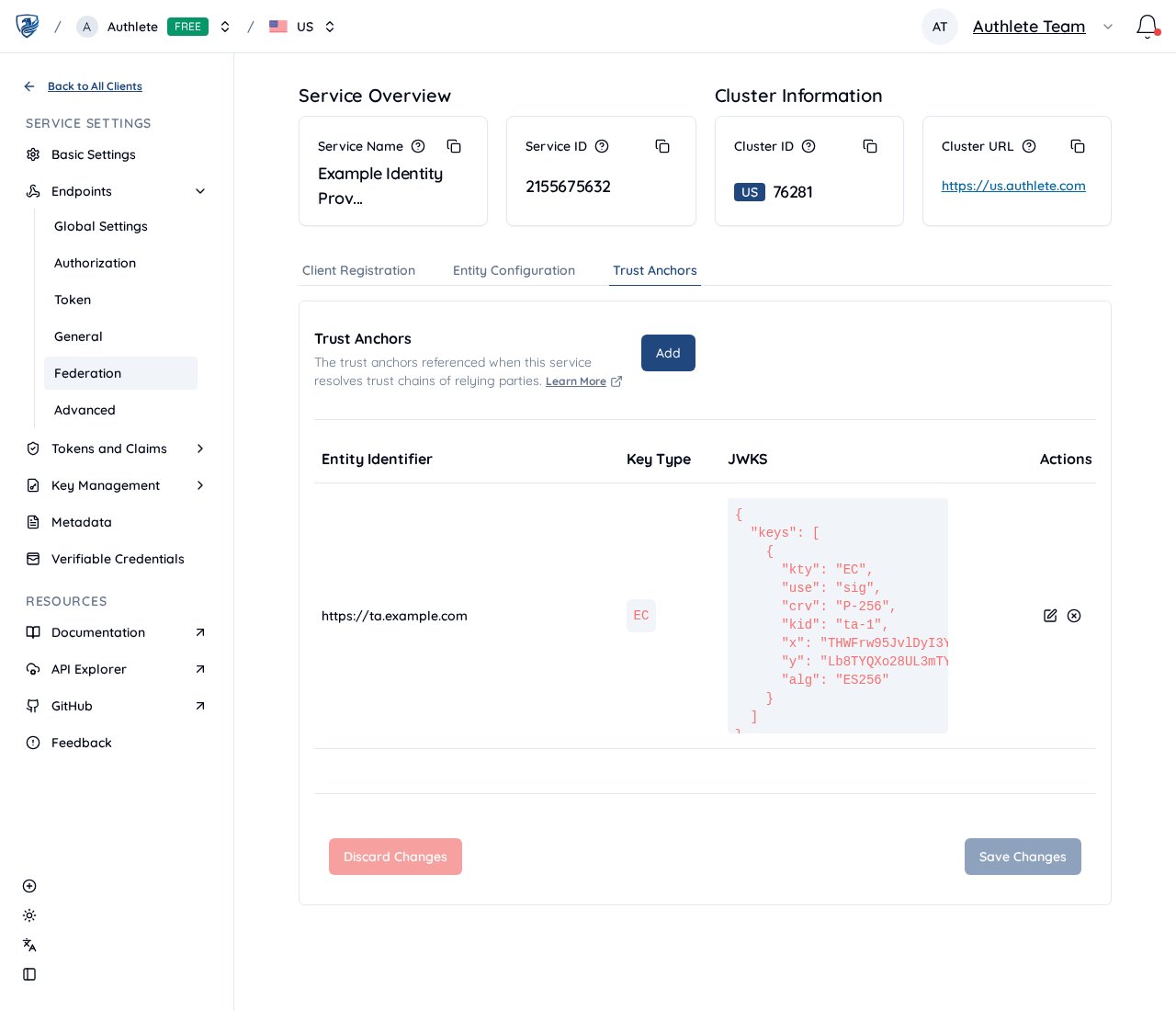
Register the trust anchors used as the root of trust when the service resolves trust chains of relying parties.- Navigate to Service Settings > Endpoints > Federation and open the Trust Anchors tab.
- Click Add.
- Enter the entity ID of the trust anchor in Entity Identifier and its JWK Set in JWKS, then click Confirm.
- Click Save Changes to apply the configuration.
Authlete API
Authlete Server provides the following APIs for OpenID Federation.The /api/federation/configuration API
This API is used to implement the entity configuration endpoint (/.well-known/openid-federation).

| Request | ||
|---|---|---|
| HTTP Method | GET | |
| Response | ||
| HTTP Status Code | 200 | |
| Content-Type | application/json | |
| Parameters | action | The next action that the implementation of the entity configuration endpoint
(/.well-known/openid-federation) should take after getting a
response from the Authlete API.In a successful case, the value of the action response parameter
is "OK". It means that the entity configuration endpoint should
return a response with 200 OK,
application/entity-statement+jwt, and the entity configuration
prepared by the Authlete API. |
responseContent | The content that the implementation of the entity configuration endpoint
(/.well-known/openid-federation) should use when it constructs
a response.In a successful case, the value of the responseContent response
parameter is the entity configuration of the identity provider in JWT format. | |
The /api/federation/registration API
This API is used to implement the federation registration endpoint.

| Request | ||
|---|---|---|
| HTTP Method | POST | |
| Content-Type | application/x-www-form-urlencodedapplication/json | |
| Parameters | entityConfiguration | The entity configuration in a federation registration request. |
trustChain | The trust chain in a federation registration request. | |
| Response | ||
| HTTP Status Code | 200 | |
| Content-Type | application/json | |
| Parameters | action | The next action that the implementation of the federation registration endpoint
should take after getting a response from the Authlete API.In a successful case, the value of the action response parameter
is "OK". It means that the federation registration endpoint should
return a response with 200 OK,
application/entity-statement+jwt, and the entity statement
prepared by the Authlete API. |
responseContent | The content that the implementation of the federation registration endpoint
should use when it constructs a response.In a successful case, the value of the responseContent response
parameter is the entity statement of the newly registered client in JWT format. | |
client | Information about the newly registered client in JSON object format. (cf. Client) | |
Client Registration and Update
This section explains Authlete’s behavior on client registration and update in detail.Automatic Client Registration
- When Authlete processes an OAuth/OIDC request, Authlete tries to identify a client at a relatively early phase. First, Authlete interprets the specified client identifier as an original numeric ID and searches the database for a client having the numeric ID.
- If a client having the numeric ID was not found, but if the “Client ID Alias” feature of the service is enabled, Authlete interprets the specified client identifier as an alias and searches the database for a client having the alias.
- If a client having the alias was not found, but if the “OpenID Federation” feature of the service is enabled, Authlete interprets the specified client identifier as an entity ID and searches the database for a client having the entity ID.
- If a client having the entity ID was not found, but if the service supports automatic client registration, Authlete tries to resolve a trust chain of the client.
- If the trust chain resolution succeeds, Authlete applies the combined metadata policy of the trust chain to the metadata of the client.
-
Authlete checks whether the client metadata contains the
client_registration_typesclient metadata and it includesautomatic. - Authlete validates the client metadata to ensure that the client can be registered to the service.
- Authlete performs request authentication for the OAuth/OIDC request.
- Finally, Authlete registers the client and continues to process the OAuth/OIDC request.
Authlete does not reference the
trust_chain request parameter for registration.
Authlete references the request parameter only for update. When the request parameter is included
in an OAuth/OIDC request that triggers automatic registration, the trust chain specified by the
request parameter is referenced for update right after registration.The reason for the limitation is that it is difficult, if not impossible, to write a coherent and
orderly implementation that performs request authentication which depends on client metadata
in the trust chain specified by the trust_chain request parameter.Also, when the request parameter is in a request object, implementation complexity jumps up.
In the case, the key that should be used to verify the signature of the request object is embedded
in the trust chain inside the request object. In that sense, it can be said that the request object
is self-signed. In general, in a procedure that utilizes a self-signed object, the content of the
self-signed object is referenced before the signature of the object is verified. Such procedures
exist in the world, so the self-signed request object will maybe work. However, processes that
must be done before signature verification, including the long and complex steps of trust chain
resolution and verification, are too complex and dependent on unverified data too much.Trust Chain Update
Case 1: when thetrust_chain request parameter is given
- If the “OpenID Federation” feature of the service is not enabled, Authlete does not try to update trust chains.
-
Authlete checks whether the service supports automatic client registration and whether the client’s
client_registration_typesmetadata containsautomatic. If these conditions are not satisfied, an error is returned. -
Authlete validates the trust chain specified by the
trust_chainrequest parameter. Especially, the entity ID of the entity configuration in the trust chain must match the entity ID of the existing client. - Authlete applies the combined metadata policy of the trust chain to the client metadata in the trust chain.
-
Authlete checks whether the client metadata contains the
client_registration_typesclient metadata and it includesautomatic. - Authlete validates the client metadata to ensure that the client can be updated with the metadata.
- Authlete updates metadata of the client.
- Authlete continues to process the OAuth/OIDC request.
When the
trust_chain request parameter is given, trust chain update is always tried regardless of whether the current trust chain has expired or not. Even when trust chain update fails, the client is NOT deleted.trust_chain request parameter is not given
- If the “OpenID Federation” feature of the service is not enabled, Authlete does not try to update trust chains.
- Authlete checks whether the current trust chain of the client has expired. If the trust chain has not expired, Authlete does not try to update the trust chain.
- If the current trust chain has expired but the service does not support automatic client registration, the client is deleted and the OAuth/OIDC request fails.
-
If the current trust chain has expired but
automaticis not included in theclient_registration_typesclient metadata, the client is deleted and the OAuth/OIDC request fails. - Authlete builds a trust chain from the entity ID of the client from scratch.
- Authlete applies the combined metadata policy of the trust chain to the client metadata in the trust chain.
-
Authlete checks whether the client metadata contains the
client_registration_typesclient metadata and it includesautomatic. - Authlete validates the client metadata to ensure that the client can be updated with the metadata.
- Authlete updates metadata of the client.
- Authlete continues to process the OAuth/OIDC request.
When the
trust_chain request parameter is not given, trust chain update is tried only when the current trust chain has expired. When trust chain update fails, the client is deleted.