
Documentation Index
Fetch the complete documentation index at: https://developers.authlete.com/llms.txt
Use this file to discover all available pages before exploring further.
Overview
“Refresh token grant” in OAuth 2.0 defines a mechanism for a client to request an authorization server to issue an access token (AT) by sending a previously issued refresh token (RT). The authorization server checks if the RT is valid, and then issues the new AT and sends it back to the client. There are four choices for handling the used RT:- 1-1: Keeping the RT valid for the next token refresh and not resetting the duration of the RT,
- 1-2: Keeping the RT valid for the next token refresh and resetting the duration of the RT,
- 2-1: Making the RT invalid and creating a new RT with a predefined duration, or
- 2-2: Making the RT invalid and creating a new RT with a remaining duration of the old RT.
The feature of “2-2: Making the RT invalid and creating a new RT with a remaining duration of the old RT” is available in Authlete version 2.1 and later.
The feature of “1-2: Keeping the RT valid for the next token refresh and resetting the duration of the RT is available in Authlete version 2.2 and later.
The Token Expiration Link feature is available in Authlete version 2.2 and later.
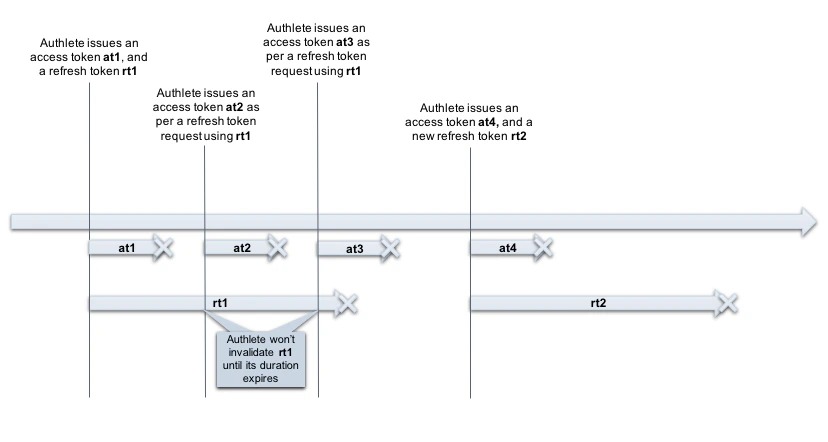
1-1: Keeping the RT valid for the next token refresh and not resetting the duration of the RT
On a token refresh request from a client with an RT (rt1), an authorization server sends a new AT (at2) and the submitted RT (rt1) back to the client. The RT (rt1) will remain valid so that the client can reuse the RT (rt1) in the next token refresh request as long as its duration remains.The validity period of the RT (rt1) won’t be changed on each token refresh.\
1-2: Keeping the RT valid for the next token refresh and resetting the duration of the RT
On a token refresh request from a client with an RT (rt1), an authorization server sends a new AT (at2) and the submitted RT (rt1) back to the client. The RT (rt1) will remain valid so that the client can reuse the RT (rt1) in the next token refresh request as long as its duration remains. Available duration of RT (rt1) is reset to the initial value on each token refresh. As a result, the available duration of RT (rt1) will be extended over the multiple requests.
2-1: Making the RT invalid and creating a new RT with a predefined duration
On a token refresh request from a client with an RT (rt1), an authorization server sends a new AT (at2) and a new RT (rt2) back to the client. The submitted RT (rt1) will be invalidated so that the client can no longer reuse the RT (rt1) in the next token refresh request.Available duration of RT (rt2, rt3, …) will be set to the initial value. As a result, the total available duration of the RT (rt2, rt3, …) gets extended more than the initial value of the RT (rt1).

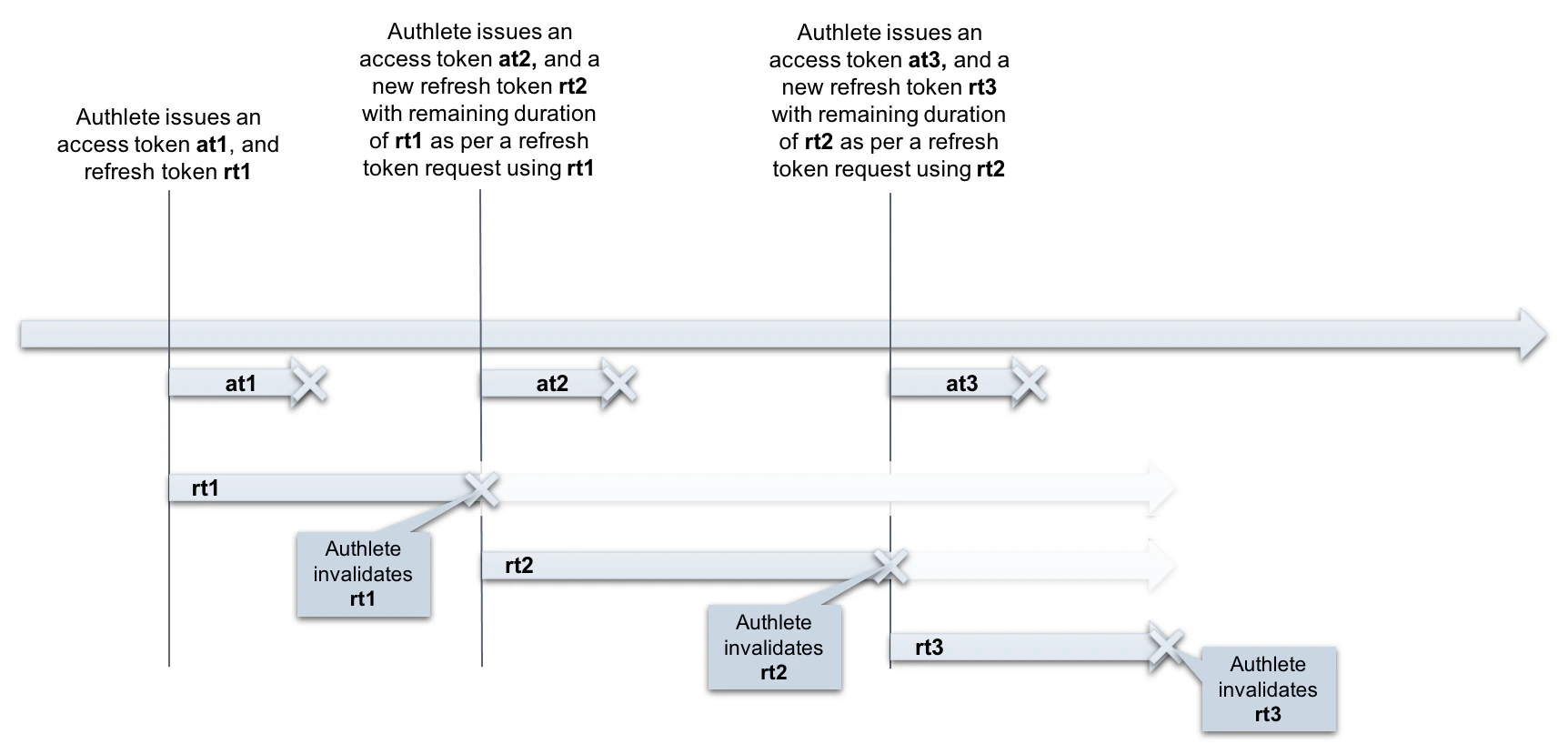
2-2: Making the RT invalid and creating a new RT with a remaining duration of the old RT
On a token refresh request from a client with an RT (rt1), an authorization server sends a new AT (at2) and a new RT (rt2) back to the client. The submitted RT (rt1) will be invalidated so that the client can no longer reuse the RT (rt1) in the next token refresh request.Available duration of RT (rt2, rt3, …) is set to the remaining duration of the first RT (rt1). As a result, the total available duration of the RT (rt2, rt3, …) is limited to the duration of the first RT (rt1)\
Token Expiration Link
On a token refresh request from a client with an RT (rt), an authorization server checks if the remaining duration of the RT is shorter than the default duration of the AT. If it is true, Authlete issues a new AT whose duration is linked to the remaining duration of the RT.\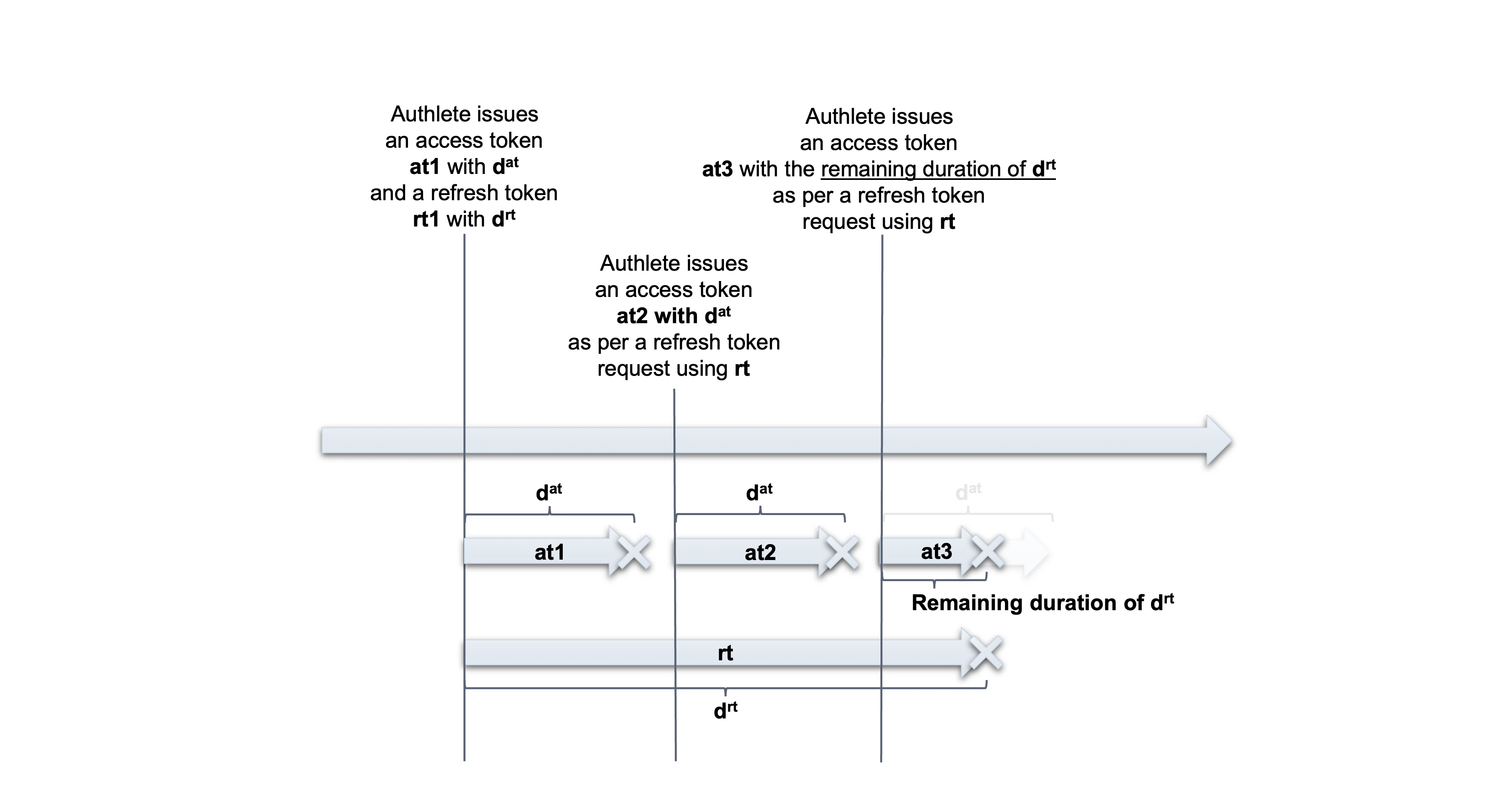
Configuration
You can configure this setting through Service Owner Console. Choose “Kept” (i.e. keeping the used RT valid) or “Not kept” (i.e. invalidating the used RT) at “Refresh Token Continuous Use” section in “Token” tab. There are additional settings for each choice.- When specifying “Kept,” you can further choose “Enable” or “Disable” at “Refresh Token Duration Reset” section.
- When specifying “Not kept,” you can further choose “Enabled” or “Disabled” at “Refresh Token Duration Takeover” section.

Examples
The following examples are a sample request and responses when a client makes a token request using a RT (< refresh_token_1 >).- Request
- Response if “Kept” (i.e. keeping the used RT valid) and “Disabled” (i.e. reset the duration of the RT) are specified
- Response if “Kept” (i.e. keeping the used RT valid) and “Enabled” (i.e. reset the duration of the RT) are specified
- Response if “Not kept” (i.e. invalidating the used RT) and “Disabled” (i.e. creating a new RT with a predefined duration) are specified
- Response if “Not kept” (i.e. invalidating the used RT) and “Enabled” (i.e. creating a new RT with a remaining duration of the old RT) are specified