
Documentation Index
Fetch the complete documentation index at: https://developers.authlete.com/llms.txt
Use this file to discover all available pages before exploring further.
JWT Authorization Requests support on Authlete
Introduction
Between the security concerns often raised to OAuth 2 deployments are the exposure of authorization requests parameters and how they can be easily tampered. This was addressed by OpenID Connect protocol by introducing Requests Objects on authorization request, but it was restricted to OpenID Foundation. With the JWT Secured Authorization Requests (or JAR for short), the IETF brings the option for serializing the authorization request in a JWT format. The specifications are very close but there are some differences on how to process JAR and OIDC Requests Object in the context on the authorization requests. If you are looking for the OIDC Request Object, check Using Request Objects note. Using a signed JWT structure for the authorization request, the server can validate if the request was tainted and the source of the request can be authenticated. Encryption is also available, allowing the authorization requests to be transported publicly with the proper secrecy required by the use case. This article describes how AS and clients can leverage JAR support on Authlete.Authlete support for JAR
The JAR related configuration can be done in two levels on: Service and Client based.Configuring JAR configuration on service level
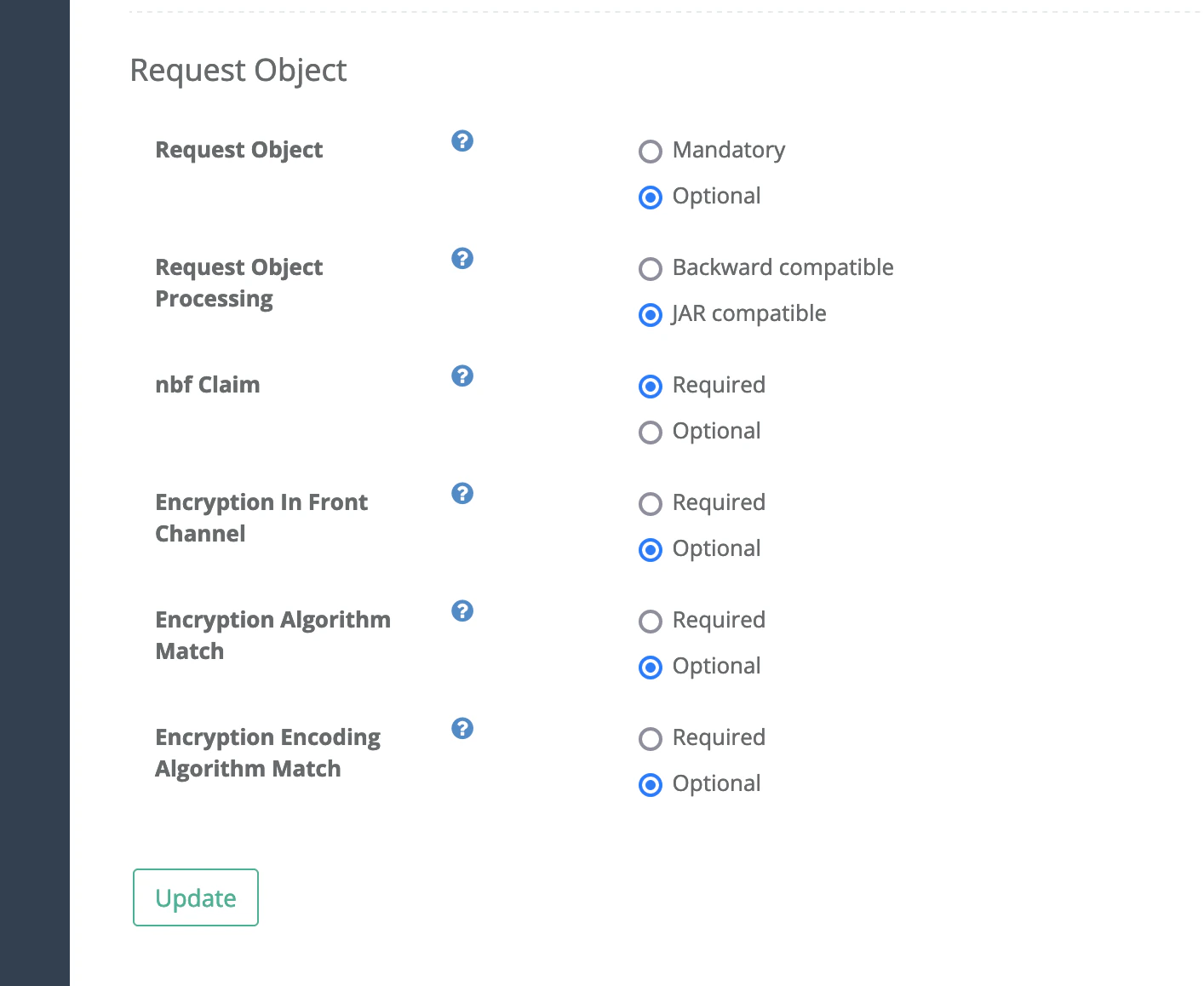
The administrator can define the security requirements to JAR and its processing across the clients. You can find the JAR related parameters grouped under “Request Object” section on Authorization tab of the Service Owner console. The most impactful parameter is the “Request Object Processing”, as its background is the conflict between OpenID specification and JAR. This parameter changes how the authorization requests parameters are processed when they are duplicated in the request URI and JWT are processed. For a more detailed description of the differences, check the article Implementer’s note about JAR under section “Conflicts”. When running with “JAR compatible” selected, the parameters on the request URI are ignored. When running on “Backward compatible” the parameters are merged. If you are configuring Authlete service for FAPI, check the note Configuring Authlete for FAPI compliance.| Parameter | Description |
|---|---|
| Request Object | if Mandatory, every authorization request, including pushed authorizations, is required to be in JWT format. If Optional, the administrator can require JAR for individual clients. |
| Request Object Processing | check description above |
| nbf Claim | if Required, the JWT must contain a “Not Before” claim, this will force the requests to be time boxed. This reduce the attack vectors on AS. |
| Encryption In Front Channel | If **Required, **the JWT send to /api/auth/authorization endpoint are required to be encrypted. In other words, if the authorization request is not pushed, it will be required to be encrypted to ensure that authorization request is not exposed on user agent.If Optional, the administrator can require JAR for individual clients. |
| Encryption Algorithm Match | when Required the encryption algorithm of key transport (the Content Encryption Key - CEK) used on JWT must match the client level config. If Optional, the administrator can require JAR for individual clients. |
| Encryption Encoding Algorithm Match | when Required the encryption algorithm of the JWT must match the algorithm defined on the client level. If Optional, the administrator can require JAR for individual clients. |
Configuring JAR support on client level
There are 2 configuration portions per client that are available to administrators on Developers Console.Setup required keys
For the usage of JAR requests, the client must be configured with public keys using the JWK format. This is available under JWK Set tab for the specific client. Authlete allows the JWK Set to be assigned directly to the client, using the JWK Set Content attribute on the image below, or a URL pointing to a public JWK endpoint containing the keys used to sign and optionally encrypt the JAR.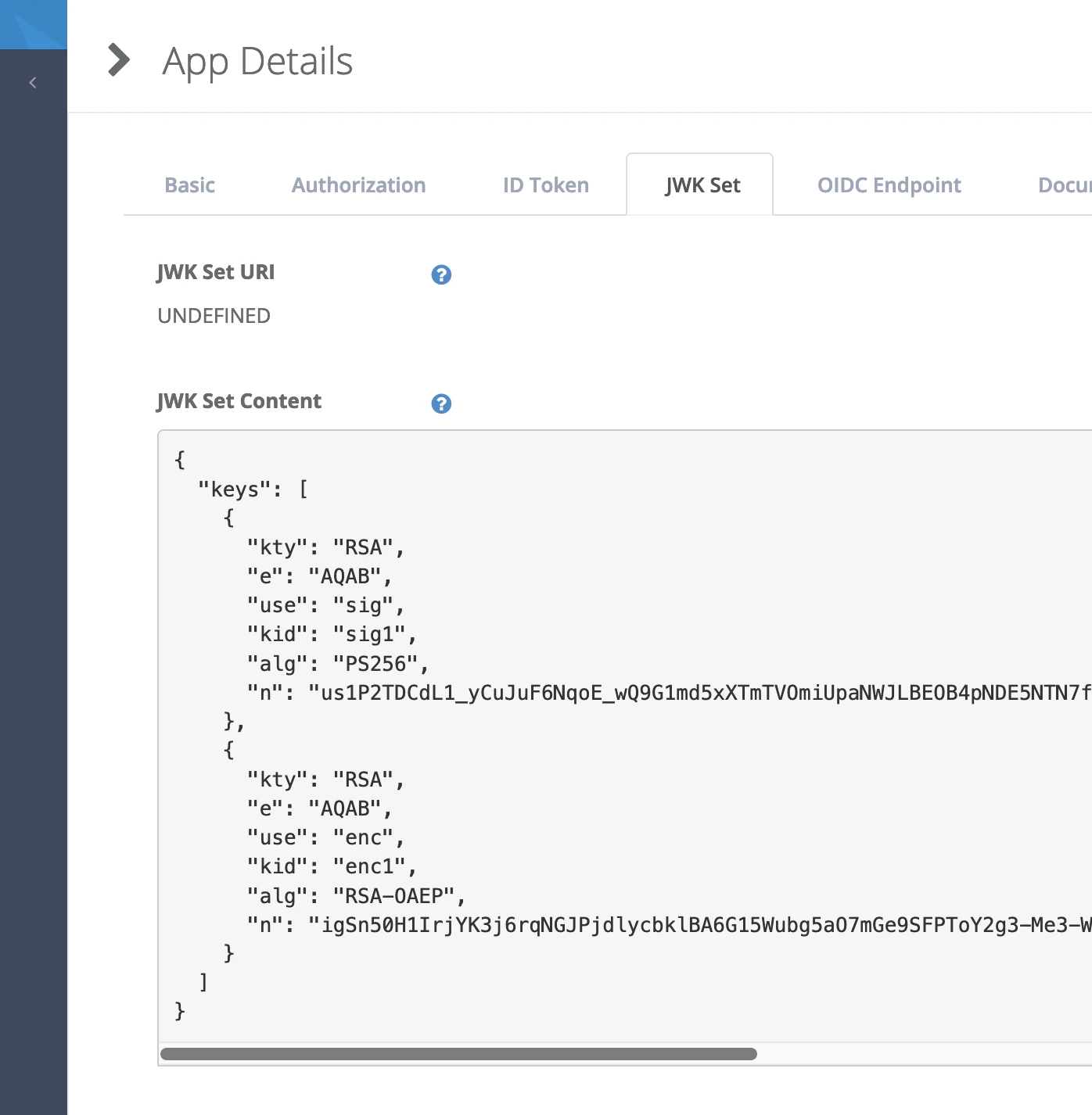
JAR requirements on client level
Authlete allow the administrator to tight the security for specific client by requiring the usage of JAR, encryption of it and the usage of specific algorithms during encryption. The opposite direction is not available: For instance if the service is configure to require JAR, every client will be required, regardless if the client is configured for Optional.| Description | |
|---|---|
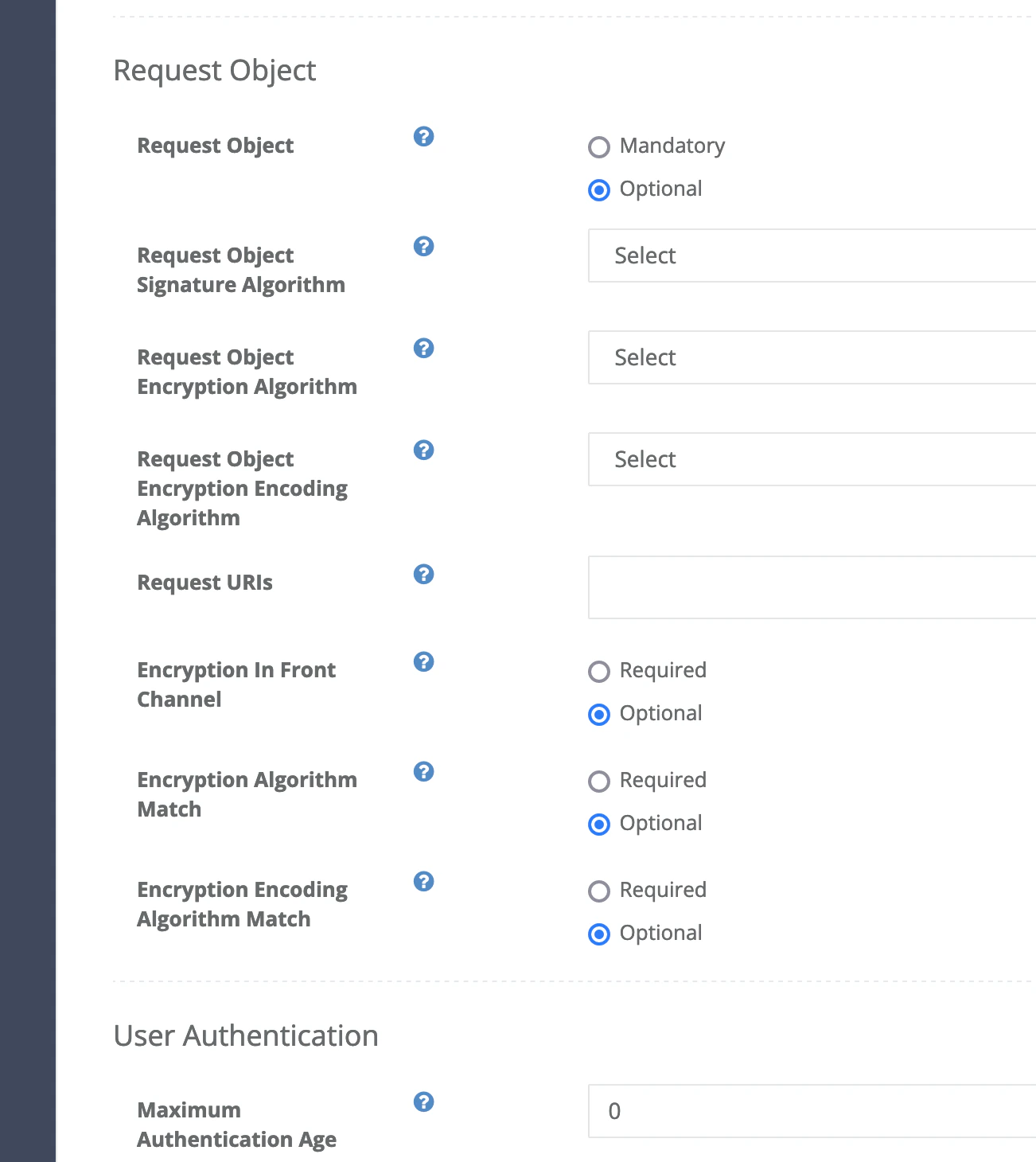
| Request Object | if Mandatory, every authorization request of this client, including pushed authorizations, is required to be in JWT format. Considered only if the service is configured for Optional. |
| Request Object Signature Algorithm | The algorithm to be used by the client to sign its Request Objects. if not defined, the client can use any algorithm supported by Authlete.The algorithm selected here must have a key for the same algorithm under JWK Set Content or JWK Set URI |
| Request Object Encryption Algorithm | The encryption algorithm for key transport used on JWT. As the Signature, a public key needs to be available under JWK Set Content for the selected algorithm.For instance, if RSA-OAEP is selected, a key with the same alg must be available on JWK Set. |
| Request Object Encryption Encoding Algorithm | The encryption algorithm for the JWT content. |
| Request URIs | List of preregistered request_uri’s that this client can use for authorization. The intent here is to allow authorization requests to be created, signed and encrypted before hand. |
| Encryption In Front Channel | If Required the JWT send to /api/auth/authorization endpoint are required to be encrypted. In other words, if the authorization request is not pushed, it will be required to be encrypted. This will ensure that authorization request is not exposed to user agent.Considered only if the service is configured for Optional. |
| Encryption Algorithm Match | when Required the encryption algorithm of key transport used on JWT must match the client level config. Considered only if the service is configured for Optional. |
| Encryption Encoding Algorithm Match | when Required the encryption algorithm of the JWT must match the algorithm defined on the client level. Considered only if the service is configured for Optional. |
JWT Authorization Request structure
The structure of the JWT containing the authorization request is a direct map from uri parameters do JWT claims like below:| Authorization Request (URI) | JAR equivalent |
|---|---|
| response_type=code &client_id=3280859750204 &redirect_uri=https%3A%2F%2Fmobile.example.com%2Fcb &code_challenge=W78h…uAFaT4 & code_challenge_method=S256 | ”iss” : “3280859750204”, “response_type” : “code”, “client_id” : “3280859750204”, “redirect_uri” : “https://mobile.example.com/cb”, “code_challenge”:“W78h…uAFaT4”, “code_challenge_method”: “S256”, “aud” : “https://as.example.com/” |
Signed JAR
Signed JAR is the most basic form, as JAR specification requires that JWT to be signed. The clients have available multiple libraries that support JWT signing as per specification. Check a list of libraries available for your platform. Regardless of submitting the JAR via URI on authorization request or via body of PAR authorization, the structure of the JWT and its content is the same. For instance:| Authorization Request | JAR content |
|---|---|
| response_type=code &client_id=3991284690217797 &redirect_uri=https://mobile.example.com/cb &scope=openid &state=af0ifjsldkj &code_challenge=2vChdex6dr…VAB0 &code_challenge_method=S256 | “iss”: “3991284690217797”, “aud”: “https://authlete.com”, “response_type”: “code”, “client_id”: “3991284690217797”, “redirect_uri”: “https://mobile.example.com/cb”, “scope”: “openid”, “state”: “af0ifjsldkj”, “code_challenge”: “2vChdex6dr…VAB0”, “code_challenge_method”: “S256”, “iat”: 1628124927, “nbf”: 1628124927, “exp”: 1628125532, “jti”: “A_erxcM69yNFZ22jqQXm2” |
Authorization request
The sample below shows the request the authorization server can make to Authlete authorization endpoint to submit the JAR request above as request uri, or front-channel. Be aware that any other parameter on the parameter content will be ignored as per JAR specification requirement.if the authorization server is required to reason about the authorization request and further process it before proceeding. the object payload can be parsed and processed accordingly.