> ## Documentation Index
> Fetch the complete documentation index at: https://developers.authlete.com/llms.txt
> Use this file to discover all available pages before exploring further.
# OAuth 2.0 and OpenID Connect Authorization Endpoints
> How the OAuth 2.0 and OpenID Connect specifications define an authorization endpoint's behavior.
[OAuth 2.0](https://tools.ietf.org/html/rfc6749) and [OpenID Connect](https://openid.net/connect/) each specify requirements that an [authorization endpoint](https://tools.ietf.org/html/rfc6749#section-3.1) must satisfy to interoperate with client applications. This document explains those requirements, focusing on the differences between the two specifications.
If you are familiar with the specifications, you can jump straight to [Implementing an Authorization Endpoint with Authlete](/configuration-reference/endpoints/implementing-an-authorization-endpoint-with-authlete).
## 1. Path
The only constraint imposed by the OAuth 2.0 specfication on the authorization endpoint's URL path is that "The endpoint URI MUST NOT include a fragment component". (see [3.1 Authorization Endpoint](https://tools.ietf.org/html/rfc6749#section-3.1)). As long as this requirement is satisfied, a service can name its authorization endpoint freely. For instance, `/auth/authorization` is a valid authorization endpoint path. An example of an entire URI with the path is `https://example.com/auth/authorization`.
## 2. Security
OAuth 2.0 requires that the authorization endpoint use TLS (Transport Layer Security).
## 3. HTTP methods
According to section [3.1. Authorization Endpoint](https://tools.ietf.org/html/rfc6749#section-3.1) of the OAuth 2.0 specification, the authorization endpoint must support the HTTP `GET` method; the HTTP `POST` method is optional. However, [OpenID Connect Core 1.0, 3.1.2.1. Authentication Request](https://openid.net/specs/openid-connect-core-1_0.html#AuthRequest) requires that the authorization endpoint supports the HTTP `POST` method. In the case of `POST`, the request parameters must be formatted as `application/x-www-form-urlencoded`.
Authorization Endpoint HTTP Methods
| HTTP method | OAuth 2.0 | OpenID Connect |
| ----------- | --------- | -------------- |
| GET | MUST | MUST |
| POST | MAY | MUST |
## 4. Authorization Request Parameters
OAuth 2.0 defines 4 grant types (*flows* to get an access token) in [1.3. Authorization Grant](https://tools.ietf.org/html/rfc6749#section-1.3). Among the four, [Authorization Code Grant](https://tools.ietf.org/html/rfc6749#section-4.1) (a.k.a. Authorization Code Flow) and [Implicit Grant](https://tools.ietf.org/html/rfc6749#section-4.2) (a.k.a. Implicit Flow) access the authorization endpoint. Both grant types take the same request parameters, shown in the table below:
OAuth 2.0 Authorization Request Parameters
| Name | Requirement | Description |
| --------------- | ----------- | --------------------------------------------------------------------------------------------------------------------------------------------------------------------------------------------------------------------------------------------------------------------------------------------------------------------------------------- |
| `response_type` | REQUIRED | `code` for Authorization Code Grant and `token` for Implicit Grant. |
| `client_id` | REQUIRED | The client ID of the client application making the authorization request. A client ID is an opaque number or string issued by a service. |
| `redirect_uri` | OPTIONAL | The URL to which the client application requests the result of the authorization request to be reported. If the client application has registered multiple redirect URIs or has not registered any redirect URI (this is allowed when the client type of the client application is "confidential"), this request parameter is REQUIRED. |
| `scope` | OPTIONAL | A space-delimited list of scopes (permissions) that the client application requires. The service defines a set of valid scope values.
Some implementations of OAuth 2.0 (e.g. Facebook) do not correctly implement the specification, requiring a comma-delimited list. |
| `state` | RECOMMENDED | An opaque value that the client application may use. If this request parameter is contained in the authorization request, it is returned to the redirect URI as a query parameter. |
OpenID Connect adds many more authorization request parameters and values to the set defined by OAuth 2.0. Most of them are described in [OpenID Connect Core 1.0, 3.1.2.1. Authentication Request](https://openid.net/specs/openid-connect-core-1_0.html#AuthRequest). Here is a combined list of the request parameters defined in OAuth 2.0, OpenID Connect and other specifications.
OpenID Connect Request Parameters
| Name | Requirement | Description |
| ----------------------- | ---------------------- | ------------------------------------------------------------------------------------------------------------------------------------------------------------------------------------------------------------------------------------------------------------------------------------------------------------------------------------------------------------------------------------------------------------------------------------------------------------------------------------------------------------------------------------------------- |
| `response_type` | REQUIRED | OAuth 2.0 defined only two values for this parameter: `code` and `token`. OpenID Connect also allows `none` and combinations of `code`, `id_token` and `token`. As a result, the complete set of valid values is:
- `none`
- `code`
- `token`
- `id_token`
- `code token`
- `code id_token`
- `id_token token`
- `code id_token token`
See [OAuth 2.0 Multiple Response Type Encoding Practices](https://openid.net/specs/oauth-v2-multiple-response-types-1_0.html) for details. |
| `client_id` | REQUIRED | The same requirement as OAuth 2.0. |
| `redirect_uri` | REQUIRED | In OAuth 2.0, this request parameter is OPTIONAL. But in OpenID Connect, it is REQUIRED. |
| `scope` | REQUIRED | In OAuth 2.0, this request parameter is OPTIONAL. But in OpenID Connect, it is REQUIRED and must include `openid`. |
| `state` | RECOMMENDED | The same requirement as OAuth 2.0. |
| `response_mode` | OPTIONAL | A new request parameter defined in [OAuth 2.0 Multiple Response Type Encoding Practices](https://openid.net/specs/oauth-v2-multiple-response-types-1_0.html). This request parameter specifies how the result of the authorization request should be formatted. |
| `nonce` | OPTIONAL | A new request parameter. An opaque string value that will be embedded in an ID token. If `response_type` request parameter contains `id_token` (meaning that an ID token is issued using Implicit Flow), `nonce` is REQUIRED. |
| `display` | OPTIONAL | A new request parameter to specify how the user interface should be displayed to the end-user. |
| `prompt` | OPTIONAL | A new request parameter to specify whether the service should prompt the end-user for re-authentication and consent. |
| `max_age` | OPTIONAL | A new request parameter to specify the maximum authentication age. |
| `ui_locales` | OPTIONAL | A new request parameter to specify preferred languages and scripts for the user interface. |
| `id_token_hint` | OPTIONAL | A new request parameter to specify the ID token previously issued by the service. |
| `login_hint` | OPTIONAL | A new request parameter to specify a hint about the login identifier that the end-user may use. |
| `acr_values` | OPTIONAL | A new request parameter to specify ACRs (Authentication Context Class References) one of which the client application requests to be satisfied. |
| `claims_locales` | OPTIONAL | A new request parameter to specify the end-user's preferred locales for ID token claims. This request parameter is defined in [OpenID Connect Core 1.0, 5.2. Claims Languages and Scripts](https://openid.net/specs/openid-connect-core-1_0.html#ClaimsLanguagesAndScripts). |
| `claims` | OPTIONAL | A new request parameter to specify specific claims that the client application requests to be embedded in the ID token returned. This request parameter is defined in [OpenID Connect Core 1.0, 5.5. Requesting Claims using the "claims" Request Parameter](https://openid.net/specs/openid-connect-core-1_0.html#ClaimsParameter). |
| `request` | OPTIONAL | A new request parameter to specify a request object, which is a [JWT](https://tools.ietf.org/html/rfc7519) packing other request parameters and being signed and optionally encrypted. This request parameter is defined in [OpenID Connect Core 1.0, 6. Passing Request Parameters as JWTs](https://openid.net/specs/openid-connect-core-1_0.html#JWTRequests). |
| `request_uri` | OPTIONAL | A new request parameter to specify the location of a request object. This request parameter is defined in [OpenID Connect Core 1.0, 6. Passing Request Parameters as JWTs](https://openid.net/specs/openid-connect-core-1_0.html#JWTRequests). |
| `registration` | OPTIONAL | A new request parameter to provide additional registration information about the client application itself. This request parameter is defined in [OpenID Connect Core 1.0, 7.2.1. Providing Information with the "registration" Request Parameter](https://openid.net/specs/openid-connect-core-1_0.html#RegistrationParameter). |
| `code_challenge` | CONDITIONALLY REQUIRED | A new request parameter to specify a code challenge as a countermeasure against the code interception attack. This request parameter is defined in [RFC 7636](https://tools.ietf.org/html/rfc7636) (Proof Key for Code Exchange by OAuth Public Clients). Authorization server implementations may always require this parameter for authorization requests using [Authorization Code Flow](https://tools.ietf.org/html/rfc6749#section-4.1). See "Proof Key for Code Exchange (RFC 7636)" for details. |
| `code_challenge_method` | OPTIONAL | A new request parameter to tell the method used to generate a code challenge. This request parameter is defined in [RFC 7636](https://tools.ietf.org/html/rfc7636) (Proof Key for Code Exchange by OAuth Public Clients). Valid values are `plain` (default) and `S256`. See "Proof Key for Code Exchange (RFC 7636)" for details. |
# Authorization Response
## 1. Response Parameters
OAuth 2.0 specifies that a successful authorization results in the authorization endpoint issuing either an **authorization code** or an **access token**.
OpenID Connect adds another parameter that may be returned from the authorization endpoint (and/or the token endpoint): the **ID token**. [OpenID Connect Core 1.0](https://openid.net/specs/openid-connect-core-1_0.html) explains, "The primary extension that OpenID Connect makes to OAuth 2.0 to enable End-Users to be Authenticated is the ID Token data structure." (see "[OpenID Connect Core 1.0, 2. ID Token](https://openid.net/specs/openid-connect-core-1_0.html#IDToken)").
Authorization Response Parameters
| Parameter | Description |
| ------------------ | ------------------------------------------------------------------------------------------------------------------------------------------------------------------------------------------------------------------------------------------------------------------------------------------------------------------------------------- |
| Authorization Code | An opaque string to be exchanged for an access token at the token endpoint. The authorization code is valid for a short period of time. |
| --- | --- |
| Access Token | An opaque string, issued by the authorization endpoint, representing the end-user and the permissions (scopes) they granted to a particular client application.
(Note that an access token issued using [Client Credentials Flow](https://tools.ietf.org/html/rfc6749#section-4.4) contains no information about the end-user.) |
| --- | --- |
| ID Token | A [JSON Web Token](https://tools.ietf.org/html/rfc7519) (JWT) containing information about the end-user. |
Before OpenID Connect, the authorization endpoint could return either an authorization code or an access token, but not both. However, with OpenID Connect, the authorization endpoint can return all three objects depending on the value of the `response_type` request parameter:
`response_type` and Response Parameters
In a response from the authorization endpoint, an authorization code, an access token and an ID token are embedded using the `code` key, `access_token` key and `id_token` key, respectively. For example, `code=SplxlOBe` in a response means that the value of the authorization code is `SplxlOBe`.
The following response parameters may be returned from the authorization endpoint:
Authorization Endpoint Response Parameters
| |
| -------------------------------------------------------------------------------------------------------------------------------------------------------------------------------------------------- |
| An authorization code issued to the client application. This is contained in a successful response when the `response_type` request parameter of the authorization request contained `code`. |
| An access token issued to the client application. This is contained in a successful response when the `response_type` request parameter of the authorization request contained `token`. |
| An ID token issued to the client application. This is contained in a successful response when the `response_type` request parameter of the authorization request contained `id_token`. |
| When an authorization request contains the `state` request parameter, the authorization endpoint includes this parameter in the authorization response with the same value provided by the client. |
| An error code. This is contained in a response when an error occurred. |
| The short description of the error which happened. This may be contained in a response when an error occurred. |
| The URI where the detailed description of the error can be found. This may be contained in a response when an error occurred. |
| The token type of the access token. This is contained in a successful response when the `response_type` request parameter of the authorization request contained `token`. |
| The lifetime of the access token in seconds. This may be contained in a successful response when the `response_type` request parameter of the authorization request contained `token`. |
| A space-delimited scope list of the access token. This may be contained in a successful response when the `response_type` request parameter of the authorization request contained `token`. |
## 2. Response Format
For both Authorization Code Flow and Implicit Flow, OAuth 2.0 specifies that a successful response from the authorization endpoint is HTTP status "[302 Found](https://tools.ietf.org/html/rfc2616#section-10.3.3)", redirecting the user agent (the end-user's web browser) to another location. In OAuth 2.0, the destination location is called **redirect URI**.
Response parameters are returned to the client application as a part of the redirect URI. For example, for an Authorization Code Flow with redirect URI `https://client.example.org/callback` and authorization code `ap8uacb2`, the response from the authorization endpoint to the client application will look like:
```text theme={null}
HTTP/1.1 302 Found
Location: https://client.example.org/callback?code=ap8uacb2
Cache-Control: no-store
Pragma: no-cache
```
If the flow is Implicit Flow, on the other hand, and the value of the access token is `pqb8u3t`, the response will look like:
```text theme={null}
HTTP/1.1 302 Found
Location: https://client.example.org/callback#access_token=pqb8u3t
&token_type=Bearer
&expires_in=3600
Cache-Control: no-store
Pragma: no-cache
```
(Line breaks added for clarity)
You might have noticed that the response parameters in the Authorization Code Flow are embedded in the query component (the part after '?') but those in Implicit Flow are embedded in the fragment component (the part after '#'). This difference is a requirement of the OAuth 2.0 specification. In either case, "302 Found" is used. The following table summarizes the relationship between `response_type` and the response parameters' location.
`response_type` And Response Parameter Location
| response\_type | HTTP Status | Response Parameter Location |
| -------------- | ----------- | ------------------------------------------------------------------------------ |
| code | 302 Found | Embedded in the query component of the redirect URI in the Location header. |
| token | 302 Found | Embedded in the fragment component of the redirect URI in the Location header. |
OpenID Connect, specifically the [OAuth 2.0 Form Post Response Mode](https://openid.net/specs/oauth-v2-form-post-response-mode-1_0.html), is more complex. It introduces a mechanism to control the response format and adds "[200 OK](https://tools.ietf.org/html/rfc2616#section-10.2.1)" with an HTML as a new response format. This format is used when an authorization request includes the `response_mode` parameter with a value of `form_post`. Here's an example from the specification (line breaks added for clarity).
```text theme={null}
HTTP/1.1 200 OK
Content-Type: text/html;charset=UTF-8
Cache-Control: no-store
Pragma: no-cache
Submit This Form
```
In the HTML above, the redirect URI is the value of the `action` attribute in the `form` tag; the response parameters are included in the form as hidden fields, `state` and `id_token`. (In this example, neither `code` nor `access_token` is embedded.)
After the HTML above is loaded by the user agent, the JavaScript written in the onload attribute of the body tag is executed. As a result, the browser is redirected to the redirect URI.
The table below illustrates the relationship between combinations of `response_type` & `response_mode` and the HTTP status & response parameters' location. Note that the query component is not usable when an access token and/or an ID token are contained in the response.
`response_type`/`response_mode` Combinations And HTTP Status/Response Parameters' Location
| | | | |
| ------------------ | --------------- | ------------------ | ----------------- |
| | | | |
| | | | |
| Query component | Query component | Fragment component | Hidden parameters |
| | | | |
| Fragment component | NOT ALLOWED | Fragment component | Hidden parameters |
| | | | |
| | | | |
| | | | |
| | | | |
| | | | |
## 3. Error Response
When an error occurs while a service is processing an authorization request, the service returns an error response to the client application. If the redirect URI to which the error should be reported had been determined before the error occurred, the redirect URI can be used.
When a redirect URI can be used, the `error` response parameter is always embedded. In addition, the `error_description` response parameter and the `error_uri` response parameter may optionally be embedded. For example, an error response looks like the following:
```text theme={null}
HTTP/1.1 302 Found
Location: https://client.example.org/callback?
error=access_denied&
error_description=The%20end-user%20denied%20the%20authorization%20request.
Cache-Control: no-store
Pragma: no-cache
```
(line breaks added for clarity)
OAuth 2.0 defines error response parameter values which may be returned from the authorization endpoint in [4.1.2.1. Error Response](https://tools.ietf.org/html/rfc6749#section-4.1.2.1) (for Authorization Code Flow) and in [4.2.2.1. Error Response](https://tools.ietf.org/html/rfc6749#section-4.2.2.1) (for Implicit Flow). OpenID [Connect Core 1.0](https://openid.net/specs/openid-connect-core-1_0.html) adds values in [3.1.2.6. Authentication Error Response](https://openid.net/specs/openid-connect-core-1_0.html#AuthError). The table below collects the error codes in alphabetical order.
Authorization Endpoint Error Values
| Value | RFC 6749 | OpenID Connect |
| ---------------------------- | :------------------------------------: | :------------------------------------: |
| `access_denied` | | |
| `account_selection_required` | | |
| `consent_required` | | |
| `interaction_required` | | |
| `invalid_request` | | |
| `invalid_request_object` | | |
| `invalid_request_uri` | | |
| `invalid_scope` | | |
| `login_required` | | |
| `registration_not_supported` | | |
| `request_not_supported` | | |
| `request_uri_not_supported` | | |
| `server_error` | | |
| `temporarily_unavailable` | | |
| `unauthorized_client` | | |
| `unsupported_response_type` | | |
## 4. Returning Errors when the Redirect URI is Unavailable
Errors may occur before the redirect URI is determined. For example, if the specified client ID (`client_id`) is invalid, it is impossible to check whether the specified redirect URI (`redirect_uri`) has been registered or not, so the error cannot be reported to the redirect URI.
Section [3.1.2.4. Invalid Endpoint](https://tools.ietf.org/html/rfc6749#section-3.1.2.4) of the OAuth 2.0 specification says:
> If an authorization request fails validation due to a missing, invalid, or mismatching redirection URI, the authorization server SHOULD inform the resource owner of the error and MUST NOT automatically redirect the user-agent to the invalid redirection URI.
but the mechanism with which to inform the resource owner (end-user) of the error is not described anywhere. The authorization endpoint behavior is, therefore, determined by its implementer. Some candidate response formats:
| HTTP Status | Content-Type | Comment |
| --------------- | ------------------ | --------------------------------------------------------------------------------------------------------------------------------------------------------------------------------------------------------------------------------- |
| 400 Bad Request | `text/html` | The error is described in HTML format and shown in the user agent. This is friendly to end-users and testers. |
| 400 Bad Request | `application/json` | The error is described in JSON format in the same way as it is for token endpoint (OAuth 2.0, [section 5.2. Error Response](https://tools.ietf.org/html/rfc6749#section-5.2)). This is friendly to client application developers. |
Considering that OpenID Connect has added a use case (`prompt=none`) where no user interaction is performed, `application/json` might be better.
# Authorization Interaction
## 1. Purpose Of Authorization Endpoint
The primary task of an authorization endpoint is to let an end-user grant authorization to a client application. In the normal case, this is achieved by displaying one or more HTML pages that
1. Show information about the client application and the requested permissions (scopes).
2. Provide a login form to authenticate the end-user.
3. Include buttons for the end-user to decide to "authorize" or "deny" the authorization request.
Here is a typical minimum set of UI components that an authorization endpoint can display:
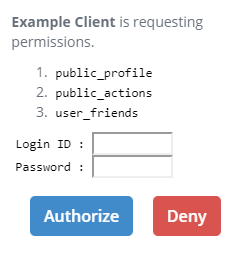 Remember, OAuth 2.0 is a framework for **authorization**, not for **authentication**. As stated in [section 3.1. Authorization Endpoint](https://tools.ietf.org/html/rfc6749#section-3.1) of the specification, "The way in which the authorization server authenticates the resource owner (e.g., username and password login, session cookies) is beyond the scope of \[OAuth 2.0]". Be that as it may, the end-user must be authenticated at the authorization endpoint because an access token must be associated with a resource owner (except the case of [Client Credentials Grant](https://tools.ietf.org/html/rfc6749#section-4.4)).
Since OAuth 2.0 makes almost no mention of end-user authentication, implementers have implemented it as they liked. However, OpenID Connect adds mechanisms to control end-user authentication.
## 2. `prompt` Request Parameter
The optional `prompt` request parameter specifies "whether the Authorization Server prompts the End-User for reauthentication and consent". ([OpenID Connect Core 1.0, 3.1.2.1. Authentication Request](https://openid.net/specs/openid-connect-core-1_0.html#AuthRequest))
Its value `none` or a space-delimited combination of `login`, `consent` and `select_account`:
| Value | Description |
| ---------------- | --------------------------------------------------------------------------------------------------------------------------------------------------------------------------------- |
| `login` | When `prompt` contains `login`, the end-user must be authenticated even when they have already logged in. |
| `consent` | When `prompt` contains `consent`, consent must be obtained from the end-user even when the authorization endpoint implementation knows that the consent was obtained in the past. |
| `select_account` | When `prompt` contains `select_account`, the authorization endpoint implementation should prompt the end-user to select a user account. |
| `none` | When `prompt` is `none`, the authorization endpoint implementation must process the authorization request without displaying any UI (i.e., without user interaction). |
The simplest implementation for a combination of `login`, `consent` and `select_account` is to always display a form having input fields for login ID and password. However, this is not appropriate if the authentication method at the authorization endpoint is different from the typical ID & password mechanism, for example, biometric authentication by fingerprints.
## 3. Authentication Context Class Reference
**Authentication Context Class Reference**, which is also referred to as **ACR** in OpenID Connect specifications, is a string representing a set of context, level and/or other attributes of an authentication method. For example, `urn:oasis:names:tc:SAML:2.0:ac:classes:PasswordProtectedTransport` represents the authentication method which is performed by presenting a password over a protected (i.e. TLS) session. (This example is an excerpt from [Authentication Context for the OASIS Security Assertion Markup Language (SAML) V2.0.](https://docs.oasis-open.org/security/saml/v2.0/saml-authn-context-2.0-os.pdf))
[OpenID Connect Core 1.0](https://openid.net/specs/openid-connect-core-1_0.html) does not specify any concrete ACR values other than "0". Instead, it just states that parties using ACR values (i.e. the OAuth server and the client application) *"need to agree upon the meanings of the values used"*. ([OpenID Connect Core 1.0, 2. ID Token, acr](https://openid.net/specs/openid-connect-core-1_0.html#IDToken))
### 3.1 `acr_values` Request Parameter
An authorization request can include the `acr_values` request parameter ([OpenID Connect Core 1.0, 3.1.2.1. Authentication Request, acr\_values](https://openid.net/specs/openid-connect-core-1_0.html#AuthRequest)) to specify a list of ACRs in a preferred order. When this request parameter is present, the authorization endpoint implementation should satisfy one of them in authenticating the end-user.
### 3.2 `acr` Claim In `claims` Request Parameter
Another way to present a list of ACRs is by including the `acr` claim in the value of the `claims` request parameter. The following JSON is an example of a value of the `claims` request parameter (excerpt from [OpenID Connect Core 1.0, 5.5. Requesting Claims using the "claims" Request Parameter](https://openid.net/specs/openid-connect-core-1_0.html#ClaimsParameter)):
```text theme={null}
{
"userinfo":
{
"given_name": {"essential": true},
"nickname": null,
"email": {"essential": true},
"email_verified": {"essential": true},
"picture": null,
"http://example.info/claims/groups": null
},
"id_token":
{
"auth_time": {"essential": true},
"acr": {"values": ["urn:mace:incommon:iap:silver"] }
}
}
```
The requirement for ACR can be marked as "essential" only via the `claims` request parameter.
```text theme={null}
{
"id_token":
{
"acr":
{
"essential": true,
"values": ["urn:mace:incommon:iap:silver"]
}
}
}
```
If the `acr` claim is requested as essential, one of the ACRs listed in `values` must be satisfied. If none of them can be satisfied, the authorization endpoint implementation must return an error response to the client application. See [OpenID Connect Core 1.0, 5.5.1.1. Requesting the "acr" Claim](https://openid.net/specs/openid-connect-core-1_0.html#acrSemantics) for details.
### 3.3 `acr` Claim In ID Token
The `acr` claim is an optional claim that may be embedded in an ID token. See "[OpenID Connect Core 1.0, 2. ID Token, acr](https://openid.net/specs/openid-connect-core-1_0.html#IDToken)" for details.
### 3.4 Supported ACRs
"[OpenID Connect Discovery 1.0, 3. OpenID Provider Metadata](https://openid.net/specs/openid-connect-discovery-1_0.html#ProviderMetadata)" lists attributes of an OpenID provider. Among them, the `acr_values_supported` metadata contains a list of ACRs supported by the OpenID provider. In Authlete, the equivalent is the `supportedAcrs` property of [Service](/api-reference/service-management/get-service).
### 3.5 Default ACRs
"[OpenID Connect Dynamic Client Registration 1.0, 2. Client Metadata](https://openid.net/specs/openid-connect-registration-1_0.html#ClientMetadata)" lists attributes of a client application. Among them, the `default_acr_values` metadata contains a list of the default ACRs of the client application that should be used when an authorization request from the client application does not have ACR values explicitly (by the `acr_values` request parameter or by the values of the `acr` claim in the `claims` request parameter). In Authlete, the equivalent is the `defaultAcrs` property of [Client](https://docs.authlete.com/#client).
## 4 Maximum Authentication Age
**Maximum Authentication Age** is "the allowable elapsed time in seconds since the last time the End-User was actively authenticated" ([OpenID Connect Core 1.0, 3.1.2.1. Authentication Request, max\_age](https://openid.net/specs/openid-connect-core-1_0.html#AuthRequest)). If the elapsed time is greater than the maximum authentication age, the end-user must be re-authenticated even if he/she has already logged in.
### 4.1 `max_age` Request Parameter
An authorization request can include the `max_age` request parameter to specify the maximum authentication age.
### 4.2 Default Maximum Authentication Age
The `default_max_age` attribute listed in "[OpenID Connect Dynamic Client Registration 1.0, 2. Client Metadata](https://openid.net/specs/openid-connect-registration-1_0.html#ClientMetadata)" is the maximum authentication age which is used when an authorization request from the client application does not have the `max_age` request parameter. In Authlete, the equivalent is the `defaultMaxAge` property of [Client](https://docs.authlete.com/#client).
## 5. `sub` claim
A client application can request a specific subject (an end-user identifier assigned by the service) from whom the client application wants to be granted authorization by specifying the value for the `sub` claim. The following is an example of a value of the `claims` request parameter that contains the `sub` claim with a value:
```text theme={null}
{
"id_token":
{
"sub": {"value": "248289761001"}
}
}
```
When an authorization request specifies a subject, the corresponding end-user must be authenticated. If this is not satisfied, the authorization endpoint implementation must return an error response to the client application. See [OpenID Connect Core 1.0, 3.1.2.2. Authentication Request Validation](https://openid.net/specs/openid-connect-core-1_0.html#AuthRequestValidation) for details.
## 6. `login_hint` Request Parameter
A client application can give a hint about the login identifier to the authorization endpoint by using the `login_hint` request parameter. For example, an email address may be specified as the value.
## 7. `id_token_hint` Request Parameter
A client application can make an authorization request with the `id_token_hint` request parameter whose value is the ID token previously issued by the authorization server. The authorization server should return an error response when the end-user identified by the ID token is different from the end-user who is authenticated already or as a result of the request.
## 8. No Interaction
OpenID Connect introduced a mechanism for the authorization endpoint to return a response without user interaction. A client application can request it by including `prompt=none` in the authorization request.
An authorization request with `prompt=none` can be processed successfully only when all the following conditions are satisfied:
1. The end-user has already logged in.
2. If the maximum authentication age is specified by either the `max_age` request parameter or the `default_max_age` property of the client metadata, the elapsed time since the last authentication of the end-user does not exceed the maximum authentication age.
3. If a specific subject is requested by the `sub` claim in the value of the `claims` request parameter, the login ID of the end-user matches the subject.
4. If the `acr` claim is marked as essential in the value of the `claims` request parameter, the authentication method satisfies one of the authentication context class references which are listed in the values property of the `acr` claim).
5. If `claims` are requested, the end-user has consented to them in advance. (Means to obtain consent are beyond the specification of OpenID Connect.)
Remember, OAuth 2.0 is a framework for **authorization**, not for **authentication**. As stated in [section 3.1. Authorization Endpoint](https://tools.ietf.org/html/rfc6749#section-3.1) of the specification, "The way in which the authorization server authenticates the resource owner (e.g., username and password login, session cookies) is beyond the scope of \[OAuth 2.0]". Be that as it may, the end-user must be authenticated at the authorization endpoint because an access token must be associated with a resource owner (except the case of [Client Credentials Grant](https://tools.ietf.org/html/rfc6749#section-4.4)).
Since OAuth 2.0 makes almost no mention of end-user authentication, implementers have implemented it as they liked. However, OpenID Connect adds mechanisms to control end-user authentication.
## 2. `prompt` Request Parameter
The optional `prompt` request parameter specifies "whether the Authorization Server prompts the End-User for reauthentication and consent". ([OpenID Connect Core 1.0, 3.1.2.1. Authentication Request](https://openid.net/specs/openid-connect-core-1_0.html#AuthRequest))
Its value `none` or a space-delimited combination of `login`, `consent` and `select_account`:
| Value | Description |
| ---------------- | --------------------------------------------------------------------------------------------------------------------------------------------------------------------------------- |
| `login` | When `prompt` contains `login`, the end-user must be authenticated even when they have already logged in. |
| `consent` | When `prompt` contains `consent`, consent must be obtained from the end-user even when the authorization endpoint implementation knows that the consent was obtained in the past. |
| `select_account` | When `prompt` contains `select_account`, the authorization endpoint implementation should prompt the end-user to select a user account. |
| `none` | When `prompt` is `none`, the authorization endpoint implementation must process the authorization request without displaying any UI (i.e., without user interaction). |
The simplest implementation for a combination of `login`, `consent` and `select_account` is to always display a form having input fields for login ID and password. However, this is not appropriate if the authentication method at the authorization endpoint is different from the typical ID & password mechanism, for example, biometric authentication by fingerprints.
## 3. Authentication Context Class Reference
**Authentication Context Class Reference**, which is also referred to as **ACR** in OpenID Connect specifications, is a string representing a set of context, level and/or other attributes of an authentication method. For example, `urn:oasis:names:tc:SAML:2.0:ac:classes:PasswordProtectedTransport` represents the authentication method which is performed by presenting a password over a protected (i.e. TLS) session. (This example is an excerpt from [Authentication Context for the OASIS Security Assertion Markup Language (SAML) V2.0.](https://docs.oasis-open.org/security/saml/v2.0/saml-authn-context-2.0-os.pdf))
[OpenID Connect Core 1.0](https://openid.net/specs/openid-connect-core-1_0.html) does not specify any concrete ACR values other than "0". Instead, it just states that parties using ACR values (i.e. the OAuth server and the client application) *"need to agree upon the meanings of the values used"*. ([OpenID Connect Core 1.0, 2. ID Token, acr](https://openid.net/specs/openid-connect-core-1_0.html#IDToken))
### 3.1 `acr_values` Request Parameter
An authorization request can include the `acr_values` request parameter ([OpenID Connect Core 1.0, 3.1.2.1. Authentication Request, acr\_values](https://openid.net/specs/openid-connect-core-1_0.html#AuthRequest)) to specify a list of ACRs in a preferred order. When this request parameter is present, the authorization endpoint implementation should satisfy one of them in authenticating the end-user.
### 3.2 `acr` Claim In `claims` Request Parameter
Another way to present a list of ACRs is by including the `acr` claim in the value of the `claims` request parameter. The following JSON is an example of a value of the `claims` request parameter (excerpt from [OpenID Connect Core 1.0, 5.5. Requesting Claims using the "claims" Request Parameter](https://openid.net/specs/openid-connect-core-1_0.html#ClaimsParameter)):
```text theme={null}
{
"userinfo":
{
"given_name": {"essential": true},
"nickname": null,
"email": {"essential": true},
"email_verified": {"essential": true},
"picture": null,
"http://example.info/claims/groups": null
},
"id_token":
{
"auth_time": {"essential": true},
"acr": {"values": ["urn:mace:incommon:iap:silver"] }
}
}
```
The requirement for ACR can be marked as "essential" only via the `claims` request parameter.
```text theme={null}
{
"id_token":
{
"acr":
{
"essential": true,
"values": ["urn:mace:incommon:iap:silver"]
}
}
}
```
If the `acr` claim is requested as essential, one of the ACRs listed in `values` must be satisfied. If none of them can be satisfied, the authorization endpoint implementation must return an error response to the client application. See [OpenID Connect Core 1.0, 5.5.1.1. Requesting the "acr" Claim](https://openid.net/specs/openid-connect-core-1_0.html#acrSemantics) for details.
### 3.3 `acr` Claim In ID Token
The `acr` claim is an optional claim that may be embedded in an ID token. See "[OpenID Connect Core 1.0, 2. ID Token, acr](https://openid.net/specs/openid-connect-core-1_0.html#IDToken)" for details.
### 3.4 Supported ACRs
"[OpenID Connect Discovery 1.0, 3. OpenID Provider Metadata](https://openid.net/specs/openid-connect-discovery-1_0.html#ProviderMetadata)" lists attributes of an OpenID provider. Among them, the `acr_values_supported` metadata contains a list of ACRs supported by the OpenID provider. In Authlete, the equivalent is the `supportedAcrs` property of [Service](/api-reference/service-management/get-service).
### 3.5 Default ACRs
"[OpenID Connect Dynamic Client Registration 1.0, 2. Client Metadata](https://openid.net/specs/openid-connect-registration-1_0.html#ClientMetadata)" lists attributes of a client application. Among them, the `default_acr_values` metadata contains a list of the default ACRs of the client application that should be used when an authorization request from the client application does not have ACR values explicitly (by the `acr_values` request parameter or by the values of the `acr` claim in the `claims` request parameter). In Authlete, the equivalent is the `defaultAcrs` property of [Client](https://docs.authlete.com/#client).
## 4 Maximum Authentication Age
**Maximum Authentication Age** is "the allowable elapsed time in seconds since the last time the End-User was actively authenticated" ([OpenID Connect Core 1.0, 3.1.2.1. Authentication Request, max\_age](https://openid.net/specs/openid-connect-core-1_0.html#AuthRequest)). If the elapsed time is greater than the maximum authentication age, the end-user must be re-authenticated even if he/she has already logged in.
### 4.1 `max_age` Request Parameter
An authorization request can include the `max_age` request parameter to specify the maximum authentication age.
### 4.2 Default Maximum Authentication Age
The `default_max_age` attribute listed in "[OpenID Connect Dynamic Client Registration 1.0, 2. Client Metadata](https://openid.net/specs/openid-connect-registration-1_0.html#ClientMetadata)" is the maximum authentication age which is used when an authorization request from the client application does not have the `max_age` request parameter. In Authlete, the equivalent is the `defaultMaxAge` property of [Client](https://docs.authlete.com/#client).
## 5. `sub` claim
A client application can request a specific subject (an end-user identifier assigned by the service) from whom the client application wants to be granted authorization by specifying the value for the `sub` claim. The following is an example of a value of the `claims` request parameter that contains the `sub` claim with a value:
```text theme={null}
{
"id_token":
{
"sub": {"value": "248289761001"}
}
}
```
When an authorization request specifies a subject, the corresponding end-user must be authenticated. If this is not satisfied, the authorization endpoint implementation must return an error response to the client application. See [OpenID Connect Core 1.0, 3.1.2.2. Authentication Request Validation](https://openid.net/specs/openid-connect-core-1_0.html#AuthRequestValidation) for details.
## 6. `login_hint` Request Parameter
A client application can give a hint about the login identifier to the authorization endpoint by using the `login_hint` request parameter. For example, an email address may be specified as the value.
## 7. `id_token_hint` Request Parameter
A client application can make an authorization request with the `id_token_hint` request parameter whose value is the ID token previously issued by the authorization server. The authorization server should return an error response when the end-user identified by the ID token is different from the end-user who is authenticated already or as a result of the request.
## 8. No Interaction
OpenID Connect introduced a mechanism for the authorization endpoint to return a response without user interaction. A client application can request it by including `prompt=none` in the authorization request.
An authorization request with `prompt=none` can be processed successfully only when all the following conditions are satisfied:
1. The end-user has already logged in.
2. If the maximum authentication age is specified by either the `max_age` request parameter or the `default_max_age` property of the client metadata, the elapsed time since the last authentication of the end-user does not exceed the maximum authentication age.
3. If a specific subject is requested by the `sub` claim in the value of the `claims` request parameter, the login ID of the end-user matches the subject.
4. If the `acr` claim is marked as essential in the value of the `claims` request parameter, the authentication method satisfies one of the authentication context class references which are listed in the values property of the `acr` claim).
5. If `claims` are requested, the end-user has consented to them in advance. (Means to obtain consent are beyond the specification of OpenID Connect.)